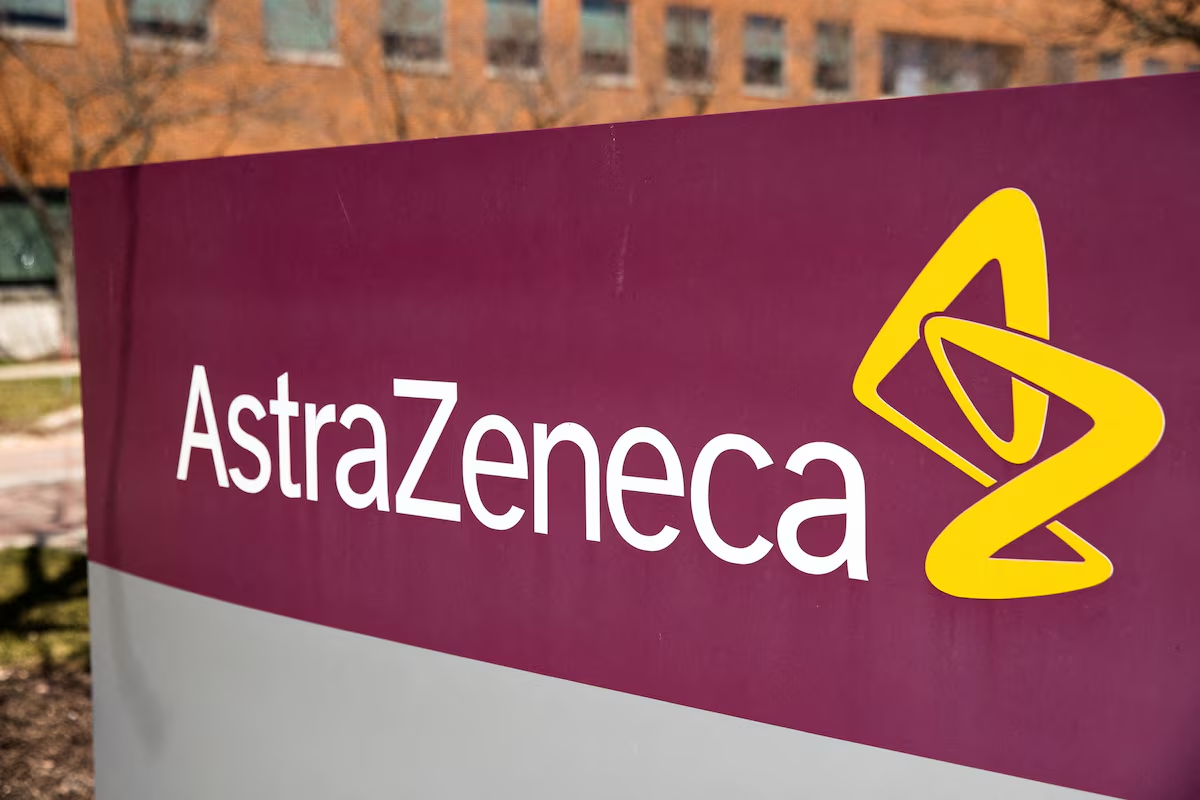

Open this photo in gallery:
AstraZeneca’s North America headquarters in Wilmington, Delaware in March, 2021.Rachel Wisniewski/Reuters
AstraZeneca AZN-N investors punished the pharmaceutical firm on Monday over reports of merger talks with U.S. rival Bristol Myers Squibb that could make one of the world’s biggest drugmakers with a combined value of nearly US$400-billion.
Shares in AstraZeneca closed down some 9 per cent, the biggest drop since 2020, as investors and analysts said Britain’s biggest drugmaker had little need for a transformative acquisition despite potential cost benefits. Bristol Myers shares slipped less than 1 per cent in early trading.
A deal, if confirmed, would create the world’s fourth-largest drugmaker by market value and the largest by revenue, in potentially one of the biggest M&A deals ever, combining a top European pharmaceutical firm with a major U.S. rival.
An AstraZeneca spokesperson declined to comment on Monday. Bristol Myers, which is headquartered in New Jersey, did not respond to a request for comment.
“The only advantage for AstraZeneca in this rumoured combination with BMS seems to be to accelerate its U.S. footprint and sales,” said Lucy Coutts, investment director at JM Finn, an AstraZeneca shareholder.
“On balance, BMS shareholders would be the winners of any combination with AZN and so this news will undoubtedly be received coolly by AZN shareholders.”
A person familiar with the matter told Reuters that AstraZeneca and Bristol had held talks, confirming an earlier Financial Times report. On Friday, the two had a combined market capitalization of nearly US$400-billion, with AstraZeneca valued at US$264-billion and Bristol Myers at US$133-billion.
AstraZeneca forecasts steady growth in 2026 on cancer drug demand, hikes dividend
Analysts and investors questioned the logic of a deal for AstraZeneca, which has been one of the most successful companies in the sector under CEO Pascal Soriot’s 14 years at the helm.
Markus Manns, portfolio manager at Union Investment, an AstraZeneca shareholder, said a deal “does not make strategic or financial sense” and that it would disrupt a “well-run company with a full pipeline.”
“If the merger rumours prove to be true, this would represent the pharmaceutical industry’s equivalent of the FIFA privatization moment,” added Manns, referring to FIFA’s now abandoned plans to sell off a World Cup stake. “(That is to say a) poorly conceived proposal that would be met with considerable bewilderment by many market participants.”
Lukas Leu, portfolio manager at AstraZeneca shareholder ATG Healthcare, said a deal could boost margins through cost synergies and expand reach in neuroscience and cell therapy, but questioned how a combined firm would position competing drugs.
“I am not a big fan of mega-mergers, it kills innovation and agility, and would be growth-dilutive for AstraZeneca in the near term,” he said.
One attraction for AstraZeneca could be further expanding its presence in the United States, already its biggest market.
AstraZeneca this year completed a direct listing on the New York Stock Exchange, and a Bristol Myers deal would effectively mean a British company buying a major U.S. pharmaceutical champion.
Bristol Myers derives the majority of its revenue from the U.S., where it has one of the largest commercial footprints.
A portfolio manager at a top-20 AstraZeneca shareholder, who commented on condition of anonymity, said that while “there may be an appeal to increasing U.S. exposure,” such a deal “would be a surprise given Astra management has consistently backed the business to grow organically through R&D delivery.”
“Consensus is that Astra has a stronger pipeline and less patent expiry pressure than BMS, so why dilute that and reduce the growth outlook?”
Since U.S. President Donald Trump returned to office, AstraZeneca has invested tens of billions of dollars in U.S. manufacturing and cultivated close ties with the administration as the company pursues an ambitious goal of generating half of its targeted US$80-billion in annual revenue by 2030 from the U.S. market.
It generated about US$59-billion in revenue last year.
Sean Conroy, an analyst at Shore Capital, said a deal could also help AstraZeneca address the patent cliff it faces after 2030 and strengthen its oncology business, although he cautioned that investors were “not often fans of mega mergers of this ilk.”
He added that overlap between Bristol Myers’ Opdivo and AstraZeneca’s Imfinzi, which are the same type of cancer immunotherapy drugs, could attract antitrust scrutiny.