
Open this photo in gallery:
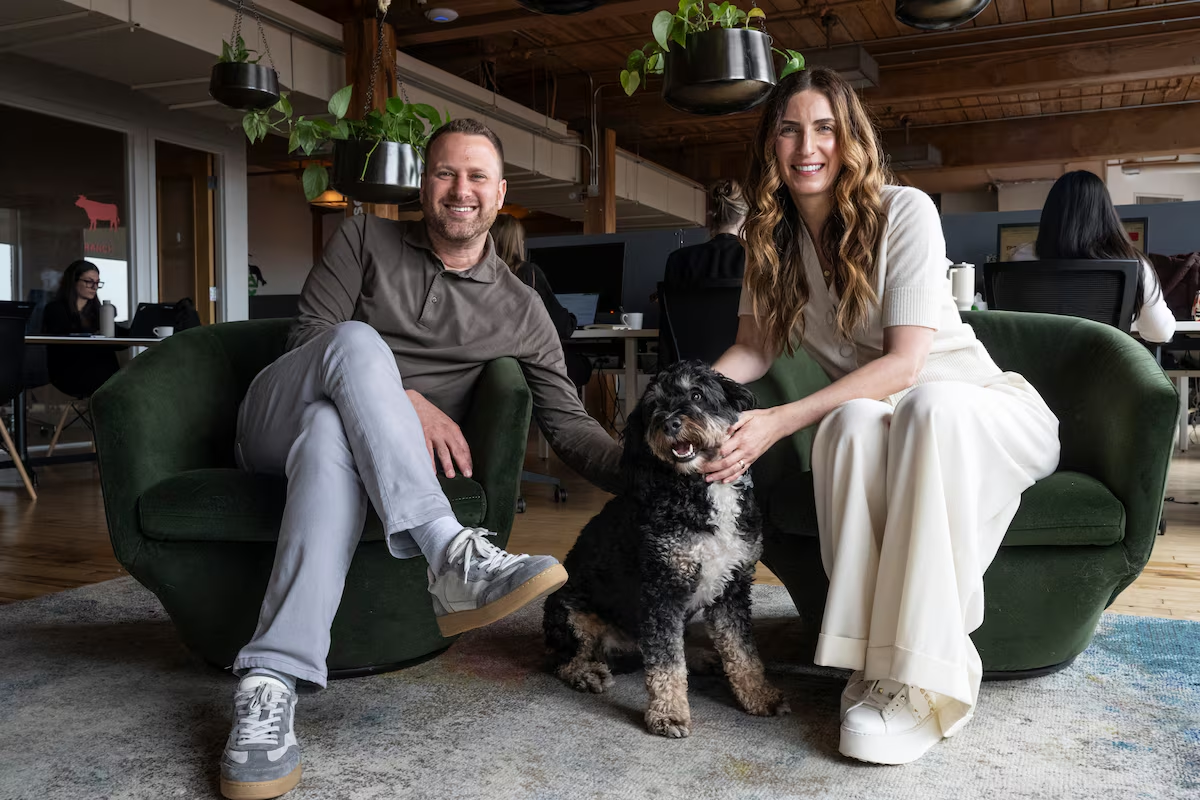
Jacqueline Prehogan and Isaac Langleben, founders of pet food company Open Farm, with their dog Teddy at the company’s offices in Toronto on July 28.EDUARDO LIMA/The Globe and Mail
At the Toronto offices of Canadian pet-food maker Open Farm, what passes for a guard dog is a miniature Bernedoodle named Ted with a sharp bark and absolutely no bite.
But he’s not just the CEO’s pet, he’s also a client. Ted eats the company’s GoodGut probiotic kibble to keep his gastrointestinal issues in check. And his caretakers point to him as a prime example of how Open Farm continues to sell premium-priced chow, even in an inflationary environment where Canadians are looking for ways to cut back – including in their own human-food budgets.
“They might cut other categories that are more discretionary, whether treats or supplies, toys, things like that,” said Open Farm’s chief executive officer, Isaac Langleben. “But the full diet, that nutritional element, is one that I think, rightly so, people are more reluctant. They’re actually willing to pay a bit more.”
Open Farm, a Canadian premium pet food maker, delays IPO in Toronto until fall
According to Mr. Langleben, Open Farm is benefiting from what economists call a K-shaped economy, in which higher-income households see their spending power increase, even as lower-income consumers struggle.
During its last fiscal year ended June 30, Open Farm recorded more than $400-million in sales, he said, and since 2018, its annual growth rate has been around 58 per cent.
In 2020, as the pandemic stoked a boom in pet ownership, Open Farm had fewer than 40 employees; now it has a staff of roughly 135.
The Globe and Mail reported in June that the company had delayed an initial public offering it had been contemplating, amid choppy markets and concerns over consumer spending trends.
Open this photo in gallery:
Open Farm reportedly recorded more than $400-million in sales during its last fiscal year ended June 30.EDUARDO LIMA/The Globe and Mail
The company has not yet decided whether to go public, though Mr. Langleben said they are “seriously considering” the option.
“We’re not in a rush,” said Mr. Langleben, who co-founded the company in 2014 with his wife, Jacqueline Prehogan, and Derek Beigleman, who is no longer with the company. “We don’t really have any gun to our head to do anything. We’re profitable. We’re cash-flow positive. We have great partners, minority partners. And I think we’re assessing all of our options to continue growing the business.”
Open Farm began when the couple began seeking out more ethically sourced meat alternatives. While the transition was relatively easy for themselves, when it came to feeding Ted’s predecessors – a pair of pugs whose portraits still hang on the office walls – they didn’t find much. So they launched the company, which now makes a variety of pet foods with ethically sourced meats, as well as plant-based recipes.
“We’re paying more for our meat. We’re always doing things the hard way. But we know that’s our entire reason for existing,” said Ms. Prehogan, Open Farm’s co-founder and chief brand officer.
Customers turning to frozen produce to avoid high food prices, Loblaw CEO says
All of Open Farm’s proteins carry animal-welfare certifications, and the company has “very aggressive sustainability targets,” Ms. Prehogan said.
Not all of those targets have been easy to meet. The most challenging, she said, has been the commitment Open Farm made in 2020 to reduce its carbon emissions by 42 per cent within 10 years. In the meantime, the company has been offsetting emissions with carbon credits and renewable energy certificates. It will soon provide a full update on that commitment, Ms. Prehogan said.
“I think that’s the key, it’s a journey. And it’s being transparent and bringing everybody along with us – the stuff that’s working, the stuff that’s really challenging,” she said.
The pet industry has grown significantly in recent years, as more people adopted animals and proved willing to spend liberally on care for their four-legged friends. But the costs of veterinary care, food and grooming have also risen, leading some consumers to take a second look at their budgets.
In the United States – the source of 85 per cent of Open Farm’s sales – there are signs of a slowdown. The U.S. pet industry’s nearly 20-per-cent growth in 2021 moderated to 9 per cent in 2025, according to research from Morgan Stanley, and is expected to contract further to 4 per cent through 2030.
Open this photo in gallery:
The company delayed an initial public offering amid choppy markets and concerns over consumer spending trends.EDUARDO LIMA/The Globe and Mail
Canadian retailer Pet Valu has also reported a pullback in spending, and in May the company cut its earnings outlook for this year. On a conference call to discuss the company’s first-quarter earnings, CEO Greg Ramier told analysts that the retailer was seeing “a higher level of value-seeking behaviour from devoted pet lovers,” while rising fuel prices had also increased transportation costs for both Pet Valu and its product suppliers.
But the contraction is uneven across the industry. New Jersey-based Freshpet Inc., which makes premium-priced fresh and frozen pet foods, has seen continued strength in its sales. “Year-to-date, the consumer’s remained remarkably resilient,” CEO William Cyr told analysts on the company’s most recent earnings call in May, although he added that Freshpet would keep “a watchful eye” for possible changes in buying habits.
“You do have some customers who are making choices to trade down and spend less to feed their pets,” Open Farm’s Mr. Langleben said. “But you’re still seeing a lot of consumers who are trading up.”
Nearly half of Open Farm’s business is online, largely through its own website, as well as Amazon.com Inc. In addition, the products are now sold in more than 10,000 stores in the U.S. and Canada, including chains such as Pet Valu and Global Pet Foods, as well as independent retailers. In June, Open Farm launched a major retail expansion in 1,700 PetSmart stores across North America.
In recent years, Open Farm has also begun expanding overseas, through wholesale partners in China, South Korea and Japan.
“Long term, we think Open Farm will be a global brand. That’s our vision,” Mr. Langleben said. “For now, we’re going to continue to invest in the markets we’re in today. But over time, definitely, more serious international expansion will be on the table, and that includes Europe, the U.K., more focused energy on Asia as well.”
The next priority for Open Farm is a major investment in marketing.
“We have the distribution, and then our job is to work with them to actually drive people and consumers into their stores,” Ms. Prehogan said. “… It’s a pivotal point for us, in terms of taking the brand to the next level.”