
Open this photo in gallery:
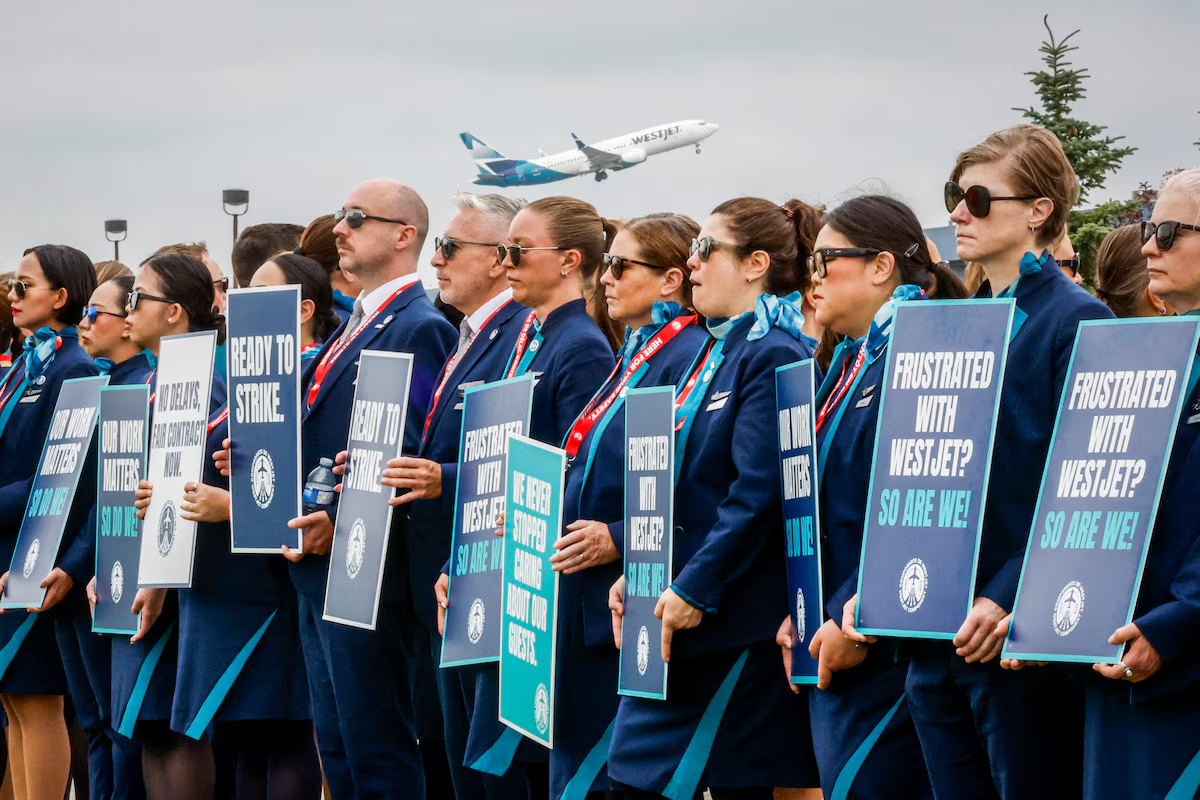
CUPE 8125, the local representing 4,400 WestJet flight attendants, had issued a strike notice on Thursday morning, after 10 months of negotiations with the airline.Jeff McIntosh/The Canadian Press
More than 4,000 WestJet flight attendants will go on strike, causing major travel disruption and the cancellation of over 300 flights on a busy summer long weekend.
Talks between the airline and the Canadian Union of Public Employees broke down late last night over the issue of wages and ground pay, which is the amount flight attendants get compensated for the work that they perform before a plane departs, and after it lands.
CUPE 8125, the local representing 4,400 WestJet flight attendants, had issued a strike notice on Thursday morning, after 10 months of negotiations with the airline. The union said at the time that both sides were too far apart on the issue of wages and ground pay. Marathon negotiations continued through the weekend, but neither side made significant inroads on the core issue of compensation.
Last summer, Air Canada flight attendants went on strike over the exact same issue, resulting in thousands of cancelled flights and days of delays. The flight attendants, also represented by CUPE, defied a back-to-work order issued by the government shortly after the strike began, and chose to unlawfully strike to compel Air Canada to come back to the bargaining table with new language around ground pay.
CUPE has long argued that the airline industry’s compensation system for flight attendants needs an overhaul, specifically because flight attendants are required to work before takeoff and after landing without getting paid.
But WestJet disputes the notion that flight attendants do not get ground pay. The airline pays its cabin crew through a system known as “credit hours”. A credit hour rate is a negotiated hourly rate that the airline says is an inflated rate that accounts for work that flight attendants do on the ground. For example, if flight attendants worked a two hour flight in a single day (time from takeoff to landing), they will get compensated a minimum of four credit hours. WestJet flight attendants are required to work a minimum of 80 credit hours in a month.
The credit hour system, by virtue of its design, disproportionately benefits senior cabin crew members who tend to work long-haul flights and have less time on the ground in between flights. It is an inequity that the union is trying to resolve by pushing for ground pay.
Last year, the union representing Air Canada flight attendants won partial ground pay for its cabin crew, and improved wages. The agreement, however, did not provide flight attendants with full pay for ground work, even though the percentage of ground pay increases in each year of the contract.
Air Canada flight attendants were also unhappy with the negotiated wage increases, saying that they did not come close to making up for a decade of inflation. Air Canada’s previous agreement was a 10-year deal that began in 2015 and expired March 2025.
The August 2025 contract guaranteed junior Air Canada flight attendants with an immediate 12 per cent raise, and an additional 8.25 per cent over the remaining three years. More senior flight attendants received 8 per cent in the first year. But the tentative agreement was never ratified by flight attendants, with 99.1 per cent of them rejecting it. In February 2026, an arbitrator determined the terms of the contract, and maintained the proposed wage increases, much to the disappointment of flight attendants and CUPE.
The question that remains, now that WestJet flight attendants are on strike, is if and when Ottawa will intervene to end the strike. During the Air Canada flight attendant strike last year, the government used Section 107 of the Canada Labour Code to direct the Canadian Industrial Relations Board to issue a back-to-work order — an order that was ultimately defied by the striking flight attendants.
Unions have been highly critical of the government’s use of Section 107 — a clause that was rarely invoked prior to 2022, and which allows the government to order the federal labour board to direct striking workers back to their jobs and impose binding arbitration to force a deal. They say Ottawa’s constant interventions undermine collective bargaining because it creates a loophole that works in favour of the employer and prevents them from proposing the best deal possible.