

Open this photo in gallery:
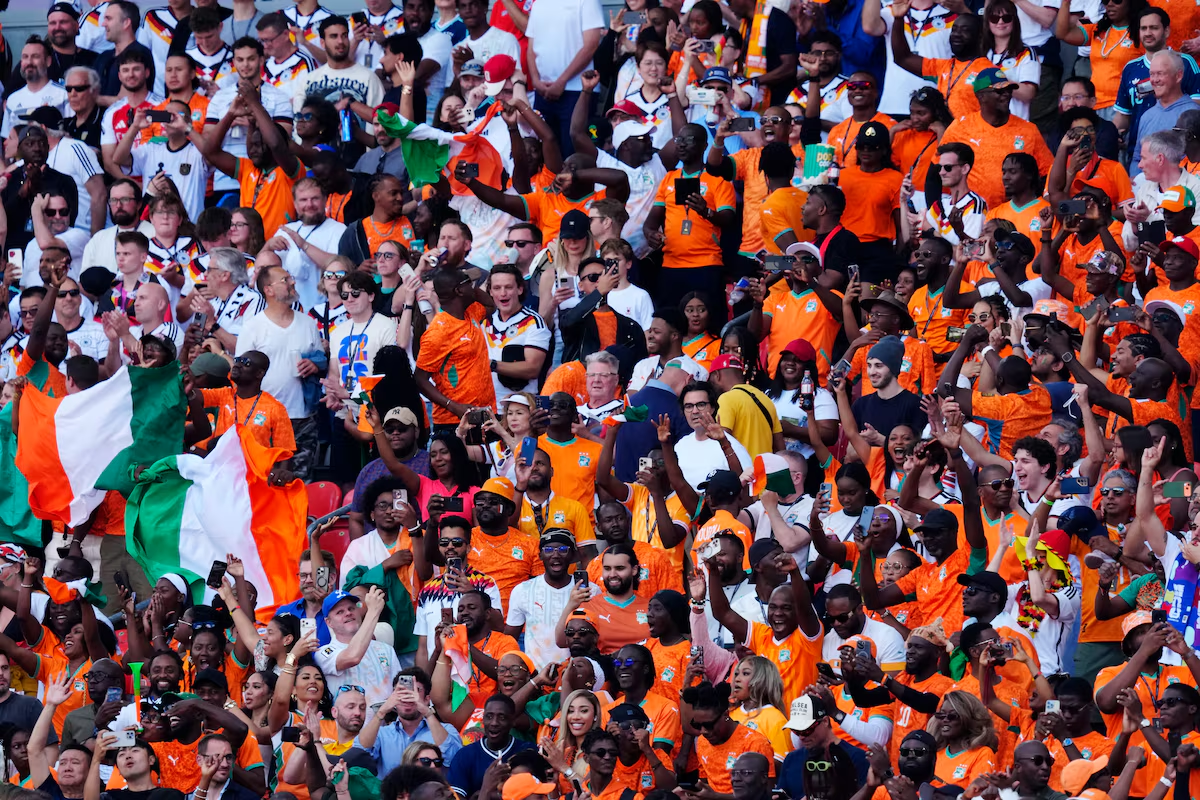
Fans cheer prior to the Group E match between Ivory Coast and Germany, in Toronto, on Saturday. Many Ivory Coast fans who spoke to The Globe said the tournament’s high costs and restrictive U.S. visa policies kept fans from travelling to the tournament.Frank Gunn/The Canadian Press
Toronto’s BMO Field was rumbling with the throaty chants of thousands of Germany fans when a rival noise pierced the din. A loud pocket of supporters in orange jerseys at the other end of the field answered back, waving flags, clapping in unison and singing “Allez les Elephants!” over and over.
Despite their smaller numbers, Ivory Coast fans’ rhythmic call-and-response cheers for their beloved “Elephants” managed to drown out the sea of Germany supporters in white jerseys chanting around the stadium. When Ivory Coast’s Franck Kessié scored first in Saturday’s game to give his team the lead, Toronto’s packed stadium erupted in pure joy, prompting more singing in French from the fans in orange.
This passionate scene would be nearly impossible in the United States, where Ivory Coast is playing two of its three games in the first round of the World Cup, many Elephants fans told The Globe and Mail. That’s because the Trump administration has placed Ivory Coast’s citizens on a restricted travel list as part of an immigration crackdown on dozens of countries, including three other World Cup competitors: Haiti, Senegal and Iran.
Facing the prospect of U.S. visa denials, plus the threat of a US$15,000 bond for each person who is approved to travel, many fans from Ivory Coast chose to come to Canada instead and cheer their team on in Toronto. Some who travelled here told The Globe and Mail they were disappointed politics had affected what was supposed to be a global celebration of soccer.
“It’s very painful,” said Phillipe Sawadogo, 56, who flew from Abidjan, Ivory Coast’s largest city, in the hopes he could get tickets to the Toronto game. An hour before kickoff, he was still standing outside the stadium mulling spending $2,000 to get in.
Open this photo in gallery:
Amos Kouaoh, left, and Herman Kouadio travelled from Washington D.C. to watch the Ivory Coast’s World Cup game in Toronto. They said American immigration policies had kept many fellow Ivorian fans from travelling to the U.S. see their team.Greg Mercer/The Globe and Mail
“This is what you do to support your team. The World Cup is supposed to be for everyone. I’d like to go to the United States, but I don’t know what will happen.”
Ivory Coast, one of Africa’s most talented teams, has three previous World Cup appearances and an enthusiastic fanbase that often follows the team wherever they play. But many who spoke to The Globe said the tournament’s high costs and restrictive U.S. visa policies kept fans from travelling this time.
Herman Kouadio and his friend Amos Kouaoh, Ivorien fans who now live in Washington, travelled to Toronto so they could watch the game with a larger crowd of Ivory Coast supporters. They were among hundreds of Elephants faithful who gathered outside the stadium before the game, some arranging last-minute tickets in rapid-fire French. Both men shook their heads when asked about the impact of White House travel policies on their countrymen.
“This is supposed to be a celebration. It’s sad that some people couldn’t be here. People had been saving up for this for years, they have been planning for this for years,” Mr. Kouadio said. “They should have been allowed to come and cheer on their team.”
In Philadelphia, where the Elephants played their first game on June 14, the crowd of supporters was much smaller than expected, and limited to fans who were legal U.S. residents, already had visas or had dual citizenship with countries not affected by the travel ban.
Open this photo in gallery:
Ivory Coast’s Franck Kessie celebrates his goal against Germany during Saturday’s match.Frank Gunn/The Canadian Press
American immigration policies have loomed large over the tournament, which is being co-hosted by Canada and Mexico. Seventy-eight of the 104 matches, including the final, will be played in cities across the U.S. Some American host cities, including Philadelphia, have complained the travel restrictions are hurting international tourist revenues they had counted on when they bid years ago to become hosts.
“The supporters have cancelled the trip because the U.S. government does not want to see supporters from certain countries, including Ivory Coast, on its soil. The United States has been clear with us, saying they do not want to see our supporters,” Julien Kouadio Adonis, president of Ivory Coast’s fan group, the National Committee of Elephants Supporters, told the Associated Press.
Last month, the U.S. relaxed the requirement for deposits of up to US$15,000 for people from World Cup-qualifying countries Algeria, Cape Verde, Ivory Coast, Senegal and Tunisia, provided they have valid World Cup tickets. But supporters from those countries complain they had to secure visas months before this policy change.
Mr. Adonis said his association normally sends hundreds of fans to the World Cup, but decided not to bother even trying to go to the U.S. because of the regulations.
“It’s a form of segregation that doesn’t dare speak its name, but the proof is there,” he said. “No European country has faced this kind of restriction. Why Africa?”
Soccer fans in U.S. dread the prospect of ICE agents around World Cup venues
U.S. immigration policies brought in by President Donald Trump have been widely condemned for restricting some fans from travelling to the country during the marquee soccer tournament. Iran has issued formal complaints to FIFA over U.S. visa restrictions against Iranian officials travelling with its team. The World Cup organizer said it had hoped the visa issues could be resolved but made it clear it cannot override any country’s authority over its own borders.
Immigration issues nearly affected the Ivory Coast team in Canada, too. While players and team officials were granted waivers to compete, Ivorien forward Elye Wahi was initially denied entry to Canada for the match in Toronto. Canadian authorities cited an outstanding investigation into suspected sports corruption in France’s top soccer league. The star player was eventually let in after his file was reviewed by Immigration, Refugees and Citizenship Canada, and he was able to play in Saturday’s game.
Canada and Mexico have different immigration and visa rules from those in the U.S. Neither country has issued travel bans for specific countries, although Canada followed the U.S. decision to put entry restrictions on countries affected by the recent Ebola outbreak in Africa, which includes World Cup qualifier Democratic Republic of the Congo.
Some players say they’re hesitant to wade into the policies that have kept their fans away from the World Cup. But Kalidou Koulibaly, captain of Senegal’s team – which plays in Toronto this Friday – said he doesn’t understand how politics has been able to intrude on a tournament built around global participation and national identity.
“I think that every team can have their people, so I don’t understand why people from Africa cannot have their people,” he said.
With a report from the Associated Press