
Open this photo in gallery:
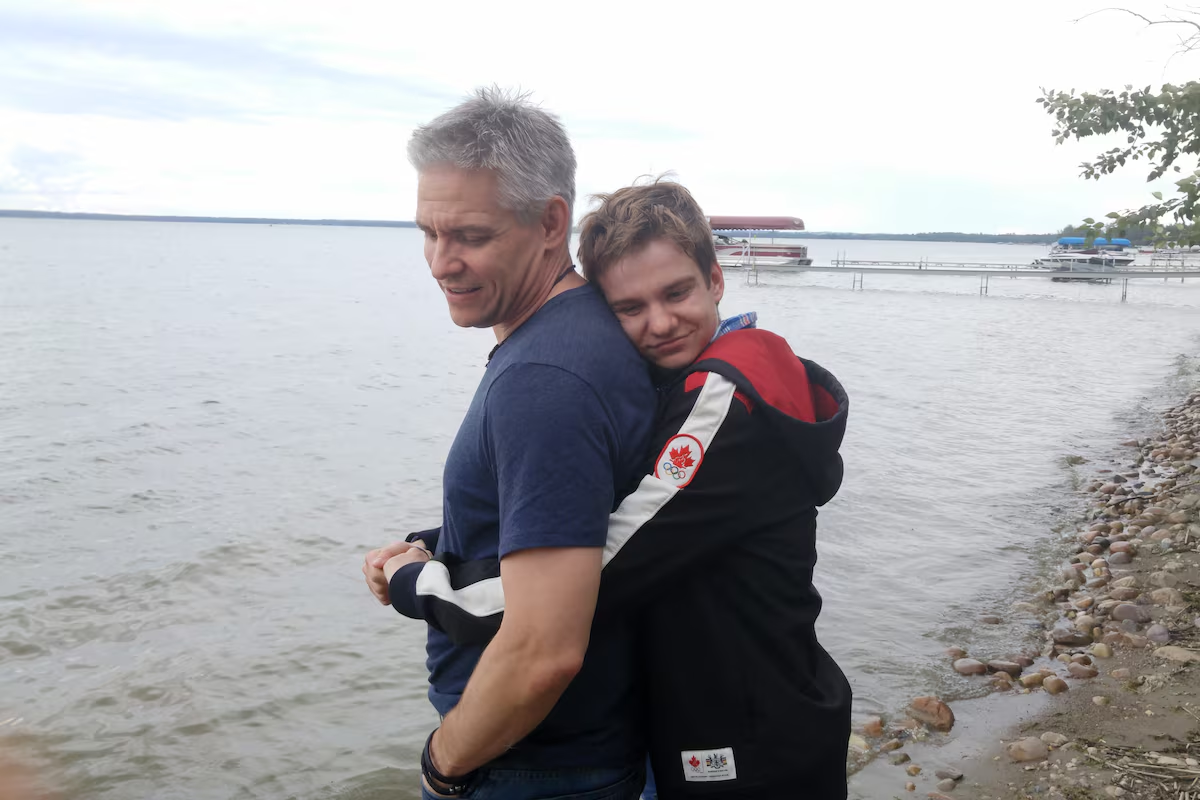
Mike Lake and his son Jaden, pictured in this undated photo. Lake says that left on their own, a child with autism can find themselves in serious danger within minutes.Mike Lake/The Canadian Press
Whenever Mike Lake hears news that a child with autism is missing, he knows how vulnerable they are.
“There’s a need to catch my breath a little bit because it hits close to home right away,” the Conservative MP from Alberta said in a phone interview on Thursday.
Lake and his party’s leader, Pierre Poilievre, are both fathers of children with autism. They are calling for a Canada-wide framework for public alerts when vulnerable children go missing, even when abduction or foul play is not suspected.
Lake’s son, Jaden, is now 30, but he said a child with autism on their own can be in serious danger within minutes.
“He has and has always had a really visual memory. He would know exactly where a swimming pool that he likes is, or a park that he likes is, but the abstract world is a little bit tougher for him to navigate,” Lake said about his son, who is non-verbal.
“So things like danger and understanding traffic, and dangers around water and those kind of things for a lot of kids on the autism spectrum – particularly in that range of the autism spectrum – are really difficult.”
On July 16, an 11-year-old boy named Parker, who had autism and was non-verbal, wandered from his daycare home in Calgary just before lunchtime. He was found dead in a labyrinth of pipes under the city, police announced Wednesday.
Early in the search, Parker’s family described him in a statement as a “loved son, brother and friend.” A massive search galvanized the city, with hundreds of officers and volunteers scouring city blocks, homes, sheds, garages, boats and under patio decks.
Calgary police Chief Katie McLellan says an 11-year-old boy who disappeared two weeks ago in a northside neighbourhood has been found dead. McLellan says the boy was discovered in a water pipe underneath Deerfoot Trail, the city’s major north-south expressway, after a tip from the public.
The Canadian Press
The search raised questions about how to alert the public when vulnerable children disappear. Amber Alerts are currently broadcast for children abducted and in serious danger.
In Parker’s case, an Amber Alert was issued as a special exemption on the second day of the search.
Lake and Poilievre say in a letter to Emergency Management Minister Eleanor Olszewski that according to Autism Canada, nearly half of children with autism are prone to wandering. Emergency alert systems, they note, are not properly equipped to respond when a child who has autism is non-verbal or is otherwise vulnerable disappears without evidence of foul play.
“The danger existed from the moment Parker went missing. The alert system should have been able to respond from that moment,” Lake and Poilievre say in their letter.
“Whatever form the solution takes, the principle should be simple: the system must respond to the danger facing the child, not only to whether a crime is suspected.”
In addition to calling for timely public alerts, the politicians also ask for strengthened first-responder training and search protocols for missing children who have autism and are nonspeaking, as well as for children with intellectual and developmental disabilities.
Olszewski, in a statement, said she has received the letter and would meet next week with Lake to discuss its proposals and how to strengthen emergency communications.
“While provinces and territories are responsible for deciding when and how many types of alerts are issued, we remain committed to working together to ensure Canadians receive timely and reliable emergency alerts when they need them most,” she says in the statement.
She also shared condolences to the boy’s loved ones.
Because of Parker’s case, a group of mothers have launched petitions urging officials to create alerts for neurodivergent children.
Lake said children with autism can be drawn to things like traffic, water or, in his son’s case, big dogs. He said their understanding of dangers – and the way they experience fear – may be different.
He commended Calgary police in their communications with the public, which they explained Parker might not respond if called or could be frightened if approached by strangers.
In their letter to Olszewski, Lake and Poilievre expressed gratitude to everyone who “worked tirelessly to bring Parker home.”
“I just think probably more than anything else, my heart just goes out to Parker and his family,” Lake said.
“It’s been a tough couple of weeks.”