Open this photo in gallery:
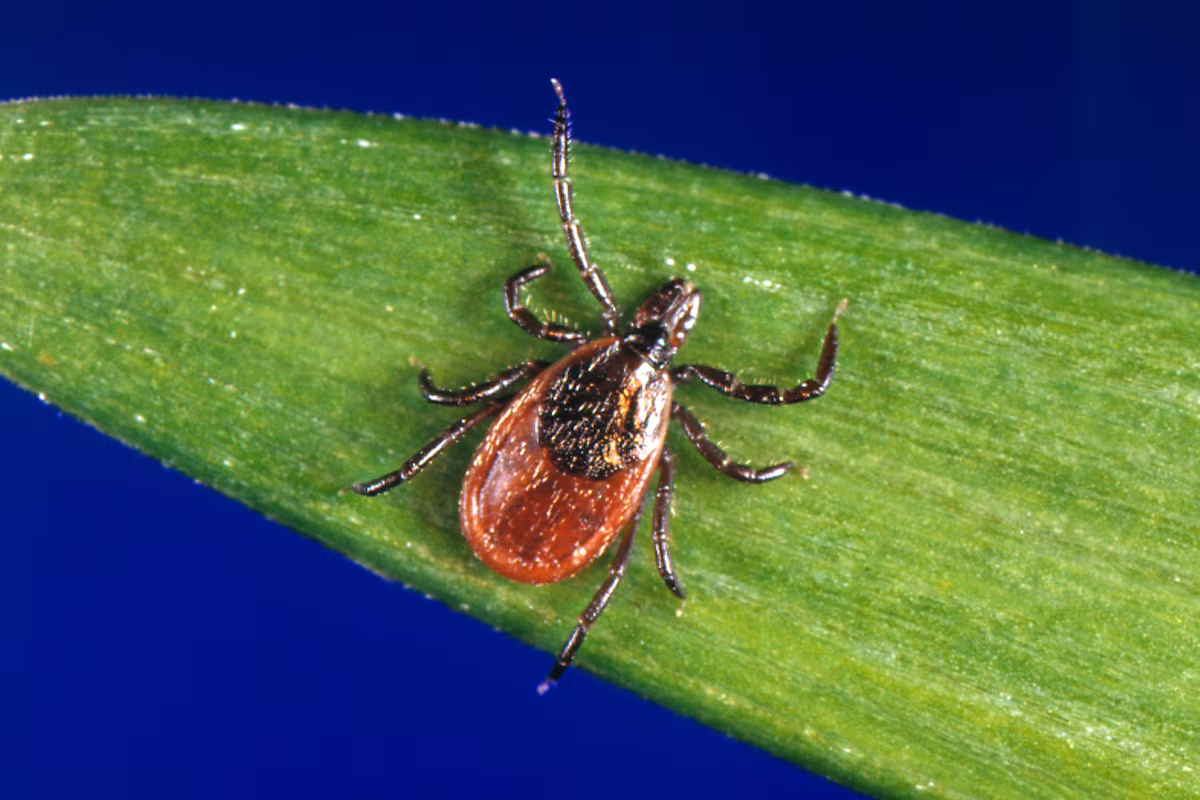
This photo supplied by the U.S. Centers for Disease Control and Prevention shows a blacklegged tick, also known as a deer tick.James Gathany/The Associated Press
On July 23, Dr. Vett Lloyd and health science reporter Jennifer Yang answered reader questions on this year’s tick season, how you can stay safe and take the right precautions if you spot a bug.
Canada is in the middle of one of its worst seasons for ticks. Last year, more than 7,100 Canadians were infected with Lyme disease, and a new case report published by the Canadian Medical Association Journal warned of increasing cases of tick-borne Anaplasmosis.
Readers asked what to do if they’re bitten by a tick, if researchers are working on a vaccine and why tick numbers are on the rise. Here are some highlights from the Q&A.
This summer’s tick season
What’s the reason or reasons there are so many ticks this year?
Jennifer Yang: Researchers believe the reasons are multi-factorial but a major driver is our warming climate. Canada is warming faster than the global average and our longer summers and warmer winters are creating the optimal conditions for ticks to survive and thrive (studies have found that a key threshold for tick survival is the number of cumulative days with above-zero temperatures).
And every spring, more ticks are being “imported” into Canada by migrating birds. I actually interviewed a government scientist last year who memorably described Canada as being “bombed by ticks” every spring. I thought his language was a tad dramatic but studies have estimated that northward-migrating birds carry between 50-175 million blacklegged ticks into Canada every year. When these ticks finish feeding and drop off their feathered hosts, they can establish new populations. And given that a female tick is capable of laying between 2,000-3,000 eggs in a single clutch, you can imagine how quickly populations could explode.
Keeping the critters away
How can you identify a tick? Are there some bugs that look like ticks but aren’t?
Vett Lloyd: It takes good eyesight, for sure. Ticks are small and have eight legs (except for the youngest ticks) but you would need a magnifying glass or similar to be able to count their legs. You can also take a picture of it with a smartphone and magnify that image. Basically if it looks like an oval with a bunch of legs and it is stuck on your body, it is likely a tick. Ticks crawl slowly so anything “scampering” is likely not a tick. We’ve had all kinds of bugs brought to us to see if they are ticks – including lady beetles and ants. Weevils and pseudoscorpions are harmless but are often submitted as possible ticks.
Your best bet is to take a picture of one and submit the picture to etick.ca for identification. Entomologists running that program will identify the critter for you. But if it is feeding from you, assume it is a tick and if you have access to health care, it would be good to consult a health care practitioner.

Lyme disease is the most common
tick-borne illness in Canada
There are two types of ticks that carry Borrelia burgdorferi, the
bacteria that cause Lyme disease in humans: The blacklegged or
deer tick is found in Southern and Eastern Canada, and the western
blac-legged tick in the West. They go through a two-year life cycle.
The ticks can become vectors of the Lyme disease-causing bacteria
after feeding on infected birds or rodents. Humans often contract the
disease after being bitten by tiny ticks in the nymph stage.
To prevent disease, ticks should be removed within 48 hours.
Blacklegged or
deer tick
(Ixodes scapularis)
Western
blacklegged tick
(Ixodes pacificus)

Lyme disease is the most common
tick-borne illness in Canada
There are two types of ticks that carry Borrelia burgdorferi, the
bacteria that cause Lyme disease in humans: The blacklegged or
deer tick is found in Southern and Eastern Canada, and the western
blacklegged tick in the West. They go through a two-year life cycle.
The ticks can become vectors of the Lyme disease-causing bacteria
after feeding on infected birds or rodents. Humans often contract the
disease after being bitten by tiny ticks in the nymph stage.
To prevent disease, ticks should be removed within 48 hours.
Blacklegged or
deer tick
(Ixodes scapularis)
Western
blacklegged tick
(Ixodes pacificus)

Lyme disease is the most common tick-borne illness in Canada
There are two types of ticks that carry Borrelia burgdorferi, the bacteria that cause Lyme disease in humans:
The blacklegged or deer tick is found in Southern and Eastern Canada, and the western blacklegged tick
in the West. They go through a two-year life cycle. The ticks can become vectors of the Lyme disease-
causing bacteria after feeding on infected birds or rodents. Humans often contract the disease after being
bitten by tiny ticks in the nymph stage. To prevent disease, ticks should be removed within 48 hours.
Blacklegged or
deer tick
(Ixodes scapularis)
Western
blacklegged tick
(Ixodes pacificus)
How does a tick bite look compared to other bug bites? Is the tick always present in the bite and for how long?
Lloyd: Telling one type of bite from another is tough – even for health care professionals. A tick will stay anchored at the bite site while feeding for days if it is allowed to. So if you are sure that there was no tick at a bite site a few hours before noticing the bite, it is less likely to be a tick than some other biting creature. But it is always possible for the tick to have started feeding and gotten brushed off, and ticks are very small so people often don’t notice them. So discovering a bite site but no tick doesn’t exclude it from being a tick bite. However, tick bites are not itchy. And they tend to be flat and not warmer than the adjacent skin.
The bullseye style target rash is distinctive, but not everyone gets a rash that looks like that and many people don’t get a rash at all. So it’s a bit tough to figure it out from a bite site. Bug spray and frequent tick checks will help catch the culprits though. And reduce the number of bites from everything – which is definitely a bonus!
With all the news about ticks, I feel hyper sensitive about taking a walk on a trail or riding a bike. Can I relax and know I am safe as long as I don’t make contact with the surrounding greenery?
Lloyd: Ticks are both disgusting and dangerous. But it is also really important to be outside and enjoy nature. There have been ticks on the planet as long as there have been humans (before humans actually) so we have to learn how to live with them. Identifying high-risk areas (one can look at some of the tick recovery maps on etick.ca or geneticks.ca). Avoiding bashing through undergrowth in high risk areas, using bug spray, and importantly, doing tick checks when you come inside are all excellent prevention tools.
For biking, you should be off the ground enough to be pretty safe unless you go through long grass. For trails, staying in the middle of the trail will reduce risk. We live in a beautiful country so it is important to get out and enjoy it!
Open this photo in gallery:
Dr. Lloyd, professor and tick researcher in the Department of Biology at Mt. Allison University works in the molecular biology lab in Sackville, N.B., July, 2025.Viktor Pivovarov/The Globe and Mail
I live in Nova Scotia where ticks are rampant. Is there any natural substance that can be sprayed around my grounds and on my house that might repel tick encounters?
Lloyd: Keeping ticks at bay is extremely important. Non-toxic alternatives are also essential. It is important to remember that not all natural products are non-toxic and not all synthetic products are toxic (in fact, they are rather thoroughly tested to make sure that they are not). Local pest control companies can advise on spraying options – both synthetic and natural products. There are landscaping and rodent-control options that will help keep ticks away. This website from Harvard offers some interesting ideas.
Depending on your interests, you can also apply aromatic mulches (balsam fir is very good as a perimeter mulch) and plants that discourage deer and mice, and so ticks.
What is the best way to remove a tick from the skin?
Lloyd: There is a lot of mythology about the “best” way to do this. The key thing is to get the tick removed as quickly as possible. If you have options, tweezers or a tick removal tool are excellent. Squashing the tick so that it pops is not a great idea – if that happens, disinfect everything as the insides of ticks contain pathogens. You also want to avoid squeezing tick innards into your body – for fairly obvious reasons. Killing the tick with kerosene, nail polish, Vaseline, burning it etc., just takes time, increases risk from both the tick and the removal method and isn’t necessary.
Once the tick is removed, it is extremely useful to keep the tick – you can put it in a plastic baggie and freeze it or just let it die in a container. The dead tick can then be tested for infection, either through the health care system if that is available in your area or privately. Even if you don’t want to test it immediately, the tick bodies last for a long time and you can always test it later if you start to get ill. Knowing what the tick had in it can be a big help to your health care provider – there is definitely more out there than Lyme disease.
Open this photo in gallery:
An adult female lone star tick crawling on a blade of grass.Lauren Bishop/The Canadian Press
Health risks of tick bites
Why is there a vaccine for tick-related diseases for animals and not humans? Can we expect one for humans soon since the infection rate is rising exponentially?
Yang: Many people don’t know that there actually was a human vaccine for Lyme, called LYMErix. But it was killed by a series of unfortunate events.
LYMErix hit the market in 1998 — the same year as the notorious Lancet paper by Andrew Wakefield, which fraudulently claimed a link between the MMR vaccine and autism. The Wakefield paper has since been retracted and widely debunked, but it unleashed a powerful wave of anti-vaccine sentiment that swept LYMErix into its wake.
Some people who received LYMErix started reporting joint pain and other effects, leading to a class-action lawsuit filed on behalf of 121 people. That suit was ultimately settled and an FDA panel later found no evidence of LYMErix causing unexpected adverse events. But it generated such terrible publicity around LYMErix that sales were dismal and just four years after its debut, the vaccine was pulled off the shelves.
This debacle spooked the pharmaceutical industry from pursuing another Lyme vaccine; in fact, another vaccine was in the works at the same time as LYMErix and showed promising results, but the company behind it never even pursued a license. Dog owners, however, have had no issues with a Lyme vaccine for the most part and millions of dogs have now been vaccinated since the early ‘90s.
Today, there are renewed efforts to develop a Lyme vaccine, and the context is very different; tick populations have exploded, along with tick-borne diseases like Lyme.
Lloyd: One point to note is that the original vaccine targeted a protein that is similar to some human proteins so, in retrospect, it was a target that might have been expected to be a risk for the induction of autoimmune responses in some people (as with all autoimmune responses, the genes of the person and prior exposures to infectious and environmental stimuli would impact the response). So it wasn’t an ideal target.
The current vaccines are raised against targets where the portions that overlap with human proteins have been removed, so that should reduce the risk of autoimmune side effects.
What is anaplasmosis and how does it differ from Lyme disease? Is it more dangerous?
Yang: I actually wrote an article about anaplasmosis recently.
Anaplasmosis isn’t a household name yet in the way that Lyme disease is, but it’s definitely here in Canada and reported cases have been rising rapidly since it became a nationally notifiable disease in 2024.
Similar to Lyme, anaplasmosis is a bacterial infection that can be transmitted by the bite of a blacklegged tick.
But it’s caused by a different bacterium (Anaplasma phagocytophilum) and transmission can occur more quickly than with Lyme (between 12-24 hours after the tick bites). While Lyme infection can cause a distinctive bullseye rash, anaplasmosis doesn’t typically cause skin rashes. Most cases are mild or even asymptomatic but early symptoms can include things like fever, fatigue, chills, headache or nausea.
Anaplasmosis can cause severe disease, including respiratory failure, bleeding problems or organ failure. The story that I recently wrote for The Globe features an Ontario man who developed acute myocarditis, a rare complication.
Public Health Ontario data also suggests that anaplasmosis is more likely to cause severe disease. In Ontario, 21 per cent of anaplasmosis cases reported between 2023 and 2025 have required hospitalization and four people have died. By comparison, the hospitalization rate for Lyme disease during this same time period was 3.8 per cent, with no deaths.
Is it true that a tick bite can give you an allergy to red meat? Is it treatable if that ever happens?
Lloyd: Sadly yes, the bites of some ticks can cause red meat allergies in susceptible people and pets. Tick saliva, which it squirts into us as it feeds on our blood, contains a sugar that we develop a reaction to. This same sugar is present on the cells of red meat, so once one is sensitize to them, it is possible to get an allergic reaction from red meat. The lone star ticks have the most of this sugar in their saliva so they are the most likely to cause this meat allergy. But blacklegged/deer tick saliva can also cause this allergy, although it typically takes more tick bites to cause it than with lone star ticks.
How bad the allergy is depends on the person’s immune system and genetics. Some people get it really badly, others not so much. Many people recover over time but if it is a serious allergy, seeking health care support to manage it will be important. Of note, pets can also get this allergy. Many commercial dog foods use non-red meat as a protein source so it can be managed in pets too by avoiding red meat.
How can I get tested in Canada for Lyme or any other tick-borne disease?
Lloyd: You can get tested for Lyme disease and other tick-borne diseases through the Canadian health care system as long as you can access a health care provider and they feel that the test is warranted. The “standard” testing isn’t perfect, but it is paid for by provincial health plans so it doesn’t cost you directly.
One can also access testing from U.S. or European labs. There are a lot of labs out there and to sort through them you may want to consult a health care provider, a naturopath or a Lyme disease support group. The private testing is fairly expensive. An additional problem is that many health care providers in Canada will not accept the results from international tests. Some, but not all the tests will need a health care provider to authorize the blood draw before you send your blood out by courier. The results are sent to either or both the provider or the person ordering the test.
Questions and answers have been edited for length and clarity.