
Open this photo in gallery:
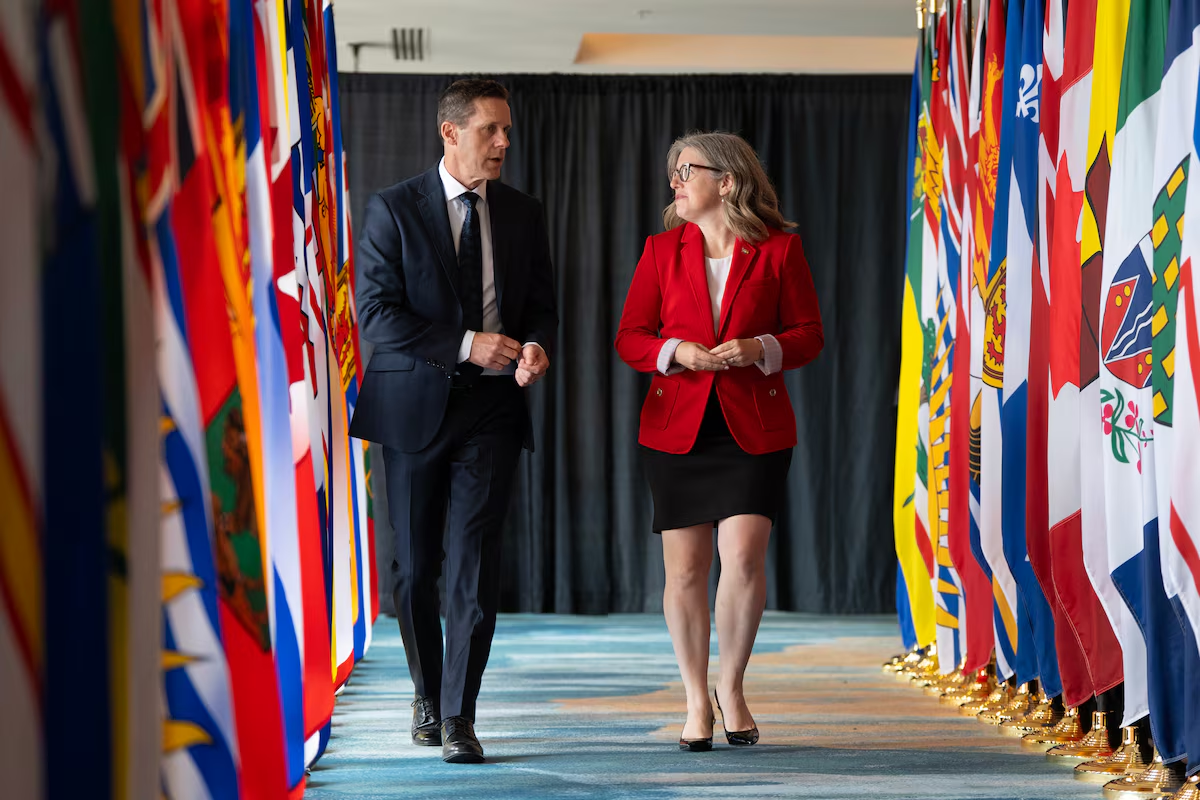
Prince Edward Island Premier Rob Lantz, left, and New Brunswick Premier Susan Holt arrive ahead of the First Ministers Meeting with Prime Minister Mark Carney in Charlottetown on Thursday.Darren Calabrese/The Canadian Press
Canada’s three Maritime provinces agreed Thursday to work together on their future electricity needs as the country looks to bolster its energy security.
The provincial governments plan to make a regional road map for electricity transmission by next spring and will consider creating an independent electricity system operator to manage power delivery in the Maritimes.
The commitment is part of a broad memorandum of understanding signed by New Brunswick, Nova Scotia and Prince Edward Island.
New Brunswick Premier Susan Holt said the deal will lead to more affordable electricity prices as the provinces co-ordinate on what energy projects they build.
“It benefits all three of our provinces and really strengthens our ability to be resilient,” Holt told reporters Thursday.
Opinion: Premiers, tear down these internal trade walls
Holt, P.E.I. Premier Rob Lantz and Nova Scotia Premier Tim Houston announced the deal ahead of a meeting between Canada’s premiers and Prime Minister Mark Carney in Charlottetown on Thursday.
Michelle Robichaud, president of the Atlantica Centre for Energy, hailed the memorandum as a big first step toward a more integrated electricity grid across the three eastern provinces.
“Collaboration allows us to look at where the money should be more efficiently spent in order to ensure that the grids remain reliable and stable and able to support economic development in the region,” Robichaud said in an interview.
For example, she said a new Maritimes power operator could identify gaps in the system and put out a tender for new wind farms as energy needs grow in the region. She said it would act similarly to an air traffic controller and direct energy to where it’s required in the three provinces.
Meanwhile, the federal government announced $5.9-million Thursday to kick-start planning and technical work to build a pair of new undersea power cables from New Brunswick to P.E.I.
“This is the first stage, absolutely, but we fully expect to install new cables,” Lantz told reporters, adding that the lines are needed to meet the Island’s future power demands and avoid blackouts.
The funding will help lay the groundwork for construction on the two new 200-megawatt, 138-kilovolt cables by 2028. The project will also include related transmission and substation upgrades in both provinces.
Decisions to lift U.S. alcohol bans should be part of broader deal, Carney says
Prime Minister Mark Carney said the Atlantic energy memorandum and federal investment in undersea cables to the Island contributes to his government’s goal to double the capacity of Canada’s electricity network.
“Lower energy costs, greater energy security, fewer emissions – building a strong, connected grid is how we will achieve all of those objectives at once,” Carney told reporters Thursday.
Holt described New Brunswick as an the “energy hub” for the Maritimes due to its central location between Quebec, P.E.I. and Nova Scotia.
“We know that Canada needs more power. New Brunswick is prepared to deliver that, and today we can now do it in partnership with the Maritime provinces.”
Bradley McPherson, director of innovation for the Centre for Nuclear Energy Research at the University of New Brunswick, agreed his province can be a crucial backstop for the Island and Nova Scotia.
For instance, he said New Brunswick can use its nuclear power as a backup while its neighbours pursue more renewable energy projects – such as wind farms that provide intermittent power.
“When I think about Wind West, for example, New Brunswick and Nova Scotia can advance that opportunity together,” McPherson said, referencing Nova Scotia’s plans for a $60-billion, five-gigawatt offshore wind project.
McPherson said he doesn’t see the agreement leading to a single unified power grid but rather a promise for the provinces to reliably help each other keep the lights on into the future.
“Energy is that piece, it underpins everything that we do. From economic development, from health care, education, it’s agriculture, it’s behind everything.”