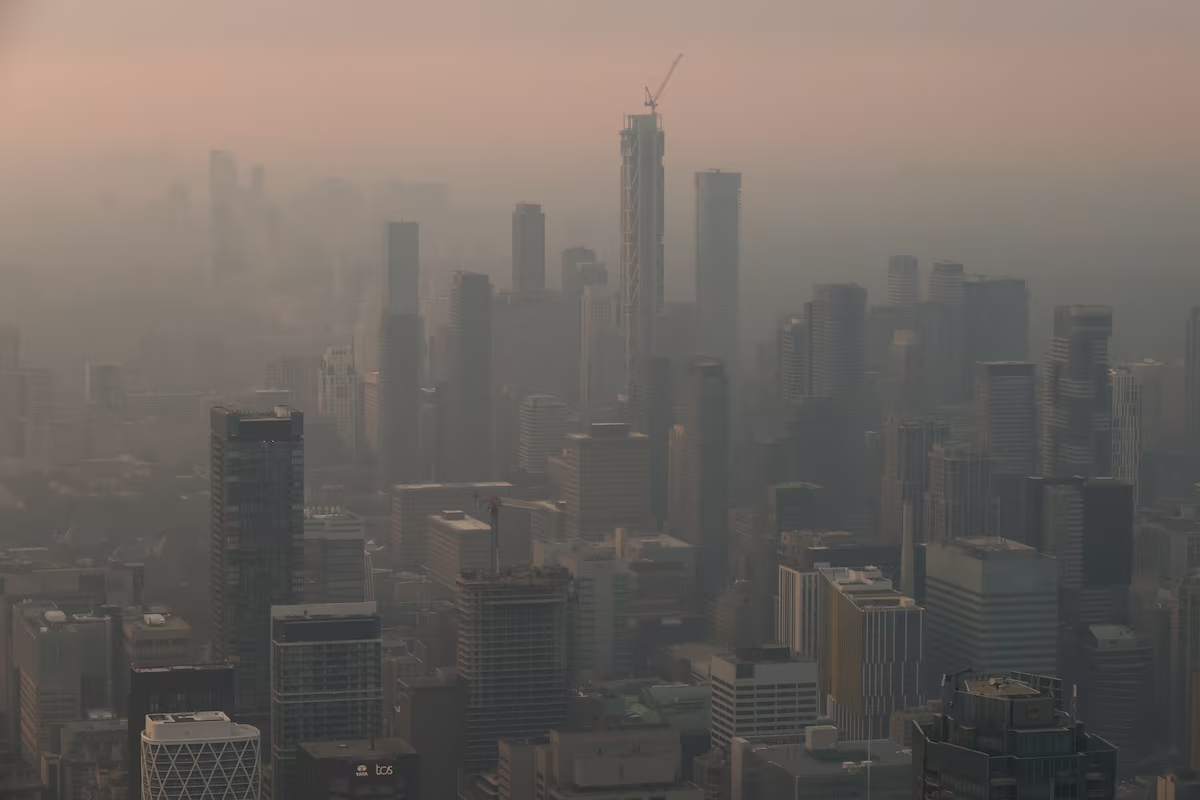

Open this photo in gallery:
The City of Toronto has a wildfire smoke response strategy that is activated once an air quality warning is issued.Cole Burston/The Canadian Press
As smoke from Northern Ontario wildfires drifted south over some of the province’s most populous areas, regional public-health units, weather agencies and municipalities encouraged the millions of people to sharply reduce their exposure to the smoke and its toxic particles, largely by staying indoors.
It also prompted local governments and support agencies last week to scramble to help a population that can’t easily follow that advice, handing out masks and opening clean-air spaces for people living without housing to find respite from the smoke.
“There have been many public-health advisories around staying indoors, but for thousands of people in Toronto and tens of thousands of people across Canada, that’s just not a reality,” said Andrew Boozary, a primary-care physician and founding executive director of the Gattuso Centre for Social Medicine at University Health Network, the Toronto-based research and hospital network.
Around 15,400 people are homeless on any given night in Toronto, a figure that has more than doubled since 2021, according to the City of Toronto’s Street Needs Assessment survey conducted in October, 2024.
Dr. Boozary said that while opening more cooling spaces, getting N95 masks and high-efficiency air-filter units into shelters, and encampment outreach provide immediate relief, such extreme weather events highlight the greater need for social housing as core health infrastructure.
Wildfires continue to rage across Canada as smoke eases in eastern cities
Kevan Mehta, pediatric respirologist at McMaster Children’s Hospital, said health risks rise as smoke exposure increases.
Dr. Mehta also said that a higher exposure, combined with underlying health problems – which many people experiencing homelessness face – can have a negative compound effect.
“A lot of health problems are related to socioeconomic status and what you have access to. Even now we’re kind of looking at safe air as a privilege,” he said.
Municipalities have response plans for extreme cold and extreme heat, which in some cases specify temperatures or other conditions, such as poor air quality, to trigger additional resources and shelter spaces.
The City of Toronto, for example, has a wildfire smoke response strategy that is activated once an air quality warning is issued. The City of Kingston has a summer response plan that outlines protocols for supporting vulnerable populations – including people experiencing homelessness – during extreme weather events, such as periods of poor air quality.
Ford defends Ontario’s wildfire response as smoke blankets central Canada, Eastern U.S.
Russell Baker, director of communications at the City of Toronto, said last week’s air quality warnings prompted the city to activate additional capacity throughout the shelter system, including contingency spaces within existing shelters.
“We make every effort to connect as many individuals as possible living outdoors with available indoor shelter spaces during periods of poor air quality and extreme heat,” he said.
Mr. Baker also said the city expanded outreach efforts to conduct wellness checks and connect people with clean air spaces and hygiene kits that contain masks.
The clean air spaces were set up at city hall, Metro Hall, North York Civic Centre, Scarborough Civic Centre, York Civic Centre and East York Civic Centre. In addition, the city has a 24-hour cooling space in the city’s Annex neighbourhood for people experiencing homelessness.
Outside of Toronto, municipalities across southern Ontario said they had teams on the ground engaging with individuals experiencing homelessness to help reduce the effects of wildfire smoke. The outreach teams provided information about air quality conditions, handed out masks, connected people with available support and told them about city-operated cleaner air spaces.
Why wildfire smoke is difficult to forecast and damaging to our health
In London, Ont., Jonathan John, director of housing stability services for the city, said that during periods of poor air quality, the city works closely with emergency shelter, drop-in and outreach partners to reduce health risks for people experiencing homelessness.
Mr. John also said the city has proposed emergency shelter guidelines, which will be considered by Council on Tuesday. They outline provisions for responding to extreme weather events, including periods of poor air quality.
Katherine Kalinowski, chief operating officer of Good Shepherd Centres, a network of shelters in Hamilton, said they are operating at, or over-capacity, year-round, but the poor air quality advisory “certainly adds another layer of risk for people who are unhoused.”
“For many of the people we serve, who perhaps spend greater amounts of time outdoors, and who may have more health vulnerabilities – because experiencing homelessness has detrimental effects on many people’s health – there’s a real vulnerability there,” she said.
Her team encouraged people staying in their emergency shelters to remain indoors where they could, to monitor their health and to connect with a physician or clinician if needed. But Ms. Kalinowski said she remains concerned about people who don’t have any shelter at all.
Wildfire smoke attacks nearly every system in the body, killing tens of thousands each year, studies show
“We have a crisis in our community, and it is a challenge every day of the week to keep up with the demand and to provide the effective services and even longer-term responses for people who are unhoused,” she said.
“That continues today, just in an environment where there’s poor air quality,”
While smoke can affect everyone – causing eye, nose and throat irritation, coughing and headaches in people with no underlying health conditions – the risk of inhalation is more severe for vulnerable groups, said Keith Corey, manager of environmental health at Grand Erie Health Unit.
“Air quality can affect people differently, but certain people with heart and lung conditions, or older adults, or young children, pregnant people, including people who work outdoors or exercise outdoors, or individuals without stable housing could be more impacted,” he said.
Last Wednesday, Toronto had one of the worst air qualities in the world and Environment Canada issued an orange warning as the quality reached a very-high risk level across Southern Ontario. As of Saturday morning, the warning was downgraded from orange to yellow level as conditions improved.
Dr. Boozary said that while wildfires don’t discriminate, poverty drives structural discrimination and exposes more people to climate-related health risks.
“We know who’s most vulnerable, and ultimately, we need to ensure that we’re driving a lot of these solutions in concert to protect people,” he said.