
Good morning. Everywhere you look in Canada’s aerospace industry, there is evidence of growth. In focus today are the supply chain issues and trade concerns on the horizon, but also a sector that has been pegged as a bright spot in an otherwise struggling economy.
Up first
In the news
Wildfires: Ontario and the Assembly of First Nations are appealing for more federal assistance with the province’s deepening wildfire crisis prompting evacuations as fires already incinerated one community. More on that below.
Development: Ottawa has referred the Port of Vancouver’s growth strategy to the Major Projects Office, including expansion of a Southern B.C. shipping container terminal, and a review of Alberta’s proposal for an oil export terminus in the Delta area.
Survey says: Alberta’s CEOs are feeling optimistic, despite geopolitical pressures and a looming vote on separation, according to a Business Council of Alberta survey.
Open this photo in gallery:
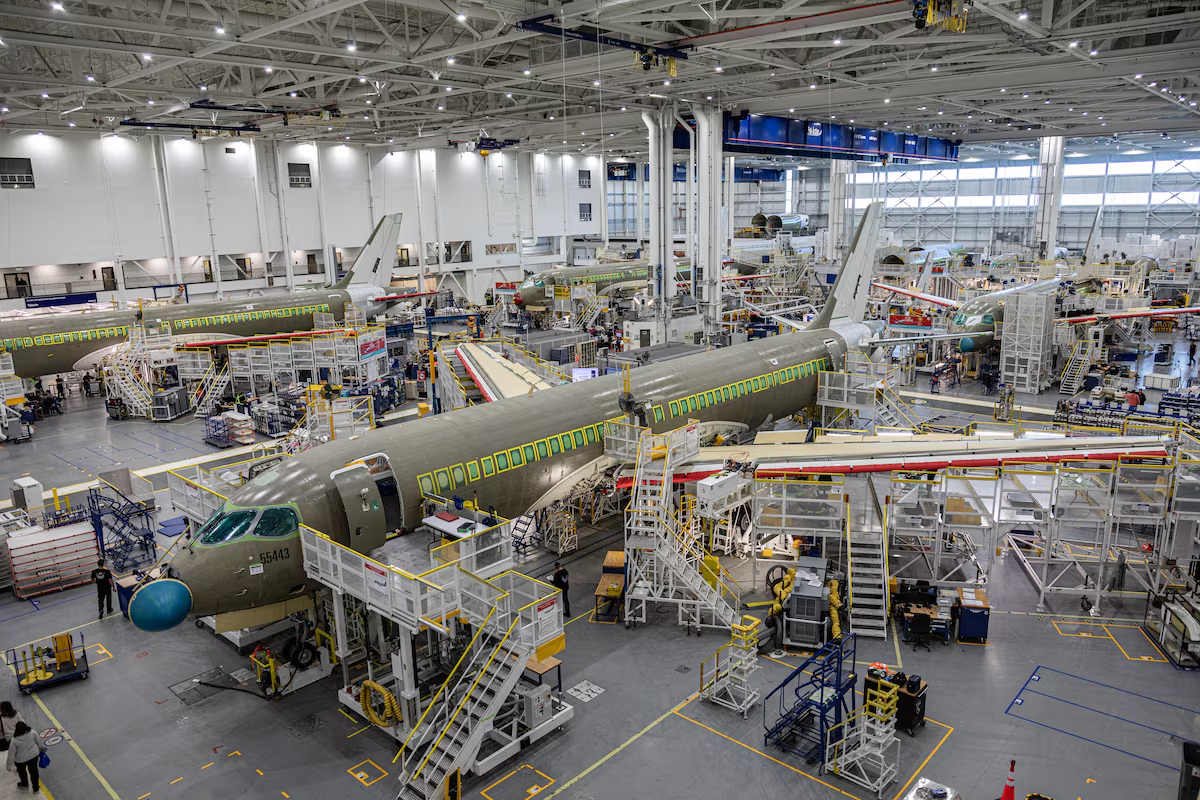
The Airbus assembly line at the company’s facility in Mirabel, Que.ROGER LEMOYNE/The Globe and Mail
In focus
A soaring industry, with turbulence ahead
Hi, I’m Nicolas Van Praet. I cover Quebec business for The Globe from our bureau in Montreal and at the moment, it’s all about aircraft.
While many of us are lazing in the summer shade or sipping beers by the dock, global aerospace and defence executives, politicians and plane buffs will descend on a tarmac in England over the coming days for the biennial Farnborough International Airshow. It’s a frenzied mix of exhibits and news conferences, with plenty of back-room schmoozing and cocktail receptions to boot.
Organizers call it “the must-attend event” of the industry calendar and this year, the Canuck contingent will be there in full force.
In the lead-up, we thought it would be a good idea to connect with Canadian aerospace leaders and experts to get their take on the current environment. We’d read the press releases outlining record orders and operational improvements, a stark contrast to some other sectors of the economy.
But we wanted to go deeper and understand what’s changed and why, and what’s next.
Open this photo in gallery:
Neil Sweeney, VP of Corporate Affairs at De Havilland Aircraft, visits a future manufacturing site just outside of Calgary on July 2.Todd Korol/The Globe and Mail
What we found is a group feeling decidedly upbeat about the state of affairs. The COVID-19 pandemic brought the industry to its knees but that’s now given way to a rebound of epic proportions, one reinforced by a new wave of defence spending that could benefit hundreds of companies.
Canadian manufacturers and service providers are seizing the moment, with all its opportunities and challenges. And they see lots of blue sky ahead. Some are expanding their payrolls and footprints. Others are doing takeovers to bulk up their capabilities.
Bombardier Chief Executive Eric Martel told me that he spent a recent Tuesday with his senior executive team swapping views about what can realistically go wrong. They struggled to see any major pitfalls for the jet maker, at least in terms of what they can control. “If World War III starts, then we’re in another scenario,” Mr. Martel said.
That’s not to say the dangers are non-existent.
Conflict continues in Ukraine and in the Middle East, and geopolitical tension is rising. That might be good for the defence industry but it’s bad for civil aviation because it can close airspace and disrupts supply chains, something that continues to be a problem for manufacturers.
Finding talent is another obstacle that could hinder growth. And then there’s the big unknown: The Trump factor.
Open this photo in gallery:
A Bombardier assembler works on a Challenger aircraft at their production facility in Dorval, Quebec, on June 22.Graham Hughes/The Globe and Mail
The aerospace industry has so far been largely spared by White House trade action. But a recent probe into the sector by the US Commerce Department has just concluded that aerospace imports into the U.S. present a national security threat, opening some avenues for the president to use aerospace as leverage in wider trade negotiations.
C-Suites in Montreal, Toronto and Calgary aren’t freaking out about possible tariffs just yet. But remember: This is a president whose threats have sent the Canadian industry spinning before. Anyone remember a certain social media post from January stating the U.S. was decertifying “all aircraft made in Canada”?
I asked those I spoke to for this story what we could do as a country to strengthen the sector in the face of global competition. The answer they gave was remarkably consistent: Sustained long-term investment by government.
And, oh yeah, a dedicated aerospace strategy wouldn’t hurt, either. So how about it, Ottawa?
I hope you’ll take some time to read my full feature today.
Charted
A national crisis
Wildfires in Ontario prompted evacuations, blocked rail traffic and halted forestry operations. Some U.S. lawmakers even threatened to sanction Canada over heavy smoke that crossed the border. Meanwhile, evacuations in British Columbia are getting less attention.
Quoted
Together, with an early diagnosis and extra time, what we’re providing is a meaningful way for people living with Alzheimer’s to live longer and prepare for the disease progression.
— Christina Scicluna, chief executive officer of the Alzheimer Society of Canada
In a reversal from its original position, Canada’s Drug Agency is now recommending that public drug plans cover a disease-modifying medication for Alzheimer’s disease.
Up next
More files we’re following
To buy: Canada will buy nearly $2-billion worth of armoured vehicles from a U.S. defence contractor that Ottawa is calling a new “strategic partner.”
To spend: Carney says the cross-border Gordie Howe International Bridge might run at a loss in the first few years of operation.
To watch: Today we are watching for data on Canada’s international securities transactions for May.
Morning update
A brutal selloff in chipmakers rippled through global markets as investors abruptly reassessed the durability of the artificial intelligence-driven rally.
Wall Street futures were in the red, while TSX futures followed sentiment lower.
Overseas, the pan-European STOXX 600 was down 0.45 per cent in morning trading. Britain’s FTSE 100 edged down 0.17 per cent, Germany’s DAX dropped 0.51 per cent and France’s CAC 40 declined 0.7 per cent.
In Asia, Japan’s Nikkei closed 4.03 per cent lower, while Hong Kong’s Hang Seng slid 1.78 per cent.
The Canadian dollar traded at 71.23 U.S. cents.