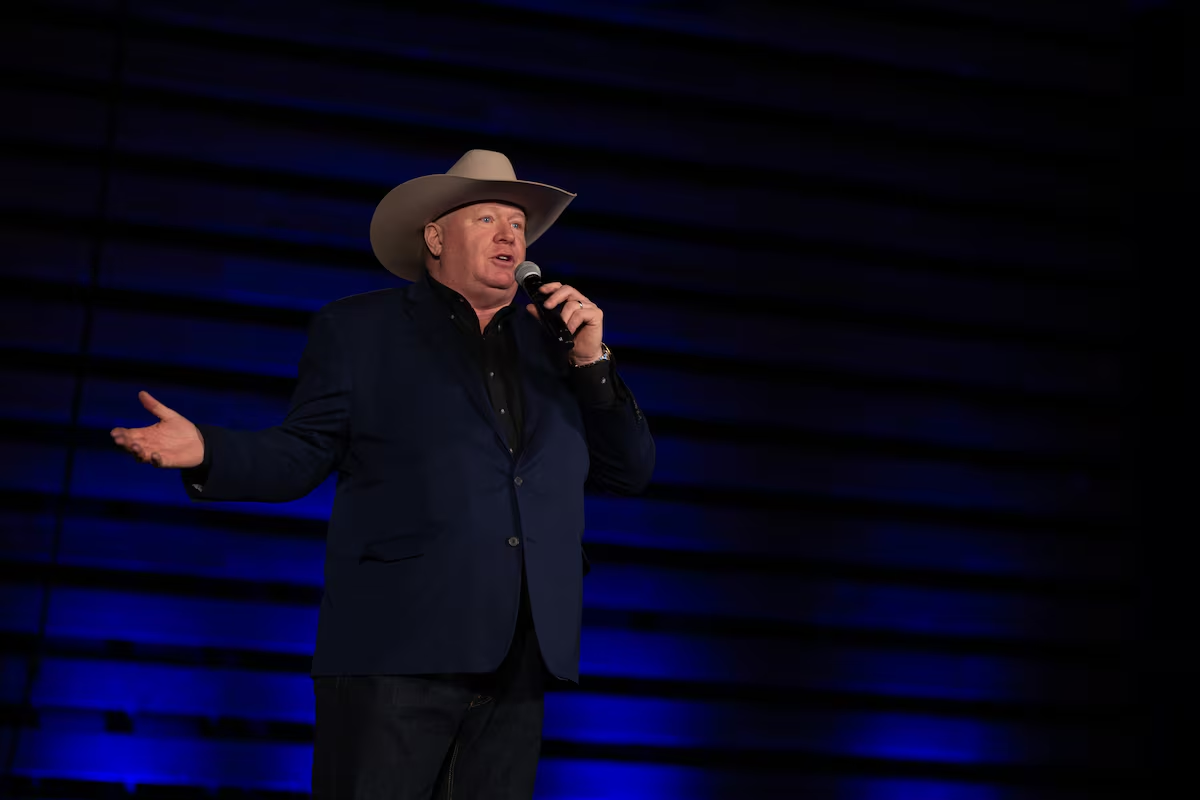

Open this photo in gallery:
Jeffrey Rath’s high-profile role in Alberta’s separatist movement has turned a spotlight on his lengthy Indigenous law career.Amir Salehi/The Globe and Mail
Over more than three decades, Jeffrey Rath built a career representing First Nations as one of few lawyers in Western Canada practising Indigenous law. He won a landmark case in the Supreme Court of Canada that set a precedent for the duty to consult and was a well-published voice in Alberta’s local newspapers, writing almost exclusively on First Nations’ treaty rights.
Mr. Rath, who has emerged as one of the most vocal and visible proponents of Alberta separatism ahead of a planned referendum on the issue this fall, often references his expertise – in public and court – to shield himself against concerns that his plans for sovereignty would violate treaty rights.
But Mr. Rath’s legal work for First Nations has also led to disputes with his former clients dating back more than a decade, including one tied to a judge’s decision on July 10 to freeze millions of dollars in assets belonging to him and his law firm, Rath & Company.
Mr. Rath’s high-profile role in the separatist movement has turned a spotlight on a career spent fighting for treaty rights – rights that have emerged as a legal roadblock for Alberta’s pro-independence movement. Recent judicial interventions have also called into question his law firm’s use of contingency fees and its oversight of First Nations’ trust accounts.
The judge’s asset freeze was related to a case involving the Tallcree First Nation, which alleged that Mr. Rath and his firm had misappropriated money he was overseeing as the band’s trustee. The allegations prompted Court of King’s Bench Justice Michael Marion to impose a Mareva injunction – a extraordinarily powerful and rarely used legal tool – to temporarily freeze more than $8.5-million in assets belonging to Mr. Rath and his firm until a final judgement is rendered.
Opinion: There is more bad news coming for separatists in Alberta
On July 15, Court of King’s Bench Justice John Gill extended the freeze on Mr. Rath’s personal and corporate assets, saying the lawyer exhibited “a pattern of behaviour” after another client, Sturgeon Lake Cree Nation, filed evidence pointing to roughly $12-million in withdrawals paid from its trust to Mr. Rath’s firm.
Mr. Rath has said publicly and in court filings that he acted properly. Over the next month, he will be cross-examined and deliver extensive financial records related to transactions between himself, his firm and Tallcree.
This dispute, and others Mr. Rath is engaged in with his clients, began over the contingency fees charged by his firm.
Contingency fees – controversial in Indigenous law – are a structure by which lawyers wear the risk of unsuccessful litigation by waiving standard hourly fees in exchange for a large slice of an eventual settlement.
Proponents argue contingency fees improve First Nations’ access to justice by eliminating up-front costs, while detractors say they leave communities vulnerable to exorbitant fees, particularly as Ottawa moved to settle with First Nations over claims worth combined billions of dollars in its bid to advance reconciliation.
Open this photo in gallery:
Audience members sit inside the Big Four Roadhouse in Calgary, with an Alberta flag visible among the crowd during a gathering of supporters of Alberta separation in January. Revelations about Mr. Rath’s legal troubles have prompted mixed reaction within the separatist movement.Amir Salehi/The Globe and Mail
The freezing order over roughly $8.5-million of Mr. Rath and his law firm’s assets stemmed from a $57-million settlement he negotiated on behalf of Tallcree First Nation in 2017.
The initial fee agreement between Tallcree and Mr. Rath resulted in his firm receiving an $11.5-million slice of the settlement. Tallcree successfully challenged that fee, and a Court of King’s Bench judge ordered Mr. Rath to repay Tallcree $8.5-million – the same amount the northern Alberta band alleges he moved in November, 2025, from the band’s minors’ trust to his private corporation.
Mr. Rath has continued as trustee of Tallcree First Nation, responsible for distributing settlement money to band members when they turn 18.
“I thought at the time we entered into the agreement that those fees were a really good deal,” Mr. Rath said in an interview earlier this year. “Any suggestion that we did anything improper, I completely reject.”
The son of a former senior federal health bureaucrat whose work took their family to Edmonton, Ottawa and California, Mr. Rath built a career representing First Nations, with governments his primary adversary.
“People ask me to describe what I do for a living. I sue governments for a living,” he told The Globe and Mail in an interview earlier this year. In his recent advocacy for provincial separation, he has served as legal counsel for the Alberta Prosperity Project and fellow separatist advocate, Mitch Sylvestre.
An Alberta judge in May struck down a citizen’s initiative petition that was collecting signatures to force a binding referendum on separation because of its failure to consult with First Nations, ruling that “there can no doubt that Alberta’s secession from Canada will have an impact on Treaties 7 and 8.”
Current and former clients of Mr. Rath’s were among the First Nations that launched the legal challenge that led to the ruling. After the judge’s decision, Premier Danielle Smith instead announced a vote this October that will ask residents if they want the province to hold a binding referendum later.
Mr. Rath, for his part, has described the notion that independence would violate treaties as “pure speculation.”
Through the 1990s and 2000s, Mr. Rath was among the few lawyers in Alberta who specialized in Aboriginal law.
Mr. Rath’s most notable legal victory came in 2005 when he convinced the Supreme Court of Canada, on behalf of Mikisew Cree First Nation in northern Alberta, that Ottawa had breached its duty to consult when it approved a winter road in the nation’s territory.
Alberta separatist lawyer argues independence vote wouldn’t violate First Nations’ treaty rights
It was the first Supreme Court decision to establish the Crown’s duty to consult and accommodate applied to First Nation treaty and Aboriginal rights. It also established that there are limits on the power of the Crown to take up treaty lands for settlement and resource development, said Nigel Bankes, emeritus professor of law at the University of Calgary.
“[Mr. Rath] was respected as someone who took on hard cases, made imaginative arguments and was – let’s put it this way – doggedly determined,” Prof. Bankes said.
Open this photo in gallery:
Mr. Rath stands among hundreds of Albertans who attended a separatist event at Eckville Community Centre to sign a petition for Alberta to leave Canada in January. He argues, based on his legal work with First Nations, that Indigenous people would be better off in an independent Alberta.AHMED ZAKOT/The Globe and Mail
Sturgeon Lake Cree Nation has also successfully challenged a $28.5-million contingency fee Mr. Rath charged after reaching a $142.7-million agricultural settlement with Ottawa in 2017. (Sturgeon Lake was among the First Nations to challenge Mr. Rath’s petition pushing for a binding secession vote, though its application was unsuccessful.)
Court documents show Mr. Rath secured $10-million in litigation financing from U.S.-based Gerchen Keller Capital before reaching the settlement. Rath & Company agreed to repay the litigation financer $23.3-million after the federal government settled.
Three Court of Appeal judges dismissed Mr. Rath’s appeal last year and a review officer hired by the court is determining his compensation.
Mr. Rath said he followed the terms he and Sturgeon Lake agreed to at the outset of litigation.
Sheldon Sunshine, chief of Sturgeon Lake Cree Nation, wrote in an affidavit this week that his First Nation has filed to have Mr. Rath removed from overseeing its minors’ trust, citing underpayments to beneficiaries, failing to pay interest on trust distribution, failing to provide financial statements and rude treatment by staff at Mr. Rath’s firm.
“I don’t know any First Nation that has worked with Jeff that can actually say that they’re friends with this guy,” Mr. Sunshine said in an interview.
In Saskatchewan court, Mr. Rath is currently suing George Gordon First Nation for a portion of a recent $213-million settlement the nation reached with Ottawa. Mr. Rath’s statement of claim, filed last October, says his firm represented the band from 2011 to 2023, but he has not received legal fees since George Gordon reached the settlement in March, 2025.
The lawsuit has forced George Gordon to withhold the $32-million Mr. Rath is suing for, preventing that portion of settlement funds from being disbursed to band members, Chief Shawn Longman said.
Mr. Rath declined to comment when asked about the suit earlier this year.
“I refuse to apologize in any way whatsoever for simply billing my clients what they agreed to pay at the time we entered into a fee agreement,” he said about the court decisions over his fees.
Open this photo in gallery:
Attendees stand with their children, draped in Alberta and American flags, inside the Big Four Roadhouse in Calgary during a gathering of supporters of Alberta separation in January.Amir Salehi/The Globe and Mail
In a Thursday social media post, Mr. Rath wrote: “Over the course of his career, Jeffrey Rath has created billions of dollars in wealth and economic opportunities for the communities that he served.”
Mr. Rath has pointed to his legal work with First Nations to argue that Indigenous people would be better off in an independent Alberta.
But his pleas are falling on deaf ears. On July 16, the Assembly of First Nations added to the chorus of formal opposition from Indigenous groups by passing an emergency resolution opposing provincial separation. At news conferences this year, chiefs have targeted Mr. Rath, often calling him out by name.
“For him to state that we’d benefit a lot more, it’s funny he would state that when at times he represented a lot of us,” Mikisew Cree First Nation Chief Billy-Joe Tuccaro told reporters in January.
Revelations about Mr. Rath’s legal troubles have prompted mixed reaction within the separatist movement.
His bombastic style has long frustrated some inside the campaign, like Lawrence Magee, an online influencer known as BertaProudDad, who said this week that the allegations against Mr. Rath were bad for the movement. Others, including David Parker, the organizer behind the separatist group that is under RCMP investigation for allegedly accessing Alberta’s electors’ list, characterized the judge’s asset-freezing as an attack from the establishment.
Regardless of his circumstance, Mr. Rath appears confident in the movement he has helmed for over a year – a sentiment he expressed in another Thursday social media post.
“The logic of Alberta Independence can’t be defeated by destroying one man,” he wrote.