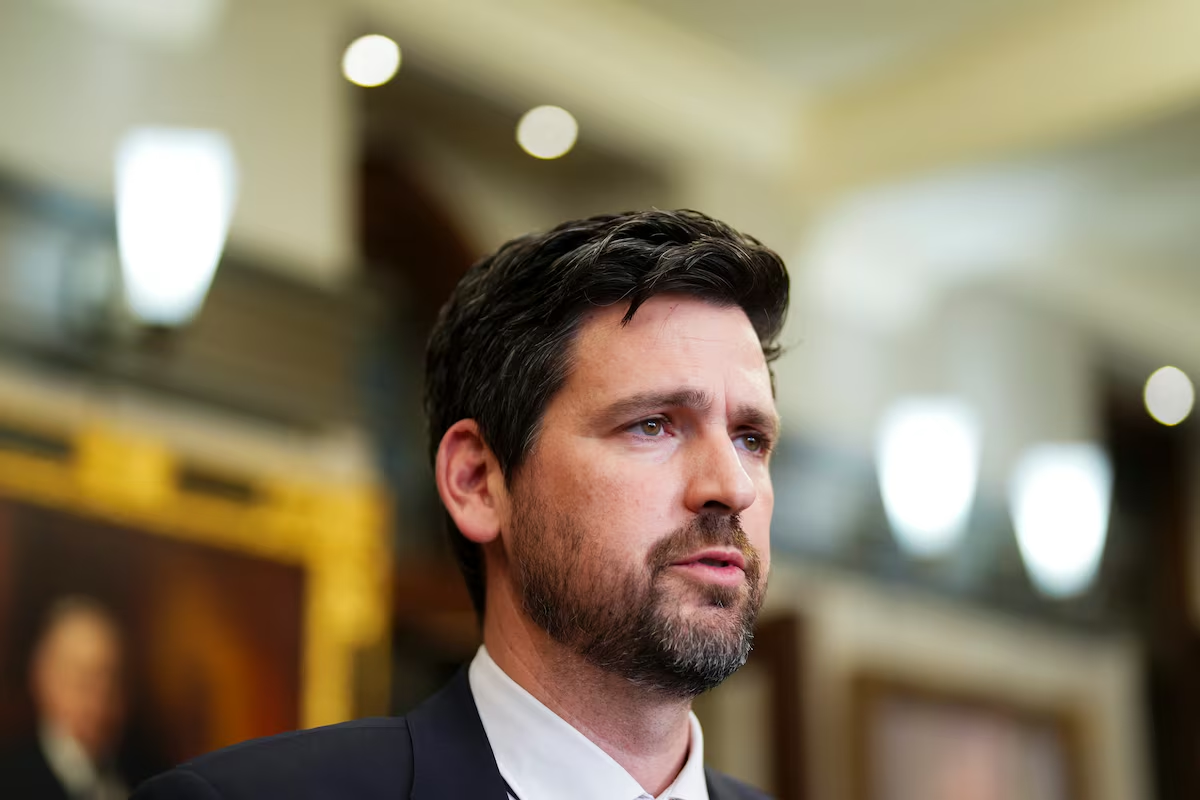

Open this photo in gallery:
Justice Minister Sean Fraser says the Liberals’ shift on crime is driven by concerns about public safety. ‘If people don’t feel safe, nothing else matters.’Sean Kilpatrick/The Canadian Press
Soothing piano music pulsed through the soaring atrium at Surrey City Hall. A sculpture, 800 aluminum birds suspended from the ceiling, floated above.
Then the police arrived, several of them heavily outfitted. They framed a midday news conference last week featuring federal Justice Minister Sean Fraser. The sign affixed to the podium read: “Stricter bail, tougher sentences.” Eleven police officers flanked the minister.
Surrey City Hall marked the end of Mr. Fraser’s cross-country tour to promote the federal government’s tough-on-crime shift under Prime Minister Mark Carney. A series of three bills, helmed by Mr. Fraser, made it through Parliament in June. The array of changes to the Criminal Code were wide-ranging. They include making it harder for repeat offenders to get bail if arrested, toughening measures on violence against women, and taking on hate crimes.
It’s a political comeback for a 42-year-old Justice Minister whose run in Ottawa seemed like it had sputtered to a deflating end 19 months ago as Justin Trudeau’s decade in power was coming to a conclusion.
The new bail and sentencing rules came into force July 15. Most of the rest of the Criminal Code overhaul is official on July 18.
The bills are a central pillar of Mr. Carney’s remaking of the federal Liberals.
The raft of changes led by Mr. Fraser responded directly to provincial calls for what Ottawa should do, from the NDP in British Columbia to Doug Ford’s Progressive Conservatives in Ontario.
Mr. Fraser argues that the tough-on-crime shift delivers what many Canadians want, as violent crime has escalated over the past decade.
“We heard loud and clear from Canadians that they want to see action,” Mr. Fraser said at the Surrey City Hall podium.
Open this photo in gallery:
Mr. Fraser speaks during a news conference after Bill C-14, the Bail and Sentencing Reform Act, received royal assent.Justin Tang/The Canadian Press
But some experts counter that the push to jail more people will not achieve the goal of increased public safety. And even before the tougher bail rules the number of people denied bail and held in custody ahead of their day in court was already at the highest levels on record.
The Justice Minister spoke, as he often does, without notes. He honed an ease with public speaking in a bustling home that his father built near Shore Road in Merigomish, a speck of a community on the Northumberland Strait, not far from New Glasgow in Nova Scotia’s Pictou County.
At Surrey City Hall, Mr. Fraser spoke of how developing the legislation was the most collaborative process he had seen in a decade-plus in politics.
“To see three new bills actually become law,” Mr. Fraser said, “is meaningful change that has moved more quickly than any other policy.”
In late 2024, Mr. Fraser’s political career in Ottawa was over, or at least on a long pause.
In 2015, four months after he turned 31, Mr. Fraser had won a seat in the House of Commons from the Nova Scotia riding of Central Nova, propelled to Ottawa on Mr. Trudeau’s wave. After the 2021 election, Mr. Fraser became immigration minister, as the Liberals rapidly welcomed more newcomers, but the surge produced negative effects.
While Mr. Fraser was not singularly to blame, Ottawa oversaw the unravelling, and various mistakes rocked the government. The price to rent an apartment surged and Canadians’ long-standing support for immigration plunged.
Ottawa calls on provinces to enforce new, stricter bail laws
In mid-2023, the then-prime minister moved Mr. Fraser to the housing portfolio. By December, 2024, the Trudeau government in tatters, Mr. Fraser departed to spend more time with his young family. Soon after, however, he endorsed Mr. Carney’s leadership bid. In March, 2025, the new Prime Minister called. Mr. Fraser returned to politics. After the Liberals won, Mr. Carney installed him as Justice Minister.
The Liberals’ election platform included various pledges that served as general scaffolding for Bill C-9 (hate crimes), Bill C-14 (bail and sentencing), and Bill C-16 (violence against women and other issues).
Advocacy groups, from the Canadian Civil Liberties Association on the left to the Canadian Constitution Foundation on the right, criticized numerous aspects of the bills.
On hate crimes, more than three dozen groups warned that the bill’s “vague language could be used to criminalize peaceful protest.” On bail, the Civil Liberties Association cited a lack of data to support the changes. Cracking down on violence against women garnered support but other C-16 provisions, such as proposals to address trial delays, stoked worries among some experts.
But political support from the provinces was solid.
At Surrey City Hall, B.C. Attorney-General Niki Sharma stood alongside Mr. Fraser. In an interview, she recalled the many letters she had dispatched to Ottawa calling for specific changes in the Criminal Code. One ask, after a high-profile murder in B.C. a year ago, centred on how bail should be more easily revoked after a person is convicted but before they are sentenced.
Ms. Sharma said Mr. Fraser focused on listening. “There was a curiosity there,” she said.
Open this photo in gallery:
With three big bills passed and coming into force this week, Mr. Fraser now faces the challenge of helping make Ottawa’s latest decision on medical assistance in dying.Adrian Wyld/The Canadian Press
Ontario Attorney-General Doug Downey is the veteran among his provincial colleagues, in the role since mid-2019. Talks on crime policy in part started directly between Mr. Carney and Mr. Ford. Mr. Fraser, with a green light from his boss, picked up the phone and called Mr. Downey. Mr. Fraser also started speaking with police across Canada.
“It was a distinct change in the conversations,” Mr. Downey said in an interview.
Critics such as the Civil Liberties Association feel the police perspective received undue weight in the writing of Bill C-14, but it was, without doubt, a pivot in the federal Liberals’ approach.
Clayton Campbell, president of the Toronto Police Association, has said talks last year were the first with the governing Liberals on criminal justice since he joined the country’s largest police union in 2018.
“They were surprised,” Mr. Fraser said of police when he first made his calls a year ago, reflecting on the legislation in an hour-long interview with The Globe and Mail.
Mr. Fraser’s calls – “I like talking to people, and I like talking to people who I don’t always agree with” – included advocacy groups and other experts, alongside the provinces and police.
Restoring mandatory minimum sentences counts among the most explicit Liberal reversals. Setting minimum punishments was a hallmark of former Conservative prime minister Stephen Harper’s approach to crime.
Peter MacKay is skeptical. Like Mr. Fraser, the former Conservative justice minister under Mr. Harper has deep roots in Pictou County. He was MP there from 1997 to 2015. His decision in mid-2015 to retire from federal politics opened a door for Mr. Fraser. Their kids these days go to the same school.
Mr. MacKay declined to comment on Mr. Fraser but questioned what he called the Liberals’ “conversion on the road to Damascus” and argued that the “half measures” will not do enough to address the issue.
Opinion: Politicians can’t seem to make a clear decision on MAID, so let’s leave it to the Supreme Court
Asked about the Liberals’ new tack on crime, Mr. Fraser cited “a political imperative,” because rivals in Ottawa and various provinces “had turned their guns on the party that I’ve been a part of.” But he insisted it was about listening to Canadians and their obvious concerns about public safety.
“If people don’t feel safe, nothing else matters.”
The Fraser family history in Canada stretches back a quarter-millennium. The Ship Hector, in 1773, brought about 170 Scots to Pictou’s shores. There were some 20 Frasers aboard. Mr. Fraser’s family has mapped their direct lineage to within a decade of the Hector. Mr. Fraser grew up not far from where the ship landed and still lives nearby.
His childhood family home, where he was one of six kids, always bustled. He played the bagpipes and basketball.
A life in politics started young, vice-president of the school environment club in Grade 2. His mother Sally, a teacher, had him reading scripture at church each Sunday. A quick wit sharpened among friends: “We just make fun of each other relentlessly.” And in a place where dozens of cousins lived and neighbours always visited, the Frasers’ kitchen table mirrored a sort of a mini-Parliament.
“Nobody ever used notes,” Mr. Fraser said.
In 2015, when he was first elected, his mom gave him a 1966 silver dollar. She won it in grade school for public speaking. He has kept it in his wallet ever since. Fellow MPs in 2021 voted him best orator in the Commons in a Maclean’s annual survey.
With three big bills passed and coming into force this week, Mr. Fraser now faces the challenge of helping make Ottawa’s latest decision on medical assistance in dying. He briefly welled up with emotion as he recalled the end-of-life experiences of parents of a friend. He also noted other perspectives on the issue.
“This is a heavy one,” he said.
There has also long been chatter about his political future. A lot of people back home see him as the next Liberal premier of Nova Scotia, but an election there is a few years away. And the Justice Minister’s eyes are squarely pinned on the job he has.
As his cross-country tour concluded, Mr. Fraser said this finish line is a starting line. Success, such as declining crime rates, is measured in the years to come.
“It feels good to get a piece of legislation done,” he said, “but it’s forward progress more than mission accomplished.”