
Open this photo in gallery:
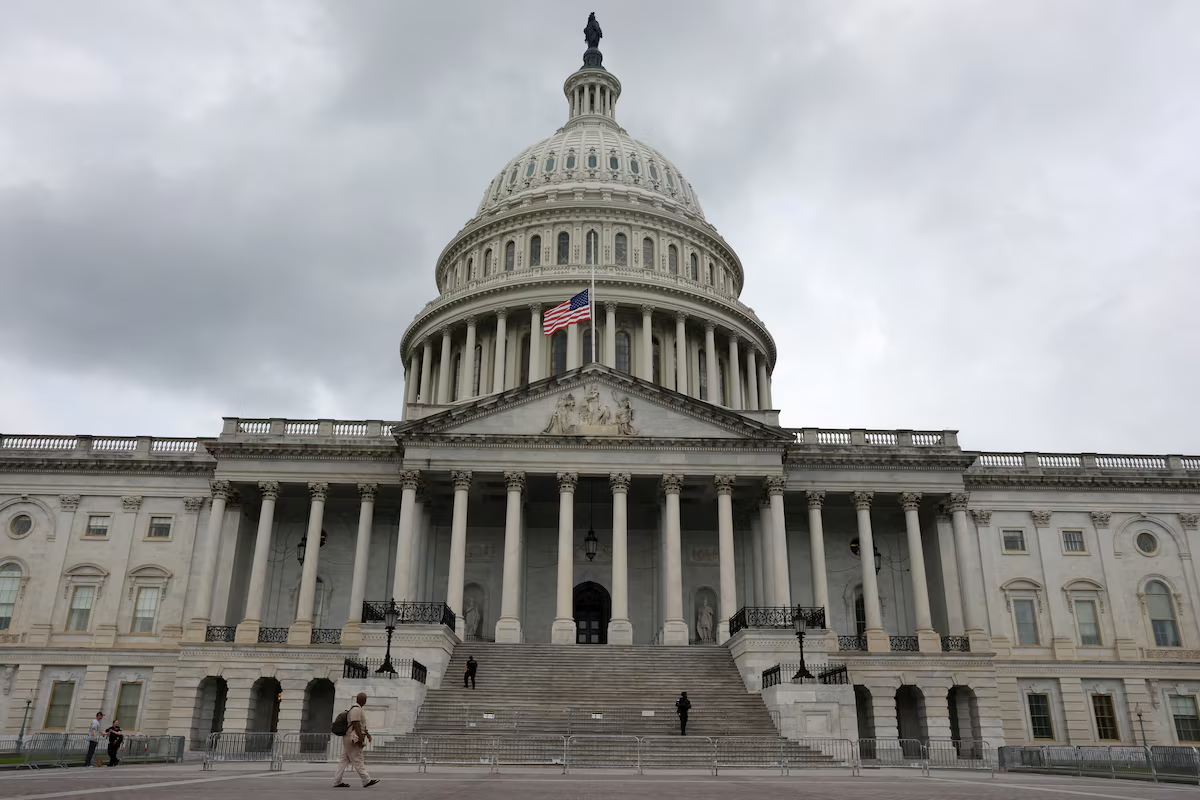
Former senior CSIS intelligence officer Dan Stanton told a Capitol Hill briefing that foreign states are using criminal organizations to target diaspora groups because it gives them plausible deniability.Leah Millis/Reuters
A former senior CSIS intelligence officer warned U.S. congressional representatives and staff in Washington Tuesday that foreign states such as India are increasingly using transnational criminal groups to outsource surveillance, coercion, intimidation and lethal violence.
Dan Stanton, who spent 32 years in Canada’s spy agency and is now director of the national security program at the University of Ottawa, told a Capitol Hill briefing that this country’s experience with transnational repression shows hostile countries are using criminal organizations to target diaspora groups because it gives them plausible deniability.
Mr. Stanton’s remarks to U.S. politicians and their aides come a week after U.S. officials and the head of the RCMP announced a series of charges and arrests across three prominent India-based gangs – including the leaders of the Bishnoi gang, which authorities say ordered the assassination of B.C.-based Sikh separatist Hardeep Singh Nijjar three years ago.
CSIS increases operation to combat Iranian state-directed activity, warns of continued threats
Mr. Nijjar’s death sparked a diplomatic fallout between Ottawa and New Delhi, after then-prime-minister Justin Trudeau told Parliament in 2023 that there was credible evidence Indian government agents had orchestrated the killing.
In 2024, the Mounties warned that Indian government agents were linked to multiple homicides, extortions and other violent criminal activities, and Ottawa expelled India’s high commissioner and five other diplomats. In May, CSIS said India remains one of the main perpetrators of foreign interference and espionage in the country.
India has denied any role in the Nijjar plot, and refuted allegations it’s involved in transnational repression or interference in Canada. Prime Minister Mark Carney, trying to expand trade with the country of 1.4 billion, said he raised Canada’s concerns about foreign interference when he met with Prime Minister Narendra Modi in New Delhi in March.
A 2024 U.S. Department of Justice indictment accused an Indian government intelligence officer, Vikash Yadav, of using hired gunmen to arrange Mr. Nijjar’s killing, as well as a failed plot against his New-York based lawyer. India now says Mr. Yadav was a “rogue operative” who has gone missing and can’t be extradited to the U.S. to face prosecution.
Opinion: How Ottawa can help local elections officials defend against foreign interference
U.S. investigators say the gunmen sent Mr. Yadav a video of Mr. Nijjar’s dead body, as proof of his killing, which he then shared with Nikhil Gupta, who he had hired to arrange the assassination of lawyer Gurpatwant Singh Pannun. Mr. Gupta had pleaded guilty in that plot and is to be sentenced in September.
The Globe and Mail previously reported that Canadian national security officials were presented with evidence that Indian consular staff in Vancouver supplied information to assist in the assassination of Mr. Nijjar, a man India labelled a terrorist for his role in a campaign to create a breakaway state in Punjab called Khalistan.
Mr. Stanton told The Globe that relying on plausible deniability offered by gangs is part of the same playbook used by states such as Iran, Russia and China when they seek to suppress their critics living in Western countries.
“I just want to signal that this is a growing problem, and India is one of the main actors,” he said. “The ones doing the really messy, dirty work have a certain criminal history, and so when they’re caught, the state that’s behind it, or their intelligence service, has that firewall because they can say, ‘They’re just criminals.’”
Mr. Stanton, speaking as part of a panel that include Representative Jim McGovern and U.S. national security experts, offered the only Canadian perspective in the room. He told the crowd that when he began working in counterintelligence, it was a world of spies and double agents. Today, countries have to defend against the new threat of transnational criminals, who sometimes wittingly or unwittingly do the work of foreign powers, he said.
“The problem is that our institutions in Canada are still organized for a world where espionage and organized crime were separate disciplines,” he said. “Today they’re increasingly intertwined, requiring police and intelligence agencies to operate across legal authorities and mandates that were never designed for this kind of hybrid threat. That’s the intelligence and law-enforcement challenge of our time.”
India began a more aggressive approach to national security following the 2008 Mumbai terrorist attacks, he said. Under Mr. Modi, the country has concluded that extradition and international legal processes are inadequate, and it increasingly embraced the “direct neutralization” of those it regards as terrorist threats outside its borders, he said.
Ex-government scientist accused of copying work files to further new career in China
Canada, along with the U.S., has been slow to recognize this shift, and needs to understand how serious of a problem foreign interference inside our borders has become, he said.
“We’ve done everything we can with terrorism, espionage, political interference and cyberthreats, but we really, our governments and countries haven’t really done much in terms of addressing transnational repression,” he told The Globe.
Mr. Pannun, a close associate of Mr. Nijjar’s in the campaign for an independent Khalistan, said last week’s indictments of Indian gang members don’t absolve India of involvement in the murder-for-hire plots, even though they were silent on any government involvement. He called for international sanctions against the Indian state.
“The Bishnoi indictment cannot be viewed in isolation. It must be read together with the U.S. murder-for-hire prosecution targeting me. Together, these two cases strip away all plausible deniability, exposing the lethal, dual-track transnational assassination apparatus operated by the Indian government,” he said in a statement.
“Justice cannot stop with the jailed gangsters, the triggermen, or the intermediaries. The trail of evidence leads directly to the highest echelons of the Indian government.”