
Open this photo in gallery:
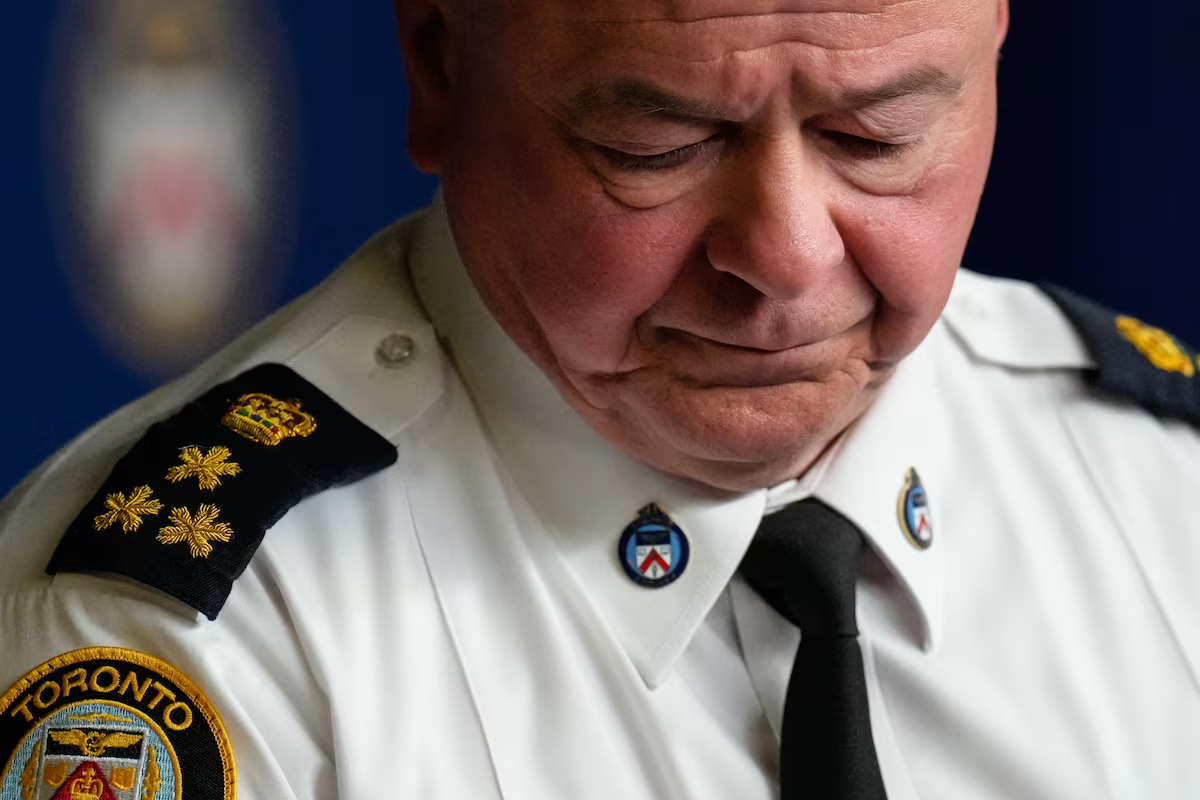
Toronto Police Chief Myron Demkiw holds a news conference in response to the weekend shooting at a Toronto street festival, on Monday.Chris Young/The Canadian Press
City officials in Toronto are calling for stricter punishments to stop and deter gang violence in public spaces, measures they say will go further than spending more money on security at street festivals like the one disrupted by gunfire that killed two men over the weekend.
But long-standing evidence on crime, punishment and deterrence indicates stricter punishments do not reduce crime, say experts who have studied the issue for years. Instead, they say, calls for longer sentences avoid the unaddressed root causes of gun violence.
Toronto deputy mayor Mike Colle on Tuesday said that while spending money on security of street festivals could help, only stricter punishments will stop and deter “gun gangsters” from violence in public spaces.
Toronto police identify victims of deadly shooting at Salsa on St. Clair festival
“Unless we deal with these criminal actors and put the fear of God in them, we’re not going to be able to stop these random gunfights, which criminals like engaging in,” Mr. Colle said in an interview.
Mr. Colle’s view echoes that of Toronto Police Chief Myron Demkiw, who on Monday urged the federal government to classify any shooting that kills someone in a crowded area as a first-degree murder. Justice Minister Sean Fraser declined comment because of the active police investigation.
On Saturday at around 8 p.m., gun violence shattered the buoyant vibes at the Salsa on St. Clair festival. A crowd numbering upwards of 13,000 people scrambled for safety amid the cracks and echoes of gunfire on a hot summer evening.
Two men – Shaquan Quashie, 25, and Cesar Vernaza, 20 – were killed in a targeted shooting, Chief Demkiw said Monday. Five other people, including bystanders, were injured. Police found two guns at the scene.
Open this photo in gallery:
People embrace during a vigil for healing following the weekend shooting.Cole Burston/The Canadian Press
Toronto Police have not yet issued any information on potential suspects. On Tuesday, spokeswoman Stephanie Sayer said there were no further details.
Records obtained by The Globe and Mail from the Ontario Court of Justice in Toronto show Mr. Quashie and Mr. Vernaza, both of whom lived in the Pelham Park Gardens area of Toronto, have made appearances in criminal court.
Court records say that Mr. Quashie was swept up in a 2021 Toronto Police-led takedown known as Project Red Owl. That bust resulted in the arrest of nearly 30 people following extensive police wiretapping that set up co-ordinated searches for weapons and drugs.
In 2024, Mr. Quashie pleaded guilty to possessing a prohibited firearm that he knew was unauthorized. A lawyer who represented him in that case told The Globe that his client was the bycatch in the 2021 raids, a young man found with a gun after being caught up in recurring cycles of violence.
“That was for protection because he had been shot previously,” lawyer Alonzo Abbey said on Tuesday. “He was not a main target, and most of his stuff he was involved in is petty crime, nothing major.”
Mr. Abbey said that his former client had a difficult life that he was trying to piece back together after time served at the Toronto South Detention Centre, where the conditions are notoriously bad.
Community reeling after deadly Toronto festival shooting at Salsa on St. Clair event
Court records show that after Mr. Quashie pleaded guilty to the gun charge, he was given the equivalent of a two-year sentence and a lifetime weapons ban. Despite this, during his time before the courts, he was charged with possessing weapons, including a “shank” (an improvised handheld weapon) and also a “spring-loaded knife.”
Ontario Court of Justice records show that Cesar Vernaza-Vinces, who turned 20 last October, also hailed from Pelham Park Gardens. He had faced several counts of possessing cars obtained by crime including a Honda Civic and an Acura RDX. He pleaded guilty to one of the offences he was charged with and received two years probation in January, 2025.
Mr. Vernaza-Vinces’s lawyers were not immediately available for comment.
On Tuesday, Toronto Mayor Olivia Chow said in a statement that people who fire guns in a crowded area such as a street festival should “face the maximum penalty under the law.”
Violent crime in Canada has been on the rise since the mid-2010s, according to Statistics Canada, and as of 2024 it was at about the same level as 2006.
In a news conference on Monday, Chief Demkiw noted shootings in the city were down by more than 25 per cent compared with the same time last year.
The mandatory minimum punishment for first-degree murder, established 50 years ago, is a life sentence with no chance of parole for 25 years. First-degree murder is a planned and deliberate killing. The Criminal Code also classifies other murders as first-degree. These include killing a police officer or murder during the hijacking of a plane, a sexual assault, or a kidnapping.
Chief Demkiw said his proposal would “act as a strong deterrent to perpetrators and recognize society’s condemnation of such reckless, egregious crimes.”
Opinion: We can’t lock down street festivals. But we can do more to lock up losers with guns
Many experts disagree. They point to years of research that shows stricter punishments do not deter crime. A 2012 book on sentencing described “one of the most striking paradoxes” in sentencing: While stricter punishments are continually proposed to improve public safety, and serve as a pillar of criminal justice policy, empirical evidence of reduced crime is “almost entirely lacking.”
Debra Parkes, a law professor at the University of British Columbia, described the Toronto shootings as horrifying. “We all want to prevent such killings from happening,” she said.
But of Chief Demkiw’s call, Prof. Parkes said it “flies in the face of the evidence about sentencing severity and deterrence.”
Hilary Dudding, a criminal defence lawyer at Toronto-based Daniel Brown Law LLP, said it is tempting to respond to high-profile tragedies with a proposal such as Chief Demkiw’s. But she said it misses root causes of gun violence, such as better job prospects and education for young people that might otherwise be drawn into crime.
Ms. Dudding also said current provisions in the Criminal Code already could merit a first-degree murder charge for “a shooter who plans to kill a specific person and who then shoots bystanders in a crowd.”
Chris Rudnicki, a Toronto criminal defence lawyer at Rudnicki and Company, noted other problems such as the availability of guns.
“These are complicated issues,” he said, “and not terribly well suited to soundbites.”