
Open this photo in gallery:
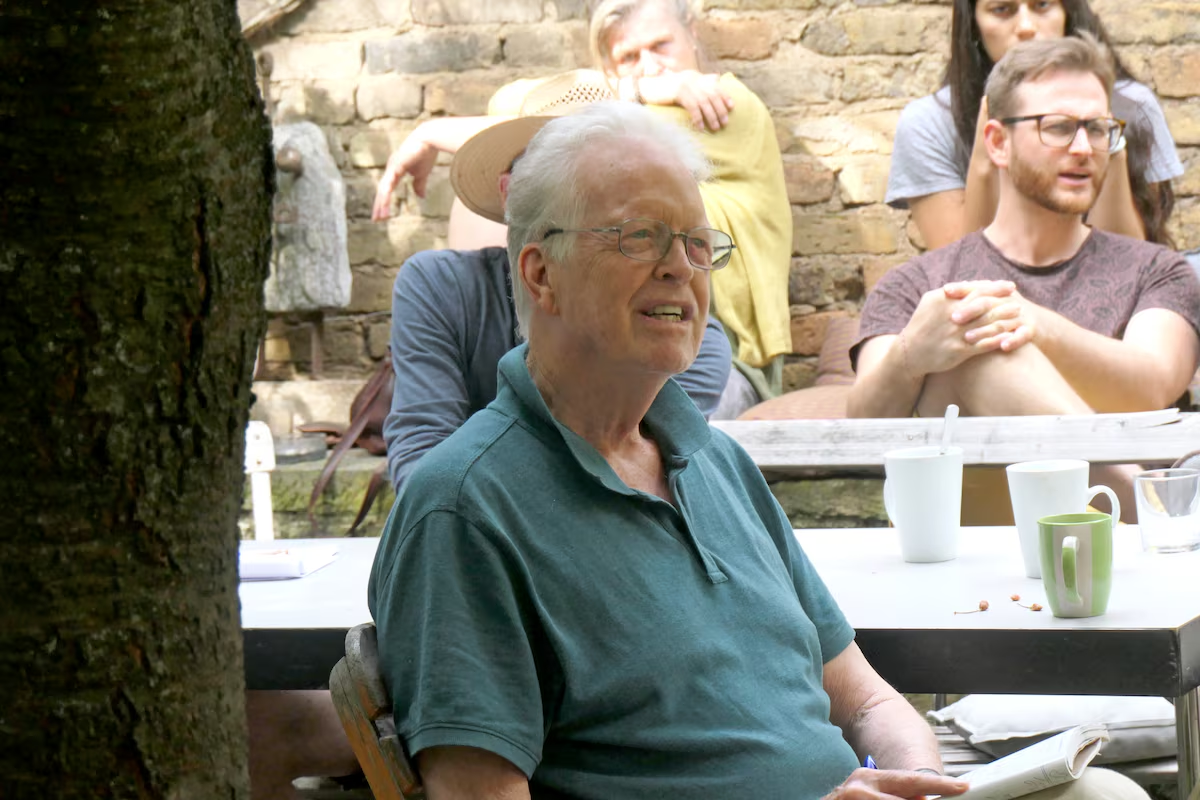
David Cayley in Friesenheim, Germany in June, 2024.Babette Babich/Supplied
He was a true intellectual, with bottomless curiosity about every subject, asking the big questions, digging deep into complex issues and delighting in the task.
David Cartwright Cayley found his calling in creating four decades of eye-opening radio programs for the CBC Radio program Ideas. He died at his Toronto home of a sudden heart attack on June 10 while playing his guitar in a bluegrass jam group with friends – a weekly ritual.
Bernie Lucht, executive producer of Ideas from 1984 to 2012, worked closely with Mr. Cayley and recalled: “He had a capacious, original and inquiring mind, a radical mind in the sense that he always wanted to get at the root of things. He read a huge amount of stuff and kept handwritten notes on what he read.
“He worked differently from other Ideas producers, who did a lot of supervising and editing of work by freelance contributors; David did not do that,” Mr. Lucht said. “I thought he was too valuable. I wanted him to produce only his own stuff.”
He created series about diverse subjects including education, modern medicine, the destruction of forests, how to think about science, the politics of information, the corruption of Christianity and alternatives to incarceration in the justice system.
He circled back repeatedly to the work of Ivan Illich, the ex-Catholic priest, theologist and critic of modernity, who became his friend, guide and teacher as well as the subject of many Ideas episodes. He also conducted erudite interviews with deep thinkers such as literary critic Northrop Frye and philosopher George Grant. Mr. Cayley spun some of those conversations into books, and wrote others focused on ecology, the criminal justice system and, last year, the history and decline of the CBC.
“He was very high-minded,” recalled Richard Handler, another long-time CBC colleague and friend. “He was always working; you couldn’t distract him. He also loved sports, the Blue Jays and the Maple Leafs.”
Mr. Cayley was born in Toronto on March 26, 1946, into an Anglican family that took both religion and education seriously. His father Edward Cayley, an English teacher, was a submariner with the Royal Canadian Navy in the Second World War until he was sidelined by painful injuries. In England, he met his wife Margaret Noble, and brought her back to Toronto as a war bride. David was the eldest of their three children.
Open this photo in gallery:
David Cayley was born in Toronto on March 26, 1946.Babette Babich/Supplied
The marriage did not last. After his parents divorced, David Cayley’s mother returned to England. His father taught English literature at Trinity College School in Port Hope, Ont., in the early 1950s, and this was where Mr. Cayley started his education (children of faculty enjoyed reduced tuition). Later, when his father was hired to teach at Holderness, a prep school in Plymouth, N.H., that readied students for Ivy League colleges, David – already a big reader – went with him. After graduating from Holderness at 16, he studied literature at Harvard, obtaining his BA at 20.
Back in Toronto, inspired by the idealism of the sixties, he volunteered to join Canadian University Service Overseas (CUSO), which sent him to the eastern Malaysian state of Sarawak as a volunteer teacher in a Chinese middle school. During his two-year stay, he met another volunteer, Mary Breen, who became his first wife and mother of his elder daughter Rachael. But like many of his fellow volunteers, he was troubled by the experience of life in a poor, developing country where his activities might do unintended harm to a traditional society.
Returning to Toronto, and separated from Mary, he moved into a commune on Major Street and took a job with Oxfam. The commune of friends, several of whom had also served in CUSO, organized a big teach-in under the title “Crises in Development” and invited Austrian-born theologian Ivan Illich to give the keynote speech. To their surprise, he accepted the invitation, and showed up for dinner one night from Pennsylvania, where he happened to be a visiting prof. Like his young hosts, he sat on mattresses covered with Indian bedspreads to eat, since there were no chairs.
After the commune ended in 1973, Mr. Cayley spent several years in Vancouver, where he was producer of the local morning show on CBC Radio while remaining a supporter of progressive causes.
In 1975, Leonard Peltier, a member of the American Indian Movement in South Dakota, was accused of killing two FBI agents and became a fugitive. After crossing the border into Canada, he was arrested by the RCMP in Alberta, and sent to Oakalla Prison Farm in Vancouver to await extradition to the United States. When his program expressed support for Mr. Peltier and the American Indian Movement, Mr. Cayley was accused of lack of objectivity and fired by the CBC. He returned to Toronto as a freelancer and joined the Ideas staff a few years later.
Mr. Cayley rarely went to church but identified as a Christian all his life. He became a close friend to Mr. Illich, who distanced himself from the Church after the Vatican put him under investigation – he had criticized Catholic missionaries in Latin America for failing to support traditional agricultural practices.
In 1980, Mr. Cayley married Jutta Mason, a midwife and community activist. In each of his books, he thanked her for helping him clarify his ideas. After the couple had three children, Kate, Luke and Daniel, they embraced Mr. Illich’s arguments that children be free to determine their own education outside of a classroom, outlined in his best-known book Deschooling Society.
“The children were mostly unschooled,” recalled Ms. Mason. “David read to them a lot and there was quite a bit of conversation.” The children could decide to go to a regular school or not, and both boys chose to attend a regular high school. “I went to university. We all did,” said Kate Cayley. “A couple of times a year we had visits from the educational authorities to check up on us.”
Of Mr. Cayley’s 10 books, Ivan Illich: An Intellectual Journey, published in 2021 by Penn State University Press, is possibly his most lasting literary achievement.
Mr. Cayley’s radio programs and books helped spread Mr. Illich’s fame to Europe. Said Dougald Hine, a British writer who lives in Sweden: “CBC Ideas was never broadcast in Europe, but recordings and transcripts of David’s programmes – especially the two series with Illich – were circulating online in the mid-2000s, when I discovered Illich’s work.”
Sajay Samuel, a professor at Penn State and long-time friend of Mr. Cayley’s, said his book brought “worldwide attention” to Mr. Illich’s thinking, which also argued in favour of traditional gender roles and critiqued modern medical care.
“The hardback sold out its first print run of 1,500 copies – an unusual feat for a book from an academic publisher. The paperback edition continues to enjoy robust sales,” said Prof. Samuel. “For now, it is the definitive account of Ivan Illich’s thought. It is available in or being translated into all the major European languages”
It has fuelled a mushrooming interest in Mr. Illich, who died in 2002. This year, hundreds gathered for meetings to discuss his philosophies in Italy and France, with Mr. Cayley invited as a featured speaker.
Mr. Cayley was predeceased by his first wife Mary Breen, and is survived by his wife Jutta Mason; sisters Susan Ladipo and Jane Foulds; daughters Rachael and Kate; sons Daniel and Luke; and seven grandchildren.
You can find more obituaries from The Globe and Mail here.
To submit a memory about someone we have recently profiled on the Obituaries page, e-mail us at obit@globeandmail.com.