
Care Between the Lines is a summer series, which will introduce you to volunteers in health care who fill gaps and provide compassion in a system that can be isolating and scary.
Carol Pang, 101, sitting on a bike beside Beaver Lake, a quiet oasis in the middle of Vancouver’s Stanley Park, slowly leans back her head, closes her eyes and smiles broadly, listening to the bird songs and enjoying the sunshine on her face.
The bike is actually a trishaw, a three-wheeled bicycle that holds two passengers, and it’s piloted by a volunteer with Cycling Without Age, a charitable group that takes seniors from care facilities on recreational rides.
Ms. Pang and a handful of fellow residents from nearby Haro Park Centre take turns on the excursion once a week. Just minutes earlier on an afternoon in June she was loaded from her wheelchair to the trishaw with the help of a lift and flurry of activity from staff and volunteers.
Open this photo in gallery:
Cycling Without Age volunteers and their passengers take a break from the ride to enjoy the view in Vancouver’s Stanley Park.
“This is a remarkable program. The residents love it,” says Allan O’Meara, Haro’s Joy and Laughter co-ordinator. “Everyone pitches in because we get rewarded with smiles.”
More than 200,000 Canadians live in long-term care homes. They get around-the-clock medical care, as well as recreational programs. But many residents live in isolation, and few ever get outside.
Programs like Cycling Without Age are not traditional health care, but help fill a not-always-visible gap by adding more richness to life in people’s final months and years.
Open this photo in gallery:
Haro Park residents Margaret Steegra, left, and Carol Pang go for a ride with Cycling Without Age pilot Wendy Wortsman.
Cycling Without Age was founded in Denmark in 2012 by Ole Kassow, a Danish management consultant who had previously worked in a care home. On his daily commute to work, he would pass by a gentleman with a walker sitting on a bench outside a Copenhagen nursing home and wondered if people with reduced mobility missed cycling.
So, one day, on a whim, Mr. Kassow rented a trishaw, headed over to the facility, and offered to take anyone who wanted to for a ride. His first passenger, Gertrude, asked to visit the city’s port and, for the next hour, recounted stories about her youth in Greenland and her life in Denmark after the Second World War.
Later, Mr. Kassow would say the intimacy of the rides provide a bubble “where magic can happen,” especially for seniors who rarely venture out into the world any more.
He started making the rides regularly, and enlisted other volunteers. After Mr. Kassow’s TED Talk about Cycling Without Age went viral in 2014, chapters began to spring up all over the world. A single act of kindness morphed into a global movement.
The Vancouver group is one of 144 chapters of Cycling Without Age across Canada. Though the size and makeup of each chapter varies, volunteers uphold the organization’s five guiding principles: generosity, slowness, storytelling, relationships, and without age.
In Vancouver, two women, Jennifer Reid and Jennifer Chen, each reached out to start a Vancouver chapter, and Cycling Without Age urged them to join forces, which they did happily.
There are now 144 chapters of Cycling Without Age in Canada, part of a burgeoning network of 3,700 chapters operating 4,500 trishaws across 56 countries. The organization even has an online tool kit for those who want to start a chapter.
Every one of the groups is slightly different, many with just a single trishaw, but they must all adhere to five guiding principles: generosity, slowness, storytelling, relationships, and without age.
Cycling Without Age also takes its motto seriously: “The right to wind in their hair.”
Jake Winn, executive director of Vancouver’s Cycling Without Age Society, said the group’s goal is not so much to provide transportation as it is to promote active citizenship.
“A big part of our work is advocacy – promoting the importance of recreation and social connection for seniors,” he said.
Open this photo in gallery:
Jake Winn, executive director of Vancouver’s Cycling Without Age Society, says the group’s goal is to promote active citizenship and social connection.
Mr. Winn likes to highlight the feel-good aspects of the work, but notes there is a practical side too. “This work is as heartwarming as anything you can imagine, but we still need funding and support,” he said.
In Vancouver, Cycling Without Age is a registered charity with only two employees. It brings in just under $285,000 annually, a meagre amount, especially when you consider that each electric-assisted trishaw costs more than $25,000. They purchased four new bikes last year, bringing the fleet to 10, but still can’t keep up with demand.
And, no, though it is asked frequently, Cycling Without Age does not provide rides for tourists, or engage in any commercial activities.
They have two core programs: one where they partner with care homes, and another where they provide community rides to seniors on the weekend for a donation. Both focus on helping isolated seniors get out and about.
The organization also partners with TransLink, the regional transit authority, in support of their Seniors on the Move program, which helps seniors who no longer drive learn how to navigate public transportation. The collaboration, an initiative called “Seniors Ride to the Park,” shows participants how to use the transit system efficiently and safely, and the workshops culminate with a trishaw ride.
The money to run the organization comes from a combination of small and large donors and government grants, as well as donations from participating nursing homes.
Volunteers depart Haro Park Centre with residents of the care home safely on board the trishaws. Nearby, a chalk message scrawled on the sidewalk reads: ‘Older people deserve to be heard & included in our communities.’
Haro Park Centre, for example, pays about $4,000 a year. CEO Rob Gillis said it’s money well spent because the outings improve the lives of residents by getting them out into nature, and interacting with people in the community.
“Our goal is to give residents the best closing chapter possible of their lives, and this helps,” he said.
Mr. Gillis said residents return from the rides re-invigorated and happy. They also sleep better, and eat better afterwards. “It’s brilliant,” he said.
Research conducted in both Denmark and Canada backs up these observations, showing the trishaw outings boost the mood and well-being of participants significantly. Mr. Winn said the cycling outings are not about transportation, but about enhancing the health of participants by building relationships.
Open this photo in gallery:
Cycling Without Age pilot Beverley Biggs takes Sophia Ljezina and her 87-year-old mother, Maria Ljuljovic, for a ride.
Sophia Ljezina accompanied her 87-year-old mother, Maria Ljuljovic, on the outing to Stanley Park in June. “She loved the trees. She loved the flowers. It was a lot of fun for her,” she said.
The most striking part of an outing with Cycling Without Age, though, is the interactions between seniors and the volunteer pilots.
“Everybody has fascinating stories, especially when they’re 90 or 100,” said Robert Koll, a retired Air Canada flight attendant who has been a volunteer trishaw pilot for three years.
Memories are often triggered by riders’ surroundings, and the pilots, with their questions, become de facto tour guides down memory lane.
On the ride where a Globe and Mail reporter and photographer followed along, one of the passengers, Alonzo Munoz, 83, noticed horse droppings along the trail (Vancouver police have their stables in Stanley Park) and that led him to recount his career as a mounted police officer in Chile.
Haro Park’s Joy and Laughter co-ordinator Allan O’Meara rides along with Alonso Munoz, 83, as Cycling Without Age pilot Robert Koll steers them through the streets of Vancouver and through Stanley Park.
Mr. Koll said that he also loves that, when they ride through the city, passersby often wave and smile, and take the opportunity to interact with the seniors. Curiosity about the trishaw allows it to act as a bridge between seniors and the community.
What really keeps the organization going and growing is the commitment of volunteers.
“Volunteer pilots are the heartbeat of the organization,” said Mr. Winn, the Vancouver chapter’s executive director.
Last year, there were more than 250 applications for 50 volunteer positions.
The limiting factor for many wannabe volunteers is availability. Most of the rides are on weekday afternoons so two-thirds of volunteers are retirees who are themselves seniors.
The younger pilots tend to compete for a small number of weekend shifts. “Getting a Saturday shift is like scoring a ticket for Taylor Swift concert,” Mr. Winn joked.
The pilots undergo 15 hours of training that includes everything from bike handling to de-escalation techniques (because patients with dementia can sometimes become angry and disoriented).
“Rides are filled with rich conversation and a lot of laughter,” Mr. Winn said. “Ultimately, it’s about creating relationships.”
From May to October, Cycling Without Age volunteers take about 30 seniors for daily rides. Beyond the benefits of taking in fresh air and a change of scenery, the interactions between seniors and the volunteer pilots foster a sense of connection.
The Vancouver chapter takes out about 30 seniors daily, from May to October, in the city’s most scenic locales, including Stanley Park, Pacific Spirit Regional Park, Queen Elizabeth Park, Jericho Beach and the Seawall.
Every bike has a name, and a story. One is named “Jill,” in honour of the mom of one of the group’s founders. Another is “Happy Return,” the name of a sailboat owned by a donor.
Before each ride, pilots do a detailed safety check to ensure the battery is charged, tire pressure is good. The bikes have e-assist so the rides are not overly strenuous, but bike handling can be challenging when you have two passengers.
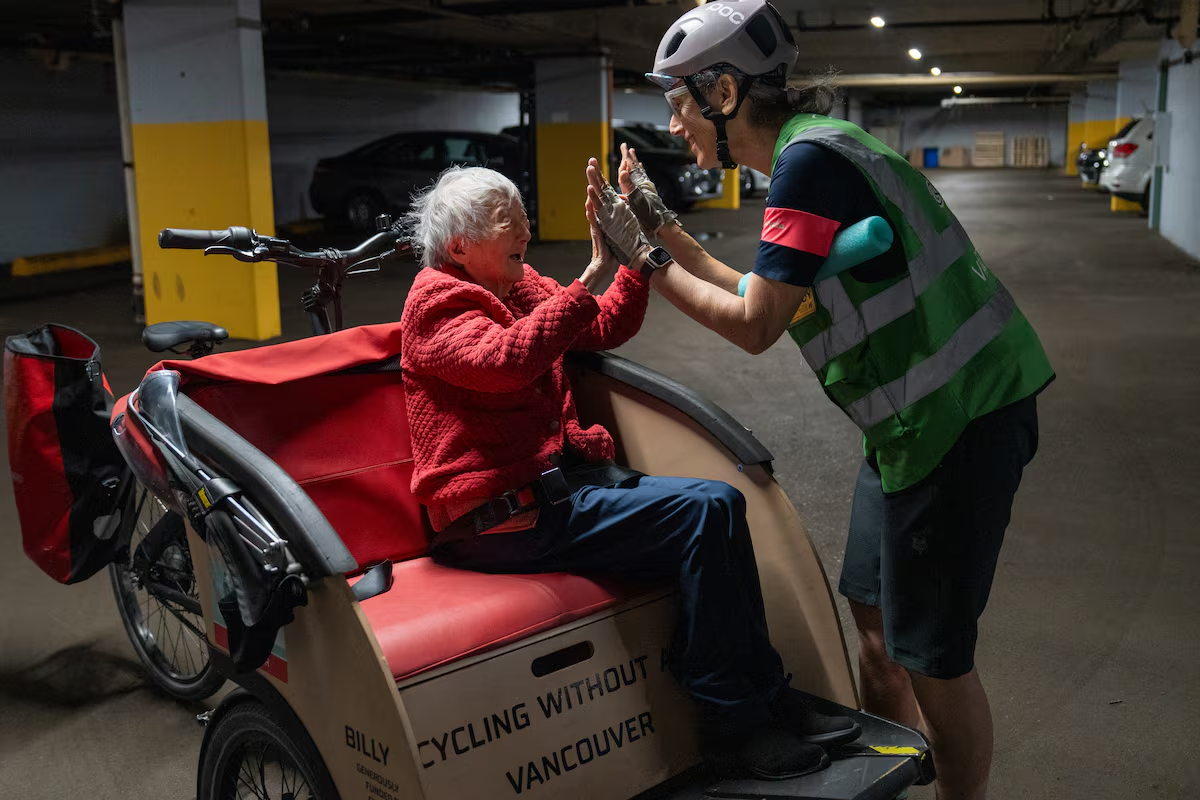
At the end of the ride on this day, the pilots returned to the Haro Park Centre, where staff helped residents get off the bikes. In the garage, where everyone was busy at work, there was a sense of elation.
As she was helped into her wheelchair, one of the residents, Lee Haines, asked: “When can we go again?” eliciting laughs all around.
Carol Pang no longer speaks, but she locked eyes with her volunteer pilot and pressed her hands together in a gesture of thanks.
Wendy Wortsman, the pilot who led her on the outing for the past hour, did the same.
Open this photo in gallery:
Carol Pang shares a moment of gratitude with volunteer Wendy Wortsman after returning from a ride on a sunny afternoon.
CARE BETWEEN THE LINES
In Saskatchewan, volunteer drivers go the distance to bridge rural health care’s transportation gap
Women’s Auxiliary Volunteers at SickKids bring warmth to patients and their families
At London Children’s Hospital, a ventriloquist and her puppets pull heartstrings