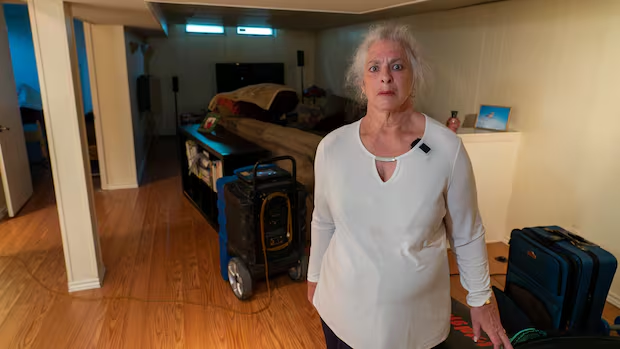
Margaret Cooper got a surprise on Canada Day when she stepped in a puddle of water on the vinyl floor of her basement in Ottawa’s Crystal Beach neighbourhood.
She ran to grab towels and returned to find “water coming from everywhere.”
“I thought I was going to have a heart attack,” Cooper recalled.
She joins more than 5,000 Ottawa homeowners whose basements flooded when at least 118 millimetres of rain deluged parts of Ottawa on July 1.
Cooper, 71, says the bungalow has been in her family for more than 50 years and had never suffered flooding before the intense Canada Day storm.
Now, she says dealing with insurance has compounded the stress of cleaning up the flood damage.
“It took everything I had to purchase [this house], so I wanted to make sure that nothing or nobody was ever able to take it from me,” Cooper said. “So I always had the maximum insurance that was available.”
I just really feel like I was lied to and cheated because I thought I had coverage for every possible water damage…– Margaret Cooper, Crystal Beach homeowner
Or so she thought. When an agent for belairdirect called her last week, she learned that her “enhanced water damage package” doesn’t cover groundwater flooding.
“She said, ‘I’m so sorry, but you get nothing because this is groundwater and we’re not covering it,'” Cooper recalled. “I just really feel like I was lied to and cheated because I thought I had coverage for every possible water damage … and I’ve been paying for it for years.”
 A dehumidifier sits in the basement of Cooper’s Crystal Beach bungalow about a week after it was flooded during the July 1 storm. (Francis Ferland/CBC)
Different kinds of coverage
Anne Marie Thomas, director of consumer and industry relations with the Insurance Bureau of Canada, says customers with basic home insurance likely won’t be covered for flooding damage from the Canada Day storm.
That’s because most home insurance policies cover water damage if the source is within the home — a burst pipe, a leaking refrigerator or a ruptured water tank, for example.
When it comes to exterior sources, however, most policies require additional coverage — leaving some homeowners high and dry.
Even with additional coverage, different kinds of flooding require different kinds of insurance coverage, Thomas explained.
For example, overland flood insurance covers damage from water that spills into people’s homes through doors and window wells when the ground is saturated. Backup insurance covers damage caused when the sewer overflows into a home’s basement.
Such coverage is typically listed as an additional purchase on most home insurance plans.
“Not everybody wants to purchase it,” Thomas said. “I personally wouldn’t go without it because these events are just becoming so much more frequent and so much more severe.”
 Flood-damaged furniture and other items sit piled in front of homes in Ottawa’s west end on July 7, nearly a week after the Canada Day downpour. (Justin Tang/The Canadian Press)
Groundwater flooding not included
Cooper’s “enhanced” policy covers sewer backup, overland flooding, and damage to exterior water and sewer lines, but excludes damage caused by groundwater flooding — when water seeps up through a home’s foundation and floor.
According to the educational charity Canada WaterPortal, distinguishing between overland flooding and groundwater flooding can be “difficult or even impossible, but the difference can be important for considerations such as insurance claims and mitigation techniques.”
Cooper showed CBC News an email from her insurer that stated an inspection of her home had determined that hydrostatic pressure forced water through visible cracks in her foundation following the heavy rainfall on July 1, and that there was no evidence of a sewer backup.
Cooper said she did not receive a copy of the inspection report, nor any proof that the damage to her basement was caused by groundwater flooding.
Belairdirect told CBC in an email that it could not comment on a specific file due to privacy requirements, but said generally its adjusters “review every claim carefully, based on the specific facts and circumstances, and in accordance with the policy wording.”
Cooper said she thought she was covered for the kind of damage her home sustained on Canada Day, and was angry to discover that she wasn’t.
She questions the point of paying for supplemental insurance coverage if people can still be left footing a big repair bill.
Costly foundation repairs
Kevin Butler, a senior associate with Tierney Stauffer LLP who specializes in insurance law, says he finds it problematic that insurers sometimes promise coverage for flooding damage and then deny it based on “some exception buried on the 45th page of the policy.”
“In those situations where what you think you’ve purchased isn’t what you actually receive, then that could give rise to potentially legal liability,” Butler said.
Alex Berezowski with The Foundation Experts said he’s never seen an insurer approve a claim for groundwater flooding since the Ottawa company was founded in 1995.
Berezowski said since Canada Day, he’s been fielding plenty calls from homeowners in the same situation as Cooper. He said groundwater flooding is most common in homes older than 25 years that sometimes have outdated or insufficient drainage systems.
“The only permanent solution is to address the problem at the source, which is at the exterior of the foundation,” he said.
Berezowski said foundation repairs needed to prevent groundwater flooding require excavation and can cost $20,000 or more.
 Workers remove flood-damaged items in Ottawa’s Bells Corners neighbourhood on July 6. (Jayden Dill/CBC)
Better to have coverage and not need it
Thomas said she’s seen a notable increase in the number of people adding flood-specific coverage to their insurance plans, including the cost of restoration and damage to personal property.
“It’s better to have the coverage and not need it than to need the coverage and not have it,” she advised.
Cooper said she cries herself to sleep thinking of families that could become bankrupt and lose their homes as a result of the flooding, and believes the provincial government needs to step in.
“This is a disaster that needs the government’s intervention because the insurance companies are doing absolutely nothing,” she said.
On Monday, Mayor Mark Sutcliffe signalled that the province was poised to deploy its Disaster Recovery Assistance for Ontarians (DRAO) program, under which homeowners, small businesses, farms and non-profits are eligible for as much as $250,000.
By Monday evening, the province issued a statement saying it will be activating DRAO for eligible areas that have experienced significant overland flooding.
Sutcliffe said last week he’s “very concerned” that residents impacted by the flooding are being denied coverage by their insurance companies, and is urging local lawyers to lend a hand.