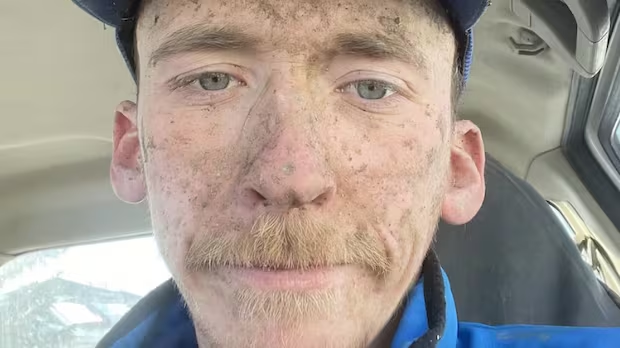
Three years after Liam Johnston was buried alive in a trench collapse while working on an excavation site in northwest Calgary, the company that employed him pleaded guilty to one of 11 charges they faced under Alberta’s Occupational Health and Safety Act.
On Monday, Justice Gordon Krinke accepted Mr. Mike’s Plumbing’s guilty plea to the charge of failing to ensure the health, safety and welfare of Johnston, who was killed on June 8, 2023.
The 10 other charges were withdrawn as part of the plea.
The company was found to have inadequate supervision at the excavation site on the day of Johnston’s death.
Court heard that the site was not properly shored at the time and a photo of one of Johnston’s co-workers in a dangerous position sent to a supervisor just minutes before the trench collapse did not raise any red flags.
“I have become painfully aware that coming home safely at the end of the day is not determined only by how hard someone works,” said Johnston’s common-law partner Emily Gofton in a powerful victim impact statement read aloud in court.
 Emily Gofton’s common-law partner Liam Johnston was killed in a trench collapse in 2023. (Meghan Grant/CBC)
The company agreed to pay $215,000 to the University of Alberta’s Injury Prevention Centre plus a $115,000 fine as part of a creative sentence jointly proposed by prosecutor Orysha Zahaylo and defence lawyer Christopher Spasoff.
Johnston’s parents joined via video conferencing from out-of-province.
“I don’t just grieve the past, I grieve the entire future that was taken away from us,” said Kim Ivison.
A lengthy agreed statement of facts (ASF) was filed as part of the plea but Justice Krinke refused to allow the media — and therefore the public — access to the document, which offers details about the hazardous location of the incident, the steps that were and were not taken by the company in the 24 hours leading up to the trench collapse, and the aftermath.
The judge did not give reasons for not allowing the document to be released and did not allow the matter to be addressed in court.
WATCH | Why employers often face fines when someone dies at work: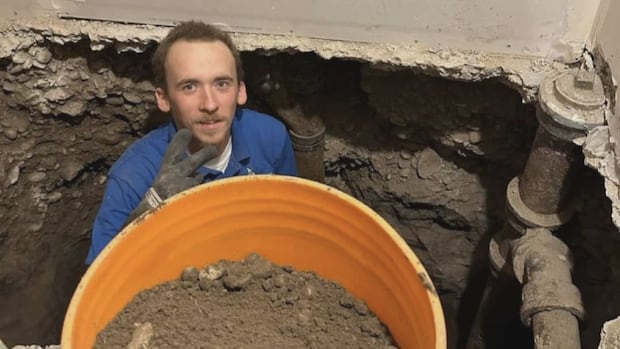
Why criminal charges are rare for workplace deaths in Canada
When a worker dies on the job in Canada, employers almost always only face fines. For The National, CBC’s Anis Heydari breaks down why criminal charges are so rare for workplace deaths and speaks to people who say more accountability would save lives.
Dangerous excavation
Before accepting the joint sentencing proposal from the Crown and defence, the court heard that in June 2023, Mr. Mike’s Plumbing was hired to replace sewer and water lines behind a home in the northwest community of Charleswood.
The work involved a team of four including a supervisor, a hydrovac operator, a labourer and Johnston, who was working as lead hand.
Although he had previously worked as an apprentice plumber, Liam had paused his apprenticeship to take on a higher paying position on the excavation crew.
The project was particularly dangerous and was complicated by a sloped site with deep lines. The team had also been instructed not to damage the homeowner’s retaining wall.
Difficult excavation
Court heard that on June 7, the crew supervisor left the site unexpectedly due to a personal matter, leaving Johnston as the senior worker.
Johnston contacted Mr. Mike’s owner Mike Brock to alert him to the difficult excavation.
An average dig to a water and sewer line in Calgary is 10 feet, said Zahaylo. In this case, the crew dug to 19 feet.
Brock attended the site, stayed for about an hour and told the crew not to enter the trench until it was shored.
‘Too deep’
By the end of the day on June 7, the team was still struggling to locate the sewer line. The excavation was so deep, extensions had to be placed on the hydrovac line.
Mid-morning on June 8, the excavation was 19 feet deep with straight cut walls.
The missing supervisor was, by this point, in touch via text message, asking for photos of the site.
In the minutes before his death, Johnston texted the supervisor that the dig was “too deep.”
12 hours to reach body
The supervisor asked Johnston for photos and received one image of another crew member standing on the wall in excavation but did not raise any kind of concern about the position of the worker.
Johnston then climbed down a ladder into the trench. Three or four seconds later, the site collapsed, breaking the ladder and burying Johnston.
It took Calgary Fire Department crews 12 hours to reach Johnston ’s body.
“If love could have saved Liam, he would have lived forever,” said Gofton. “I will spend the rest of my life carrying a love that has nowhere to go.”
Trench not properly dug
The medical examiner ruled Johnston died from traumatic asphyxiation.
An expert report prepared after the incident found that an appropriate slope requirement for the excavation would be greater than 45 degrees from its base which was not practical because it would undermine the home.
Instead, the excavation should have used vertical cuts with a shoring system or been widened with marginally sloped walls and a portable trench box.
Court heard that three months before the incident, three of the four workers on the project took a safety course on issues including shoring and installation, trench collapse and occupational health and safety.
The court found Mr. Mike’s failed to implement and enforce safety measures by failing to ensure that workers did not enter an excavation unless they were protected by shoring.
‘We failed as a company’
After Johnston’s death, court heard that Brock implemented additional safety measures including revising its excavation hazard process, providing more supervisory oversight and review and employee training.
Brock was in court for the plea and offered an apology when given the chance to address the court.
“I know nothing I can say today will lessen the pain and suffering of Liam’s family,” said Brock.
“We failed as a company to provide the supervision and verification required … I remain committed to ensure the lessons continue to shape how our company operates.”