
Open this photo in gallery:
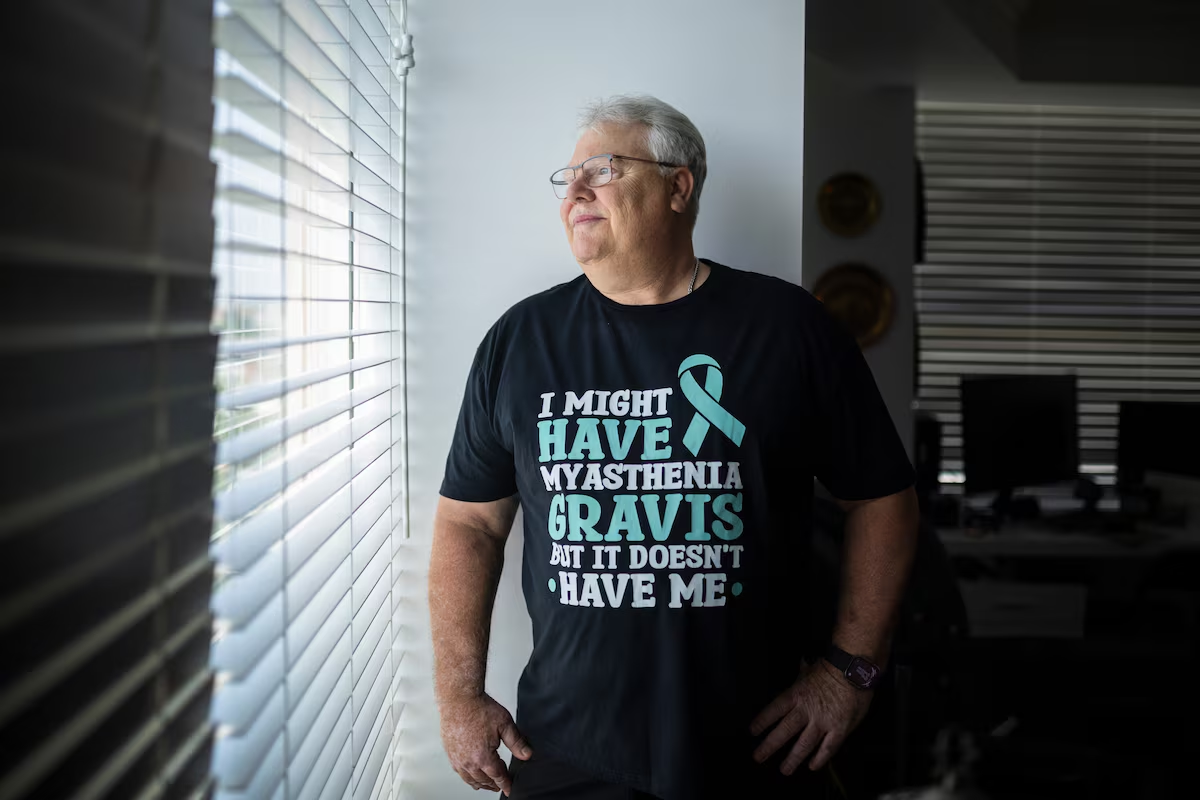
Bill Willard, who was taking a plasma-derived drug called immunoglobulin to treat a neuromuscular condition, is pictured at his home in St. Catharines, Ont., on July 3.Nick Iwanyshyn/The Globe and Mail
Shortly after Bill Wallard retired in late 2021, he started experiencing disturbing medical symptoms, such as drooping eyes, difficulty eating and joint pain.
It took months of hospital visits and travel from St. Catharines, Ont., where he lives, to a specialist in Ottawa to finally get a diagnosis: myasthenia gravis, a rare autoimmune disorder in which antibodies attack nerves and weaken muscle control.
He was prescribed a medicine called immunoglobulin, which infused him with healthy antibodies in intravenous sessions of up to five hours every few weeks. His symptoms cleared up within days of beginning treatment.
“It was a prayer answered, that’s for sure,” he said.
With his newfound energy he, along with his wife and sister, wanted to give back to the health care system that saved him. They began organizing blood drives for Canadian Blood Services (CBS) that, Mr. Willard said, now bring in around 150 donations a year.
The reason they focused on blood donations is that immunoglobulin is part of a fast-growing but unusual category of medicines: It is manufactured directly from a golden-coloured fluid found in human blood called plasma that is rich in proteins and antibodies.
The use of plasma-derived drugs is skyrocketing in Canada, which is one of the highest per-capita consumers of immunoglobulin in the world. Public spending on plasma and related drugs surpassed $1-billion last year, nearly two-thirds of CBS’s budget, which is largely funded by provincial governments. CBS expects demand to grow another 50 per cent over the next five years.
Open this photo in gallery:
Canadian Blood Services collected 328,000 litres of plasma in the 2025-26 fiscal year, up 52 per cent from five years earlier, the CEO said last month.Jeff McIntosh/The Canadian Press
Patients, physicians and governments have become increasingly concerned about whether the growth is sustainable. Canada consumes far more immunoglobulin than it produces, forcing efforts to collect more plasma within Canada, such as the spread of for-profit plasma collection clinics into Ontario, where they were previously banned. In some cases, patients are being offered alternative drugs not made from the substance. There is also a push to reduce demand by better policing which patients immunoglobulin therapy is prescribed to and how much they receive.
Why Canada spends $1-billion a year on drugs made from blood plasma
CBS collected 328,000 litres of plasma in the 2025-26 fiscal year, up 52 per cent from five years earlier, chief executive officer Graham Sher said at a public board meeting last month.
About 99 per cent of the plasma CBS collects is sent to manufacturing plants in the United States to be made into immunoglobulin.
The desire to collect more plasma in Canada led CBS to sign a partnership with Spanish pharmaceutical company Grifols in 2022, leading to the expansion of its plasma-collection sites into Ontario. Grifols now operates 17 collection centres across six provinces, all of which pay donors, while CBS locations do not.
The plasma collected at CBS and Grifols’ sites in Canada is used by Grifols to manufacture about 34 per cent of the immunoglobulin used in Canada, with the remainder manufactured from plasma collected in the U.S.
Grifols allowed donors to give plasma despite disease concerns, Health Canada report shows
Immunoglobulin demand has risen in many developed countries, driven by factors such as an aging population and patients living longer.
Canada has the third-highest per-capita use, with 232 grams of immunoglobulin used per 1,000 people, according to the Georgetown Blood and Plasma Research Group at Georgetown University. That’s less than the U.S. and Australia, which use more than 300 grams per 1,000 people, but more than double the use in other developed countries such as New Zealand, Italy and Britain.
Open this photo in gallery:
Grifols Plasma Donation Centre in Whitby, Ont. The desire to collect more plasma in Canada led CBS to sign a partnership with Grifols in 2022, leading to the expansion of its plasma-collection sites into Ontario.Shay Conroy/The Globe and Mail
Canada has some unique, systemic reasons why its use of immunoglobulin is so high, according to Homira Osman, vice-president of research, public policy and programs at Muscular Dystrophy Canada, a patient group.
Dr. Osman recently completed a study where she interviewed dozens of physicians and provincial health leaders, and identified key systemic drivers of Canada’s high immunoglobulin use.
One is that Canada has a highly variable patchwork of oversight on immunoglobulin use, which can vary across provinces and institutions, such as hospitals. And even where expert committees and guidelines have popped up, they are frequently advisory in nature, meaning there is little to stop a physician from prescribing immunoglobulin for a use that is not recommended.
Canadian Blood Services CEO defends Grifols partnership after deaths of two donors
Jeannie Callum, a hematologist at Kingston Health Sciences Centre, said the inappropriate use of immunoglobulin has contributed to Canada’s high rates.
She said each time the drug is used for a non-approved purpose it comes from a finite supply that could be at the expense of a patient for whom the drug is their only treatment option.
“The patient with primary immunodeficiency who cannot survive without it has no substitute, no alternative, and no recourse when the supply runs dry because it was consumed inappropriately elsewhere,” Dr. Callum said.
One province that has successfully enforced rules around the use of immunoglobulin is Saskatchewan.
The province once had among the highest rates of immunoglobulin usage, at 204 grams per 1,000 people in 2019-20, higher than the then-national average of 180 grams.
Editorial Board: The deaths of two plasma donors need scrutiny – from Parliament
In 2021, the province launched a stewardship program to track usage of the drug in more detail and to give clinicians standardized ordering forms.
In the 2025-26 year, Saskatchewan reported a significantly lower usage of 135 grams per 1,000 people – far below the national average, which had risen to 202 grams.
Open this photo in gallery:
Vials of plasma are stored in Grifols Plasma Donation Centre, in Whitby Ont.Shay Conroy/The Globe and Mail
Saskatchewan Health Authority spokesperson Brittany Patterson said the stewardship program was driven by a recognition that immunoglobulin is sourced from human donors, has a limited supply and is costly.
Other provinces are further behind. In 2020, the Auditor-General of Ontario found the use of blood products, including immunoglobulin, was not well tracked in the province. The auditor made a number of recommendations, including improved data collection and that physicians should not be able to prescribe the drug for purposes not approved in provincial guidelines.
The Ontario Ministry of Health said it has “fully implemented” most of the auditor’s recommendations, although neither the ministry nor the Auditor-General would specify which recommendations were followed. A 2025 follow-up report from the auditor said 19 of 30 recommended actions had been taken, although it noted that addressing inappropriate prescribing was still a work in progress.
CBS told The Globe and Mail it was still in the early stages of an information-technology project to track immunoglobulin use, as recommended by the auditor.
The agency is beginning to design and test such a system in four Ottawa labs this year, with the goal of rolling out a tracking system to all Ontario hospitals next year.
Dr. Callum said better data collection is a necessary first step. “The fundamental problem is accountability: Without systematic data on where immunoglobulin is going, to whom, and for what indication, non-compliance cannot be investigated, quantified or corrected,” she said.
Finally, according to Dr. Osman’s study there is another crucial reason why immunoglobulin may be overused: “Ordering blood and plasma is much easier than accessing a pharmaceutical drug,” she said.
Plasma-derived drugs are distributed to patients through a pharmacare-like program run by CBS. Unlike other drugs, none of the patients, physicians, hospitals or insurers need to worry about the cost, which is covered by CBS and indirectly paid for by provincial governments.
Dr. Osman said that has created a structural default toward using immunoglobulin, even in cases where there are alternative drugs, as those may require more administrative red tape to access or have covered through insurance.
(Muscular Dystrophy Canada receives some donations from pharmaceutical companies, which Dr. Osman said make up less than 5 per cent of the organization’s funding.)
Open this photo in gallery:
After three years of taking immunoglobulin, Mr. Willard began taking Vyvgart for his condition, a drug that is not made from plasma.Nick Iwanyshyn/The Globe and Mail
Mr. Willard said he has gone through the complicated process of being prescribed alternative drugs. In December, after three years of taking immunoglobulin, he began taking a drug called Vyvgart for his condition, which had been approved by public health plans the year before. That drug is not made from plasma.
Whether Vyvgart is cheaper for public plans is uncertain: It can cost about $300,000 or more per patient per year based on its list price, depending on a patient’s weight and the frequency of treatment – but that is difficult to compare to immunoglobulin, whose price per patient is not public.
Canada’s Drug Agency, which reviews new drugs and issues non-binding recommendations for public health plans, has issued positive reviews for Vyvgart, but recommended that public plans negotiate discounts on the drug.
Mr. Willard said he has liked Vyvgart because the infusion appointments are much shorter and it leaves immunoglobulin available for the patients who really need it.
He said he has also heard from patients in other countries who struggled to pay for the drug, and he deeply appreciates that his access is funded by public health insurance.
“I just thank God I live in Canada,” he said.