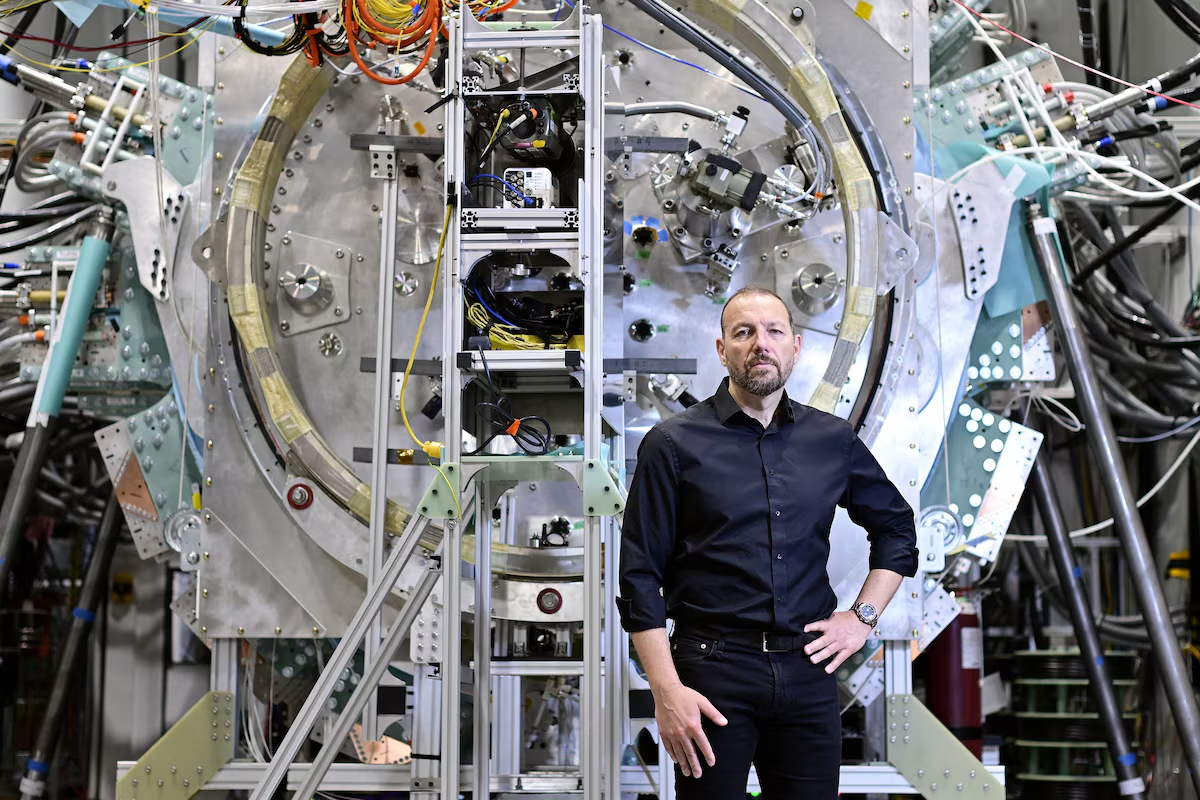

Open this photo in gallery:
Greg Twinney, CEO of General Fusion stands for a photograph with the LM26 in Richmond, B.C. on May 3, 2025. The Richmond, B.C.-based company becomes the first publicly-listed company focused on fusion energy.Jennifer Gauthier/The Globe and Mail
General Fusion Inc. has completed its go-public transaction despite heavy redemptions by unitholders in the NASDAQ-listed special purpose acquisition company that merged with the Canadian fusion energy developer.
The Richmond, B.C.-based company, which will trade under the ticker symbol GFUZ, becomes the first publicly-listed company focused on fusion energy; it is set to be followed by TAE Technologies Inc., which has agreed to merge with Trump Media & Technology Group Corp., owner of the Truth Social site and majority-owned by U.S. President Donald Trump. That deal is expected to close after Oct. 1.
General Fusion said in a release it was entering the public markets with about $150-million in cash, which will provide “a strong foundation to execute” on completing key development work on the company’s fusion demonstration device, chief strategy officer Megan Wilson said in an e-mail. This would enable General Fusion to achieve what it calls scientific break-even – the point beyond which the machine would produce more energy than it takes in if loaded with the appropriate fuel mix.
General Fusion go-public deal to close Friday – but amount contributed by SPAC partner a mystery
The test machine is not designed to generate electricity but to serve as a precursor to a full-scale fusion reactor General Fusion hopes to put into operation by 2035. “We have the capital, an operating machine, and an exceptional team to keep advancing our LM26 program and developing our path to bring this uniquely practical technology to the world.
But the company’s cash level falls well short of what it had hoped for. It was looking to add up to US$314-million to its balance sheet, according to investor materials.
Under the merger deal with publicly traded Spring Valley Acquisition III, General Fusion stood to get up to US$230-million the SPAC had raised from unitholders and held in trust. But unitholders had the right to redeem their units in full.
A General Fusion spokeswoman declined to say exactly how much was redeemed; the amount is expected to be revealed in a regulatory filing next week. But a rough guestimate is possible based on publicly available information.
General Fusion also raised a private placement alongside the SPAC merger that brought in US$107.7-million. It had US$49-million in cash and cash equivalents as of Dec. 31, and used about $24-million in cash on operations in 2025. Assuming its cash use had continued apace, its pre-merger cash level likely stood at around US$37-million. The companies also indicated in investor materials the transaction could cost US$24-million.
If those numbers are correct, General Fusion’s cash level, excluding SPAC contributions, would be US$120.7-million. With the company saying it has US$150-million in cash, that would mean less than $30-milion, or 13 per cent of the US$230-million the SPAC originally raised, went to the merged company.
High redemptions are not uncommon in SPAC mergers. The SPAC that merged this year with Toronto-based Xanadu Quantum Technologies Inc., saw nearly 90 per cent of unitholders redeem their investments beforehand. Redemptions were even higher when another Canadian-founded quantum computer developer, D-Wave Quantum Inc. did its SPAC merger in 2002.
Even with the muted SPAC-holder support, General Fusion knew it would emerge from the merger amply capitalized thanks to that oversubscribed private sidecar deal, known as a PIPE, General Fusion CEO Greg Twinney told the Globe & Mail last month. “Nobody can count on the SPAC trust, so we needed to get adequate PIPE capita,” he said. “That’s what we did.”
General Fusion is in much better shape than fourteen months ago when it cut staff, reduced operations and published an open letter from Mr. Twinney urging financiers to help secure the future of the cash-strapped 24-year-company. In the following months Fusion raised US$88-million from private investors, bringing its total funding to date to US$400-million. That includes US$100-million-plus from governments.
General Fusion is one of a spate of Canadian companies go public this year, following Apotex Health Corp., AGT Food and Ingredients Inc. and Lumina Metals Corp. It’s one of three, including Xanadu and Uni Express Inc. (UniUni), to pursue a SPAC combination.
General Fusion was founded in 2002 by physicist Michel Laberge, who sought to revive an approach to nuclear fusion shelved in the 1970s. The method, which differs from those used by other companies, involves using a metal sheath to momentarily contain and then rapidly compress plasma to reach the temperatures and pressures needed to initiate fusion reactions. Its test machine is not designed to generate electricity but to serve as a precursor to a full-scale fusion reactor General Fusion hopes to put into operation by 2035.
Efforts to develop fusion power into a commercially viable form of electricity production are in the early stages, but interest has picked up. Companies in the sector raised US$2.6-billion in 2025.