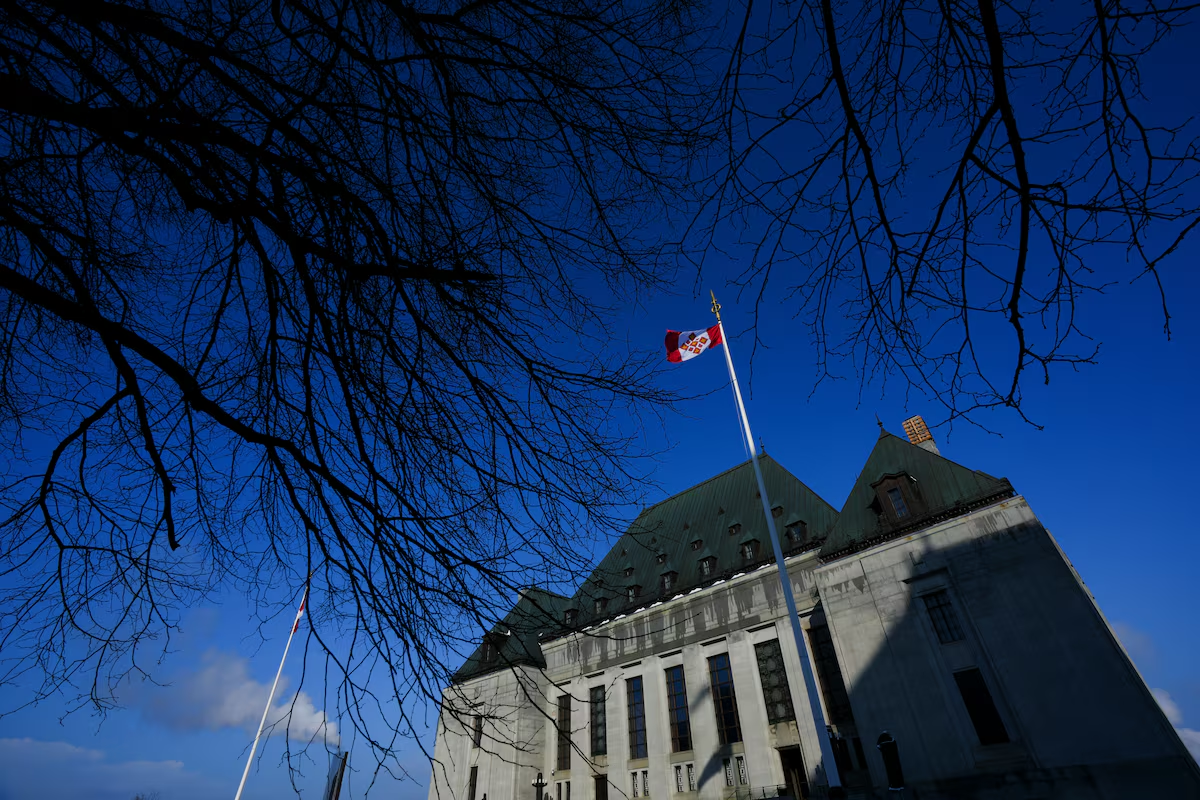

Open this photo in gallery:
The Supreme Court of Canada’s 7-2 judgment was written by Justices Suzanne Côté and Michelle O’Bonsawin, and the majority included Chief Justice Richard Wagner.Sean Kilpatrick/The Canadian Press
The Supreme Court of Canada on Friday upheld a mandatory minimum sentence legislated under former Conservative prime minister Stephen Harper.
The 2014 law gave judges no choice but to impose a jail sentence of at least six months on people convicted for the first time of paying for, or trying to pay for, sexual services from a person under the age of 18.
Strict mandatory minimum sentences had been a hallmark of Mr. Harper’s approach to criminal justice. But the Supreme Court and other courts across the country often ruled that such Harper-era laws, which gave judges zero leeway in sentencing, violated the provision against cruel and unusual punishment in the Charter of Rights and Freedoms.
On Friday, the Supreme Court sided with Mr. Harper in a case from Quebec. The Supreme Court has done so before, such as with its 2023 Hilbach ruling, but Canada’s top court is better known for its various rulings against Mr. Harper’s mandatory minimums.
Friday’s 7-2 judgment was written by Justices Suzanne Côté and Michelle O’Bonsawin, and the majority included Chief Justice Richard Wagner.
The ruling focused on the abstract question of reasonable hypothetical scenarios, and whether a strict minimum punishment for an imagined crime violates the Charter. This approach became common at the top court starting in 2015.
In the case at hand in Friday’s Supreme Court ruling, Mario Denis was busted in a 2018 sting with a fake online ad for escort services. An undercover cop offered Mr. Denis, then in his early 50s, a 16-year-old escort named Alexa. Mr. Denis met the undercover officer at a motel, paid for the planned sex and then police arrested him. After a trial, a judge sentenced him to the minimum jail time of six months. Mr. Denis argued the minimum violated the Charter. The trial judge dismissed that entreaty.
Editorial: A staged Supreme show doesn’t court confidence
Mr. Denis has since served his time, but the case continued. In 2024, the Quebec Court of Appeal agreed that six months in jail for Mr. Denis did not violate the Charter. But Quebec’s top court also concluded the minimum was cruel and unusual punishment because it was “grossly disproportionate” in a reasonable hypothetical scenario.
The Supreme Court reviewed that scenario: An 18-year-old man texts a female friend who is a minor and they agree to have sex for money. The top court overturned the Quebec appeal court’s ruling and concluded the minimum of six months in jail for anyone – real or imagined – convicted of this crime did not violate the Charter.
The Supreme Court ruling emphasized what’s necessary for a hypothetical to determine that a mandatory minimum violates the Charter: that the penalty is shown to be so excessive that it becomes intolerable to society or shocks the conscience of Canadians.
“There is no doubt that the sexual commodification of children is a veritable scourge in Canada, one that the state has every interest in suppressing and severely punishing,” wrote Justices Côté and O’Bonsawin.
Mandatory minimum punishments may be associated with Mr. Harper, but they long predate his time in office. The most severe is a half-century old, a mandatory life sentence for first-degree murder, without a chance of parole for 25 years.
Mr. Harper legislated more than 40 new or increased minimums during his decade in power. Three years ago, the federal government under former Liberal prime minister Justin Trudeau repealed 20 minimums.
Open this photo in gallery:
Former prime minister Justin Trudeau, shown with Stephen Harper in 2025, repealed many of the mandatory minimum punishments that his predecessor introduced.Chris Young/The Canadian Press
Last December, under Prime Minister Mark Carney, Ottawa sought to reinstitute more than a dozen mandatory minimums through Bill C-16 that had been ruled unconstitutional by the courts. The bill passed Parliament in June and takes force on July 18.
In previous rulings when the Supreme Court struck down a mandatory minimum, such as the 2016 Lloyd judgment, the top court suggested to Parliament that a small “safety valve” of discretion for trial judges could make a mostly rigid minimum compliant with the Charter.
The Liberals, in general, took the advice. Bill C-16 states that when a minimum includes jail time, a judge can impose a sentence with less jail time if the minimum “would amount to cruel and unusual punishment for that offender.”
The change in law was, in part, a direct response to a controversial Supreme Court ruling last October. In a 5-4 decision called Senneville, the top court struck down a minimum of one year in jail for possessing or accessing child pornography, another Harper-era measure. The majority of judges employed a hypothetical to discover the Charter violation.
Chief Justice Wagner cowrote the Senneville dissent with Justice Côté. They wrote that a “reasonable scenario is not one that is far‑fetched, fanciful, unrealistic, outlandish.”
In the mid-2010s, before he became Chief Justice, the judge was in dissent in cases of mandatory minimums, such as 2015’s Nur ruling and 2016’s Lloyd judgment. Both times, he sided against striking down mandatory minimums and questioned the hypothetical scenarios used by the majority of judges to do so.