Mark Carney’s government will, come fall, face the pivotal task of deciding how to respond to a parliamentary committee recommendation to bar medical assistance in dying for patients with mental illness.
Justice Minister Sean Fraser has promised to review the newly released report from the Special Joint Committee on Medical Assistance in Dying. He also intends to read dissenting opinions. Four senators want the government to refer the matter to the Supreme Court of Canada.
“The issue couldn’t be more personal, it couldn’t be more serious,” Mr. Fraser said Thursday. “I intend to take the time to get it right over the summer.”
Open this photo in gallery:
Justice Minister Sean Fraser has said he intends to ‘take the time to get it right,’ before deciding how to respond to the recommendation to bar MAID for patients with mental illness.Sean Kilpatrick/The Canadian Press
How Ottawa proceeds when it returns from summer break will mark a crucial moment in the fierce debate over whether patients whose underlying condition is a mental illness should be able to have a health care provider’s help to end their life.
Some see the issue as unfinished legal business a decade after the country’s original assisted dying law came into effect. Others strongly caution against such an expansion, warning it places vulnerable people at even greater risk.
In May, The Globe and Mail reported that, according to three sources, the government was open to drafting legislation to extend an exemption for patients with mental illness past its current expiry date of March, 2027, should the committee recommend doing so. The Globe did not identify the sources because they were not authorized to speak publicly about the government’s plans.
Patients and advocates who see the ability of someone suffering from mental illness to obtain MAID as a Charter right are expecting a drawn-out legal battle. They’ve already been fighting the issue in court for nearly two years.

With the support of her family, Ms. Brosseau filed an application in Ontario Superior Court for emergency access to MAID in May.
In August, 2024, Claire Brosseau, a 49-year-old Toronto resident, joined advocacy organization Dying With Dignity Canada in filing a lawsuit against the federal government over its decision to bar MAID in cases of mental illness. The matter remains before the courts.
Ms. Brosseau was diagnosed 35 years ago with Bipolar 1, a form of bipolar disorder characterized by extreme swings in mood involving manic or hypomanic and depressive episodes.
In a recent interview with The Globe, she likened herself to a rat in a cage as she paces in her 600-square-foot apartment to log 10,000 steps a day.
Ms. Brosseau spends most of her life in her 600-square-foot Toronto apartment. She says leaving causes severe distress due to the severity of her mental illness.
Ms. Brosseau said she needs to remain close to home because of the severity of her illness. She becomes distressed if she leaves, such as to run an errand. She steps out only to walk her beloved two-year-old dog, Olive.
In May, she filed an application in Ontario Superior Court for emergency access to end her life with medical help. She was supported by members of her family. In a statement at the time, she said she has been assessed medically and found eligible for MAID, but she cannot obtain it legally “because my illness is a mental illness.”
Ms. Brosseau said that she simply cannot wait any longer for the federal government to act, but fears that if she dies by suicide, her loved ones will be left with the traumatic fallout.
MAID became legal in Canada in June, 2016, for Canadians whose deaths were deemed “reasonably foreseeable.” In 2021, the law was updated after a Quebec court decision allowed patients with incurable conditions, such as multiple sclerosis, to seek to end their lives.
At that time, it was determined that patients whose sole underlying medical condition is mental illness would not be immediately eligible. A two-year temporary exclusion was put in place to allow more time to study the delivery of MAID in this area.
The federal government has since twice delayed implementing MAID for mental illness. This spring, political pressure grew on Mr. Carney’s government to intervene.
‘Medical assistance in dying is healthcare,’ says Claire Brosseau
In late May, 90 disability and mental health organizations sent a letter to Mr. Carney, Mr. Fraser and Health Minister Marjorie Michel requesting that Ottawa permanently halt MAID in this area.
The groups wrote that patients living with mental illness need supports and health care to “live dignified lives – not state-facilitated access to suicide.”
The Archbishop of Toronto also wrote to Mr. Carney and other MPs in April to ask that they consider measures to restrict the expansion of MAID and instead prioritize investments in palliative care, mental health supports and resources for marginalized and isolated individuals.
Ms. Brosseau, herself a Catholic, said she has prayed for emotional relief. She’s also exhausted countless interventions, but her suffering persists.
“Priests, brothers, sisters, every cocktail of drug, reiki, tai chi, sound bath, sensory deprivation tank,” she said. “I’ve tried everything.”
What many fail to understand, she said, is there is a difference between an acute mental health crisis and persistent, treatment-resistant mental illness, such as the type she lives with.
Open this photo in gallery:
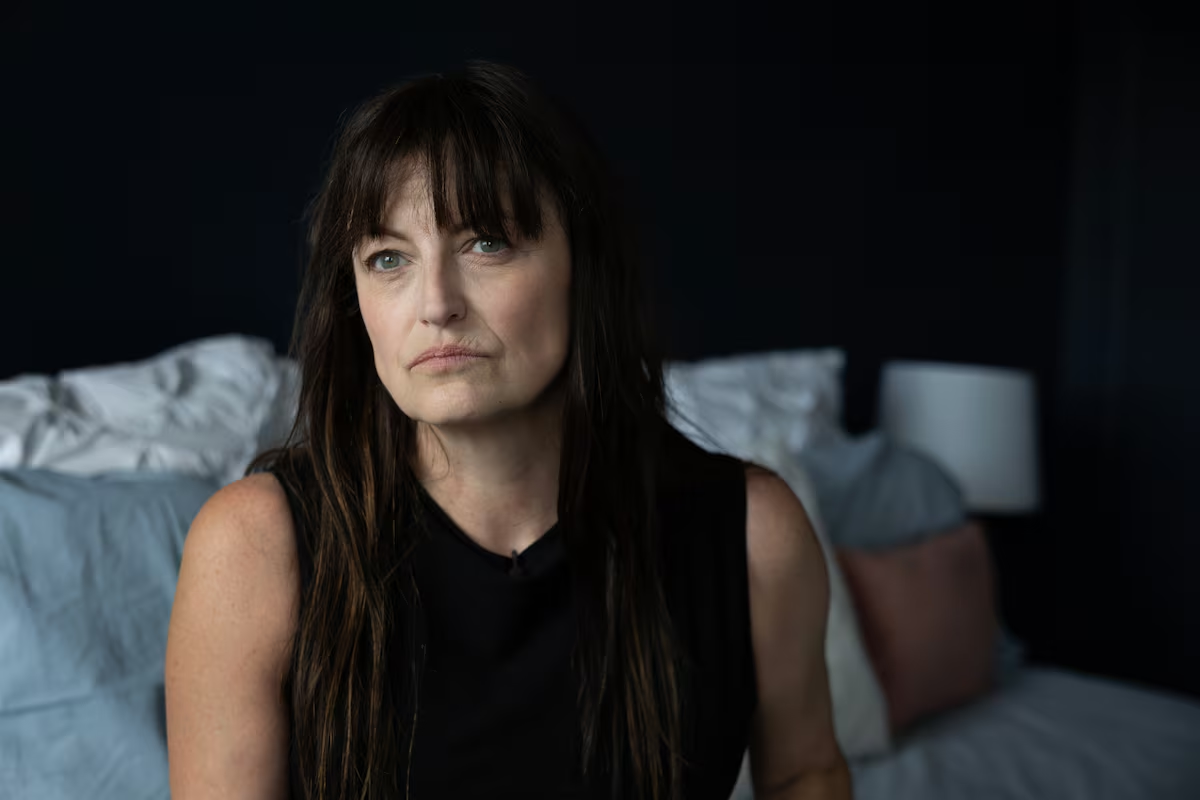
Ms. Brosseau, who has been living with a persistent, treatment-resistant mental illness for over three decades, says she cannot wait any longer for the federal government to act.
She hopes others never know this kind of pain, nor know someone who experiences it.
“Every day I wake up and I open my eyes and I’m like, ‘Well, I wish that hadn’t happened,’” she said.
“There’s nothing left for me to do and I’m not doing any more.”