
Listen to this article
Estimated 4 minutes
The audio version of this article is generated by AI-based technology. Mispronunciations can occur. We are working with our partners to continually review and improve the results.
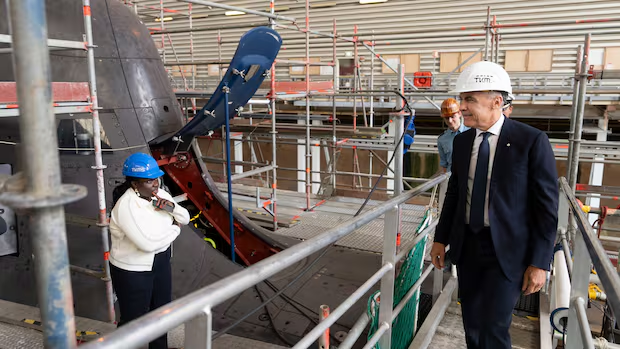
German shipbuilder ThyssenKrupp Marine Systems (TKMS) is expected to be Canada’s preferred choice to build the navy’s new fleet of submarines, sources confirm to CBC News.
Prime Minister Mark Carney will be in Halifax later today where he’ll put an end to long-running speculation about the future of the multi-billion dollar program which will determine the navy’s future.
Secretary of State for Defence Procurement Stephen Fuhr is also slated to be Equimalt, B.C., where he’ll also reveal the decision to the West Coast navy.
The choice of the joint German-Norgwegian bid over South Korea’s Hanwha Ocean was first reported early Monday by the Globe and Mail, but confidential sources — speaking on condition that they not be identified — have subsequently confirmed to CBC News that TKMS is expected to be the preferred bidder.
In circumstances of major defence purchases, the federal government selects a preferred bidder and then attempts to negotiate a contract. If the talks fail, it turns to negotiate with the second place winner.
Carney made it clear at the end of May that a decision on the replacement of the navy’s aging Victoria-Class boats would happen by the beginning of the summer
The prime minister is headed to Ankara, Turkey, for the NATO summit, where Secretary General Mark Rutte has told allies they are expected to show up not only with a plan to meet the defence spending benchmark, but military capabilities.
The submarine deal is expected to be one of the highlights of Canada’s presentation to allies, along with the prime minister’s plan to create a defence investment bank that will allow NATO countries easier access to capital for the arm-making industry.
The choice to negotiate with a German shipbuilding company has far reaching geostrategic implications, notably pulling Canada into a closer European orbit when the United States is pulling away from NATO.
Potential to reshape navy
The decision is bound to disappoint the South Koreans who have long felt that Canada looks more toward Europe than to the Indo-Pacific. Some analysts have suggested that the choice of the German-Norwegian bid could be a blow for Canadian ambitions and investment in Asia.
Almost a year ago, Carney announced the field of submarine bidders had been narrowed to two choices — the German-designed Type 212CD and the South Korean KSS-III. Both bidders and their governments were given until the spring to submit detailed bids and promises of economic offsets — proposals that could mean billions of dollars in investment in the Canadian economy.
The navy is looking for 12 submarines and has said both boats meet its high-level requirements.
 HMCS Corner Brook passes an iceberg in Frobisher Bay on Aug 19, 2009. It is among the Victoria-class subs due to be retired in the 2030s. (Adrian Wyld/The Canadian Press)
The acquisition cost could run to $24 billion, but with lifetime maintenance and support, the final bill over three decades could be upward of $100 billion, according to some estimates.
The submarine plan has the potential to fundamentally reshape the Canadian navy. If all boats are purchased, a full one-third to half of the fleet would be made up of submarines.
While Canada had the world’s third largest navy after the Second World War, its complement of submarines was never that large.
 A Korean KSS-III submarine is welcomed at CFB Esquimalt in Esquimalt, B.C., on May 25. (Chad Hipolito/The Canadian Press)
Defence analyst Dave Perry said the decision announced today in Halifax will have an impact for decades.
“The selection today of TKMS as the preferred bidder is a huge step forward to acquire Canadian naval capability,” said Perry, president of the Canadian Global Affairs Institute.
“It will give Canada a right sized fleet of modern submarines for the first time in generations.”
During last year’s election, the federal Liberals promised to move swiftly to rearm Canada in the face of increasing international conflict and tension.
Perry said it appears Carney has lived up to his rhetoric.
While a contract still needs to be signed, Perry said: “It shows the Government of Canada actually meant it when it said it was going to move much faster procuring military equipment for Canada. For a project of this size, the submarine buy has moved with astonishing speed.”
The Germans say they can have four submarines to Canada by 2036. That would be just in time for the Canadian navy which plans to fully retire its aging Victoria-Class submarines by the early 2030s.