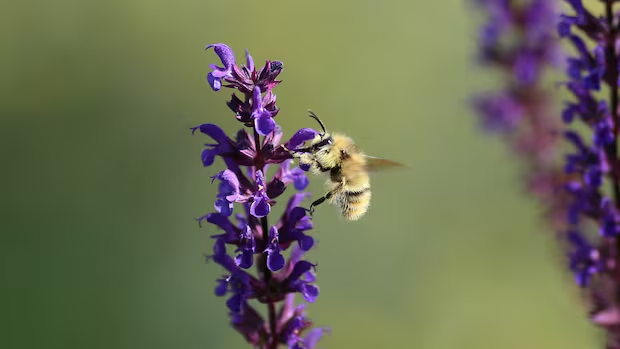
LISTEN | Full interview with Jo Wimpenny:
The Sunday Magazine21:55Wasps make you squirm? Step away from the swatter, says zoologist
You are sitting at a picnic table on a summer afternoon when a wasp lands near your plate, or an ant climbs onto your hand. Almost instantly, the reflex takes over. You swat, you flick, you recoil.
From bemoaning itchy mosquito bites to targeting invasive moths with insecticide, our relationship with bugs is built largely on fear, economic damage and medical anxiety, says ecologist Michelle Tseng.
“People know a lot about the negative things,” she said. “And that narrative has dominated.”
As summer draws Canadians back into gardens and parks, scientists and environmental caretakers say we need to reexamine how we view insects, swapping our repulsion for appreciation of the key environmental role they play.
“Most of the insects on the planet are beneficial and necessary for proper ecosystem functioning,” said Tseng, an associate professor at University of British Columbia. “Most people don’t understand that, but we also don’t expect them to.”
 Mayflies serve as a vital food source for fish and various invertebrates. (Submitted by Michelle Tseng)
Fear is learned
Children typically start out deeply curious about insects, says zoologist Jo Wimpenny. But between the ages of four and eight, she says, they begin picking up fear from parents, caregivers and media. Wasps become “vicious,” and spiders become “sex-starved invaders,” she said.
“We love putting things into categories,” Wimpenny, author of Beauty of the Beasts: Rethinking Nature’s Least Loved Animals, told The Sunday Magazine host Piya Chattopadhyay.
“An animal that looks like a wasp or a spider is bad. An animal that looks cute like a panda is good.”
Wimpenny emphasizes that simplicity comes at a cost.
In her research, she warns that we are living through an era of catastrophic biodiversity loss, where panic around insects — in addition to insecticide use, habitat loss and climate change — is accelerating their decline. A 2019 global analysis found that more than 40 per cent of insect species are declining and a third are endangered.
“Just lumping them into good and bad is overlooking so much.”
What we don’t see
Wimpenny says most people don’t see what insects are actually doing.
“A lot of people know that wasps are … nuisance wasps,” she said. “But there are lots of other different species of wasp.”
Tiny wasps pollinate figs, some help with wine production, and most are predators that eat aphids, cabbage white caterpillars, and other sorts of larvae that would otherwise devour crops.
“If we didn’t have wasps, we would soon notice because all of these pests would just build up. So they’re out there just doing all of this for free,” she said.
In Grant Minkhorst’s Toronto garden, that natural balance has slowly been restored by a common gardening practice called companion planting, where different plants are grown side by side to benefit each other.
Aphids on his milkweed attract ladybugs, which naturally manage the aphid population. Planting native berry shrubs brought in birds that hunt his slugs. Today, he worries little about garden insects and pests.
“I want them to thrive and survive … start to look at insects as partners and friends,” said Minkhorst.
 Cardinal Meadowhawk dragonfly species eats soft-bodied insects like mosquitoes, flies and flying ants. (Submitted by Michelle Tseng)
Coexistence is messy
Tseng notes that the relentless spread of invasive spongy moths in Ontario proved extremely difficult to control and triggered several targeted aerial insecticide applications, concluding most recently in 2022. Meanwhile, British Columbia mitigates the threat through precise spraying campaigns, a strategy Tseng says inevitably kills off blameless native moths and butterflies, too.
However, she acknowledges the double-edged sword.
“The flip side is, if you let spongy moths get out of control, it’s economically a huge deal, and you don’t want that to happen,” she said,
Residential habits, as simple as lawn care when using herbicides, carry similar weight, she adds.
“It affects the plants, for sure … but it also affects large amounts of the overall health and well-being of all the bugs in that area.”
For his part, Minkhorst differentiates between native insects and highly destructive invasive species like Japanese lily beetles and Asian jumping worms. He picks them off and puts them in soapy water, avoiding pesticides entirely.
Where he once reached for chemical interventions, he now gently reframes his relationship to his land. He points to how millions of backyard hobbyists proudly claim the title of “plant mom” or “plant dad” on social media, but to him, that’s incomplete.
“You’re not just a plant mom or a plant dad,” he said. “You’re like a slug mom. You’re like an ant dad. And you’re a bee parent.”
However, respecting insects doesn’t mean ignoring real dangers. Tseng emphasizes that awareness and prevention measures are key to safely navigating our shared environments.
“It is a concern and we must be aware of the impacts insects could have on us like disease, but all of it is just in educating yourself and knowing how to prevent and also risk assess,” she said.
 Drought-tolerant perennial coneflowers provide easy access to pollen and nectar to insects like honeybees. (Submitted by Grant Minkhorst)
Don’t fret, take a breath
Tseng says as society navigates its relationship with bugs, there are takeaways in Indigenous storytelling and frameworks that have long connected with the Earth as a living system. The natural world is viewed as a home, where the rightful human stance is stewardship and gratitude.
This framework, Tseng points out, relies on seeing plants and animals as akin.
“There’s this sort of reciprocal responsibility for humans to take care of nature, and nature to take care of humans,” she said.
 Western Tiger Swallowtail butterfly frequently found in wooded areas and flower gardens. (Submitted by Michelle Tseng)
Wimpenny says rebuilding the relationship starts with crafting new stories where insects, such as spiders, aren’t the villain.
“Little Miss Muffet doesn’t need to sit on her tuffet afraid of the spider,” she said. “She could easily invite it down to share something together.”
And the next time you encounter an insect outdoors, Wimpenny urges taking a brief, quiet breath.
“Take the time to relax and actually spend some time with it,” she said. “Ask yourself: Why is it doing what it’s doing? And how do you feature as part of that?”