
As downtown Toronto started to swell on Thursday afternoon with soccer fans preparing to march through the streets to the city’s final World Cup game, Portugal versus Croatia, Toronto transit officials knew they’d have to stay nimble.
Josh Colle, chief strategy and customer experience officer for the Toronto Transit Commission, said it was clear that one bus route and three streetcar routes, which had served as backbones of the service for all the other local World Cup matches, would have to be diverted because of the crowds.
But there were still unknowns. “Could we have 10,000 Portuguese or will it be 60,000?” Mr. Colle said. “That will certainly have a different impact on the length of the diversions.”
Open this photo in gallery:
A road closure at Fort York Blvd. and Fleet St. is part of Toronto’s plans to manage the increased fan traffic during a World Cup 2026 match day on June 26.Fred Lum/The Globe and Mail
Years of planning by transit services in Toronto and Vancouver have gone into managing the influx of fans during the month of matches. Still, even the best laid plans have sometimes had to be scrambled during the fan marches, one of the few wildcards for transit.
The games in Canada wrap up next Tuesday afternoon with a round of 16 match at BC Place. Despite fears of transit apocalypse, systems in both cities have proven up to the task of moving tens of thousands more daily riders than usual.
Now, the transit agencies in both cities say they will use those successes to help them make the case for greater investment in their systems going forward.
Toronto logged 760,600 boardings across the five primary surface corridors serving the stadium during the first four match days, for a 43 per cent increase over the same days the year before. (Data for the last two matches are not yet available.) In Vancouver, on June 24 – the day Canada lost a 2-1 heartbreaker to Switzerland at BC Place – the city recorded 1.4-million boardings across all modes of transit, its highest ridership since March, 2020.
During the tournament’s first week in June, Vancouver’s total boardings across buses, SkyTrains, SeaBuses and West Coast Express commuter rail were up 7.8 per cent, which TransLink spokesperson Anita Bathe said demonstrated the system’s role as “economic infrastructure.” The increase in ridership included an uptick on non-game days.
“We are carrying people to and from the ferries, the airport, the tourist attractions, to restaurants,” said Ms. Bathe.
The system “has proven how reliable it can be to handle these mass crowds,“ she said. “And so, when we look to talk about investment in transit in the future, we think this is a really great proof point.”
TransLink riders surveyed by a Globe and Mail reporter on their way to the New Zealand versus Belgium game last Friday praised the system for its smooth operation.
And transit became part of the communal fan experience. When Baljit Aujla took the Expo Line in Vancouver to the Canada-Switzerland game, the SkyTrain “was packed,” he said.
Open this photo in gallery:
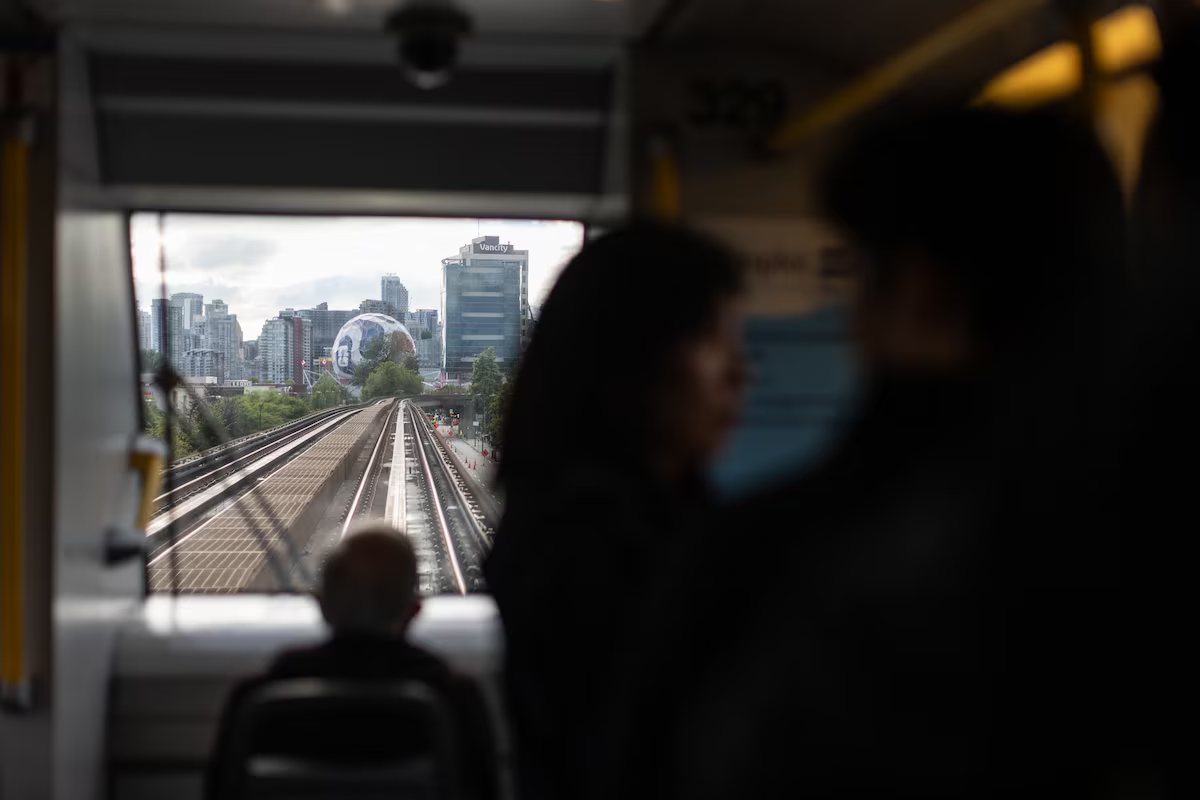
Baljit Aujla and his son Jasraj ride the Skytrain Expo Line from towards the Main Street – Science World station, headed to see New Zealand take on Belgium on June 26.Jesse Winter/The Globe and Mail
“All full of red colours. When you got off at Science World, people were singing and dancing, even after the game.”
Despite the volume, “overall it’s smooth,” he said. “Managing this kind of crowd is not easy, but it’s been very good so far.”
Locals and visiting supporters in Toronto also found the transit system worked smoothly. Riyaz Ismail, who is originally from Kenya and now lives near Scarborough, wore a Senegal jersey on his way to the stadium last Friday, where the team went on to beat Iraq 5-0.
Open this photo in gallery:
Alejandra Barrientos (right) helps Massamba Sarr buy a TTC ticket to ride the streetcar to Toronto Stadium for the Iraq vs. Senegal match.Fred Lum/The Globe and Mail
It was the third match he’d seen in Toronto. He said he’s relied on the GO Transit network and the TTC when travelling to the stadium.
“It’s been very efficient. I think it’s better than driving,” he said. “I’m very pleased it’s not as crowded on the buses and trains as I thought it would be.”
Lance Sharman and three friends – all wearing their local soccer team’s jerseys on their way to the game – flew to Toronto from Cambridge, U.K., to watch the Senegal-Iraq match.
Compared to the London Underground, an extensive subway system in the nation’s capital city, he said Toronto’s subway system is “far more friendly” and less crowded despite hosting the World Cup. “It’s been fine because we’ve learned about the trains and a lot of it we’ve just walked,” Mr. Sharman said.
A TTC employee monitors the boarding process as fans pile into the streetcar enroute to Toronto Stadium and the FIFA Fan Fest. Toronto logged 760,600 boardings across the five primary surface corridors serving the stadium during the first four match days.
Fred Lum/The Globe and Mail
Behind the scenes, years of planning and investment enabled both systems to increase service and then pivot when necessary.
After the Saturday afternoon match between Germany and Cote d’Ivoire on June 20 in Toronto, the TTC noticed fans were opting to walk rather than hop on transit right outside the stadium.
“Dinner was approaching, it was a beautiful day, it was the weekend,” said the TTC’s Mr. Colle. “We have a drone overlooking the passenger flows there, and you could just see people going up Strachan Avenue to King Street. Whereas, on a rainy weeknight” – such as the June 17 Ghana versus Panama match – “you might not get that. So, with all the planning we’d been doing, we also had to be on our toes.”
Open this photo in gallery:
At Strachan Ave. and Fleet St., a TTC employee directs fans heading to Toronto Stadium. Years of planning and investment enabled the transit systems to increase service and then pivot to improve the flow where necessary, such as increased foot traffic in key corridors.Fred Lum/The Globe and Mail
Mr. Colle said the tournament enabled the TTC to set goals such as reducing response times to service incidents by actively monitoring typical weak links such as overhead streetcar wires that might fail during particularly hot days. “We did field exercises to try to reduce response times, and we’ve been tracking that throughout the tournament,” he said.
New high-frequency bus lanes were added over the past year in time for the World Cup, as well as other infrastructure improvements.
Mr. Colle hopes the changes might enable the service to set new expectations among TTC customers, as well as the governments that support the system.
If the agency hopes to keep up its new level of service, “there’s a level of investment in infrastructure and people and process that’s required to keep that up,” he said.
“That’s what we’re showing ourselves. And also hopefully showing our customers, and in turn our partners and funders.”
The Globe at the 2026 World Cup
Four moments, small margins: How Canada scrapped its way into the final 16 countries at the World Cup
A day in the life of a Vancouver server on World Cup game day
Cathal Kelly: Jesse Marsch needs a win over Morocco to justify his place in the spotlight