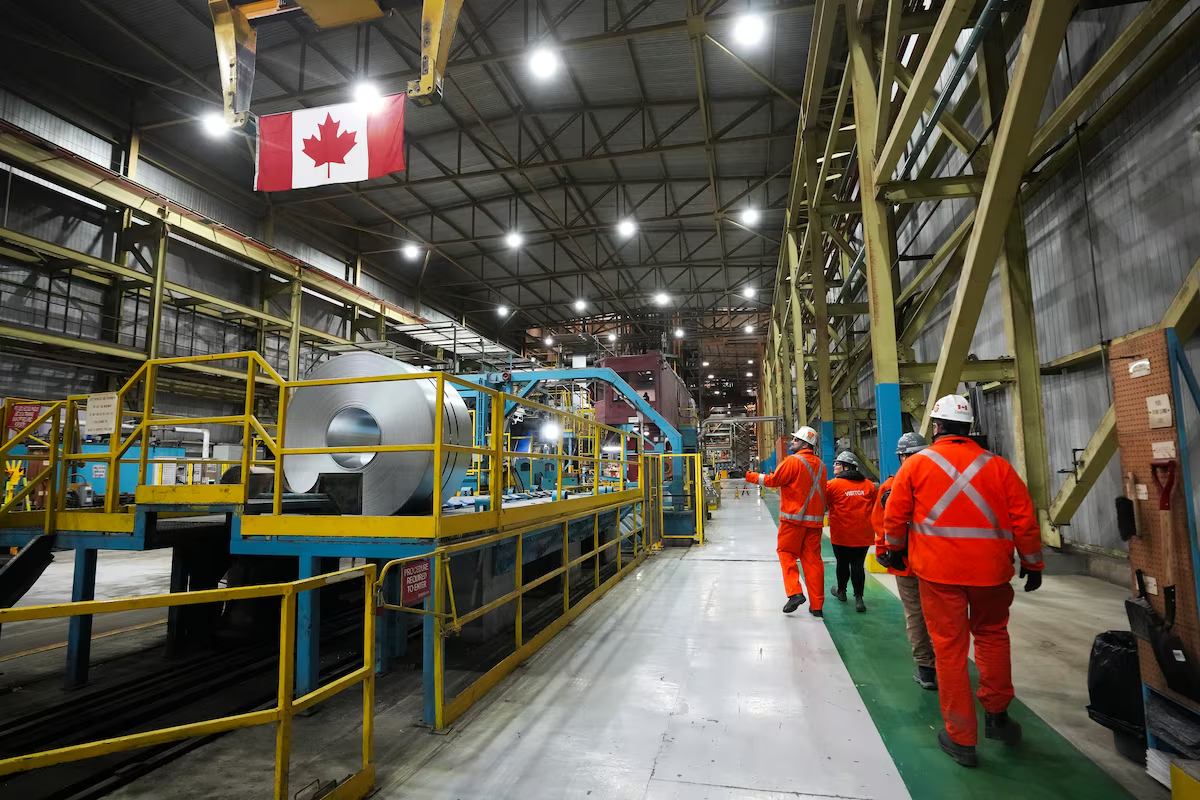

Open this photo in gallery:
Steel workers work at the ArcelorMittal Dofasco steel plant in Hamilton, Ont.Nathan Denette/The Canadian Press
Getting caught up on a week that got away? Here’s your weekly digest of The Globe’s most essential business and investing stories, with insights and analysis on the biggest headlines, stock tips, personal finance strategies and more.
Alberta proposes southern route for new West Coast pipeline
Open this photo in gallery:
Prime Minister Mark Carney and Alberta Premier Danielle Smith announce a proposed pipeline from Alberta to the B.C. coast in Calgary on Thursday.Todd Korol/The Canadian Press
The Alberta government has proposed a southern route for a new oil pipeline to the West Coast, which will be planned and built by the federally owned Trans Mountain Corp., working with Pembina Pipeline Corp.
Prime Minister Mark Carney and Alberta Premier Danielle Smith announced the plan Thursday evening in Calgary. It represented a stark turnaround for the Premier, who had insisted that a conduit to the Pacific should be routed to B.C.’s northern coast.
The project is a major component of a push by the federal government to increase exports around the world in the face of a trade war with the United States and to make peace with Alberta over resource development.
USMCA wasn’t renewed. What’s next for the North American trade deal?
Open this photo in gallery:
Trucks coming from Mexico enter the U.S. to an inspection station after crossing the border in Otay Mesa, Calif.SANDY HUFFAKER/AFP/Getty Images
North American trade has entered a new era. On Wednesday, U.S. President Donald Trump declined to renew the United States-Mexico-Canada Agreement for another 16 years.
Ottawa and Mexico City asked for the 16-year extension. Washington refused. Economics reporter Mark Rendell looks at whether anything changes right away, what’s happening with trade negotiations and what non-renewal mean for the Canadian economy and businesses.
The U.S. dairy industry wants more access to the Canadian market. Here’s why, explained in five charts
Open this photo in gallery:
Noah Berger/The Associated Press
The White House’s demands are clear: Trump’s administration wants Ottawa to change the way import licences are allocated so that Canadian retailers will be able to import American dairy products.
Ottawa has so far refused to comment on whether it will be changing dairy import restrictions. To understand why Washington might make dairy trade a USMCA linchpin, Kate Helmore uses five graphs to tell the story of a U.S. milk industry facing increased production, stagnant domestic demand and a competitive global market where other big players face the same pressures.
Inside the fastest-growing Canadian AI startup you’ve never heard of
Open this photo in gallery:
Turbopuffer is probably the fastest growing tech company in Canada right now, with lots of buzz around it.Photo illustration by Yannis Davy Guibinga/The Globe and Mail
Turbopuffer is an unusual Canadian startup.
The company, started by Simon Eskildsen and Justine Li, has devised a new, efficient way for AI systems to search for information when serving up answers, a crucial feature for AI to be useful, while slashing costs for an industry that can’t stop losing money. It’s won Turbopuffer some massive customers, including Anthropic, the company behind Claude, now worth nearly US$1-trillion.
Turbopuffer might sit more naturally in San Francisco rather than a few blocks from Parliament, but while a lot of Canadian talent decamps for Silicon Valley, Mr. Eskildsen has no interest in leaving. If only he could sell everyone else on Ottawa.
The federal government’s economic footprint is shrinking at the fastest year-over-year pace in 30 years
In last year’s federal budget, Prime Minister Mark Carney promised to shrink the public service and boost defence spending.
We’re starting to see how those policies are playing out across Canada’s economy.
When Statistics Canada this week released gross domestic product numbers for April, which showed a healthy rebound after months of sluggish growth, the agency noted the public sector contributed to the lift. Federal public administration, excluding defence, posted its first month-over-month increase since December, it said. And at the same time, federal defence real GDP is rising at its fastest pace ever.
This week marked the end of the first half of 2026 – and what a half-year it was for stock investors. In a global market bubbling with excitement over artificial intelligence, which of these stock indexes performed best of all?
a. Canada’s S&P/TSX Composite Index
b. The tech-heavy, U.S.-based Nasdaq Composite Index
c. South Korea’s KOSPI Composite Index
d. Japan’s Nikkei 225 Index
c. Just about every major stock market index did well from Jan. 1 to June 30, but the standout star was the red-hot KOSPI Composite Index in South Korea. It soared 97 per cent as the country’s big computer chip makers rocketed higher. By comparison, the S&P/TSX Composite (up 9.9 per cent), the Nasdaq (up 12.6 per cent) and the Nikkei (up 40 per cent) looked like ho-hum propositions.
Get the rest of the questions from the weekly business and investing news quiz , and prepare for the week ahead with The Globe’s investing calendar.