
Listen to this article
Estimated 5 minutes
The audio version of this article is generated by AI-based technology. Mispronunciations can occur. We are working with our partners to continually review and improve the results.
The U.S. envoy to Canada says 14 months of trade talk between Canada and the Trump administration has resolved few issues, but he insists the Americans will keep talking in the hopes of striking an agreement on the future of CUSMA, as well as settling other issues.
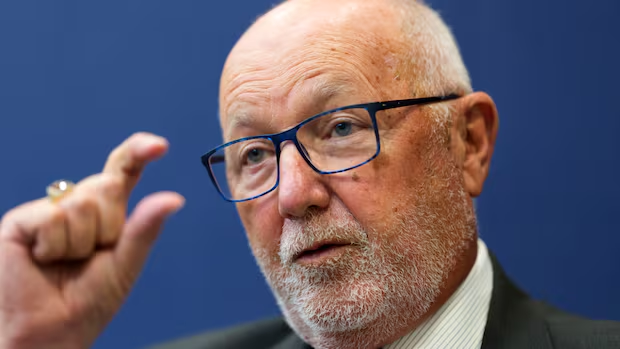
U.S. Ambassador to Canada Pete Hoekstra made the remarks on CBC’s Ottawa Morning, where he was asked by host Rebecca Zandbergen how far apart he believes Canada and the United States are on settling the trade irritants that are frustrating a renewal of the Canada-U.S.-Mexico Agreement.
“I think we have a ways to go yet,” he said. “[President Donald Trump and Trade Representative Jamieson Greer have] said we’re going to continue talking in July and August and we’ll just keep going through the process and see if we can iron these things out.”
“If not, then, we’ll keep talking. Hopefully on a number of these issues we reach resolution sooner rather than later, but it’s already taken 14 months and we haven’t seen significant progress,” Hoekstra said.
WATCH | Hoekstra says Canada-U.S. negotiations have ‘a ways to go yet’:
CUSMA negotiations ‘have a ways to go yet’: U.S. ambassador
U.S. Ambassador to Canada Pete Hoekstra says while Canada-U.S. trade negotiators haven’t made ‘significant progress’ over 14 months of CUSMA talks, he’s hopeful an agreement could be reached in July. The U.S. administration has opted not to extend the existing agreement with Canada and Mexico.
The Trump administration announced Wednesday that the U.S. will not join Canada and Mexico in extending the free trade deal between the three countries that Trump signed in his first term.
Despite that announcement, the deal remains in effect while the negotiations between the countries continue. That’s because the deal remains in effect for another 10 years, with annual reviews.
That could change if the U.S. issues an official six-month notice of withdrawal, something Trump has stopped short of threatening to do.
U.S. wants Canada’s oil, envoy says
Asked if he sees that happening, Hoekstra said the shape and timing of trade negotiations between the two countries will be set by Trump and Prime Minister Mark Carney.
Zandbergen asked if Hoekstra understood Canada’s desire to seek trading partners in other parts of the world because of the instability in the Canada-U.S. trading relationship. This prompted the envoy to push back.
Hoekstra said 85 per cent of trade between the two countries that takes place under CUSMA carries on tariff-free, and that the arrangement is predictable.
He also said the U.S. is putting tariffs on things not covered by CUSMA, which demonstrates the Trump administration is “predictably” following the rules of the existing deal.
WATCH | Ambassador Hoekstra says U.S. could ‘find other sources’ if no oil deal with Alberta:
Ambassador Hoekstra says U.S. could ‘find other sources’ if no oil deal with Alberta
U.S. Ambassador Pete Hoekstra told CBC Radio while Canada is a ‘logical supplier’ to fill America’s needs of three to four million barrels of oil per day, if the U.S. can’t get that oil from Alberta, his country ‘will go to other places.’
Having said that, Hoekstra says his government has no issue with Canada looking to boost its trading relationships with other countries.
“We’ve always said that if Canada can diversify its markets for extraction and those types of things, fine,” he said.
The U.S. is aware of how deep Alberta’s oil reserves are. Hoekstra said that even if Canada built pipelines east, west and north, it would still have enough oil to sell south of the border.
“We’re looking and we’ve made it clear that we’re in the market for three to four million more barrels of oil per day. Canada is a logical supplier for that.”
While the U.S. may want three to four million additional barrels of oil, Canada’s next proposed oil pipeline seems destined to take Alberta bitumen to Vancouver instead, where it will be put on ships bound for countries in Asia.
In an interview airing Friday on CBC News Network’s Power & Politics, Energy Minister Tim Hodgson said Asia is the destination for most of the oil currently flowing through the Trans Mountain Pipeline from Alberta to the B.C. coast.
That’s instead of the U.S., where Canada already sends the majority of its oil.
‘We have alternatives’
“When we only have one customer for our oil, and we sell that oil at a discount to world markets because we only have one customer, and that customer is doing things that are weaponizing our trade against us, the way you respond is you create the ability to sell to the rest of the world,” Hodgson said.
“We need to show our ally to the south of us that we have alternatives,” he added. “We need to be able to earn a world price for our oil. When we sell at a discount to the Americans we are losing billions of dollars.”
Hoekstra said that while Canada is best placed to fill their demand, because of existing physical and business infrastructure between the two countries, the U.S. also has other options.
“We think Alberta might be the ideal place to fill those requirements, fulfil those needs that we believe that we have. But at the same time, if we can’t strike a deal with Alberta, we will go to other places in the world and we’ll find other sources of oil.”
Hoekstra did not specify where the U.S. would acquire that oil.