
Open this photo in gallery:
Dr. Michael Klein, pictured in 2006, died on June 10 in Roberts Creek, B.C.Rafal Gerszak/The Globe and Mail
When his son was born at Montreal’s Royal Victoria Hospital, Michael Klein was barred from attending the birth. In 1968, the delivery room was no place for dads, not even one who was a neonatology intern.
The exclusion enraged Dr. Klein even though it reflected the dominant belief in Western countries at the time that child-bearing was a highly medicalized surgical procedure rather than joyful, natural event.
Over more than half a century that followed, Dr. Klein fought tirelessly to bring the joy back into childbirth and eliminate the overuse of invasive procedures such as episiotomies and cesarean sections, and championed the role of midwives and birth doulas.
Along the way, he would also “catch” thousands of babies himself, invariably with a smile on face. Dr. Klein died on June 10 in Roberts Creek, B.C.
“More than anything, my father felt it was privilege to be part of the birth process,” said his daughter, bestselling author and activist Naomi Klein. “As a result, he was a renegade in the medical profession.”
Philanthropist Tannis Richardson turned her grief over losing a daughter to diabetes into a personal mission
A self-described “dissident doctor,” Dr. Klein nevertheless carved out a stellar career as family physician and medical researcher, one that left a lasting mark on maternity care and the practice of family medicine.
But he followed an unusual path to success, and ruffled a lot of feathers along the way.
Michael Charles Klein was born on June 17, 1938, in Los Angeles, a “red diaper” baby, raised in a socialist, secular Jewish family.
His father, Phil, was a cartoonist at Walt Disney Studios, bringing to life characters such as Donald Duck, Bambi and Pinocchio, but was fired after organizing a union drive. A gifted artist, he was reduced to menial jobs like sign painting after being blacklisted for his politics; it was, after all, the McCarthy era.
For his part, Dr. Klein lived a bit of a dual life: He was an all-American boy, who captained the swim team and excelled at school, while secretly attending socialist summer camps and walking picket lines with his parents.
He was drawn to medicine in large part because of the way his father was persecuted. “I wanted to be independent. Medicine was a way of not being subject to the things my Dad was,” Dr. Klein said in a 2018 interview on the CBC radio show White Coat, Black Art.
The independence afforded medical practitioners would allow him to wear his politics on his sleeve, though it did not shelter him completely from repercussions.
While in medical school at Stanford University, where he graduated in 1966, he took time to work in both Chiapas, Mexico and Addis Ababa, Ethiopia, where he practised alongside midwives.
Dr. Klein’s memoir Dissident Doctor: Catching Babies and Challenging the Medical Status Quo, is loaded with eye-popping anecdotes. One of the most memorable was performing an emergency tracheotomy on a 10-year-old boy while his grandfather, Ethiopian Emperor Haile Selassie (and a cadre of bodyguards) looked on.
Open this photo in gallery:
Dr. Klein speaks to the media during an announcement by Midwives Association of British Columbia in Vancouver in 2014.Rafal Gerszak/The Globe and Mail
Upon returning to Stanford, Dr. Klein questioned the routine practice of episiotomy (a surgical incision made between the vaginal opening and the anus) during childbirth, an insolence that got him transferred to a county hospital.
There, he not only delivered babies but cared for them and the mothers after birthing. Essentially, he practised family medicine – something that was not recognized as a specialty in 1969 – and became one of its leading disciples.
Dr. Klein immigrated to Canada twice. The first time in 1967 as a Vietnam War deserter, after he refused to serve as an officer in the U.S. Army Medical Corps. The second time was in 1975, drawn by a desire to work in Canada’s public health care system. (It helped that his wife, Bonnie Sherr Klein, an activist documentary filmmaker, also had a job offer from the National Film Board’s legendary Studio D, where she would make the iconic Not a Love Story: A Film about Pornography.)
Dr. Klein worked as a neonatology intern at Montreal’s Royal Victoria Hospital, treating the sickest of sick children. After treating two young patients with lead poisoning, one of whom died, Dr. Klein did some sleuthing to discover the children drank juice stored in an earthenware jug glazed with lead. His findings, published in the New England Journal of Medicine, prompted life-saving regulatory changes.
“My Dad was always about solving mysteries. That’s why he loved family medicine,” his son, Seth Klein, said.
The question that puzzled Dr. Klein most was: Why were episiotomies routinely performed on women during birthing in a Western setting, but not in the rest of the world?
A groundbreaking clinical trial he undertook in 1984 showed that episiotomy caused the very problems it was supposed to prevent, namely tearing, and led to a seismic shift in a practice that had been routine since 1920. As a result, the number of women undergoing episiotomies during childbirth fell to 12 per cent from 65 per cent, and the rate of serious injuries dropped to less than 1 per cent from almost 5 per cent.
Dr. Klein did similarly impactful research on cesarean sections (surgical delivery of a baby through incisions made in the mother’s abdomen and uterus), showing the practice was grossly overused, largely for the convenience of physicians, not delivering mothers.
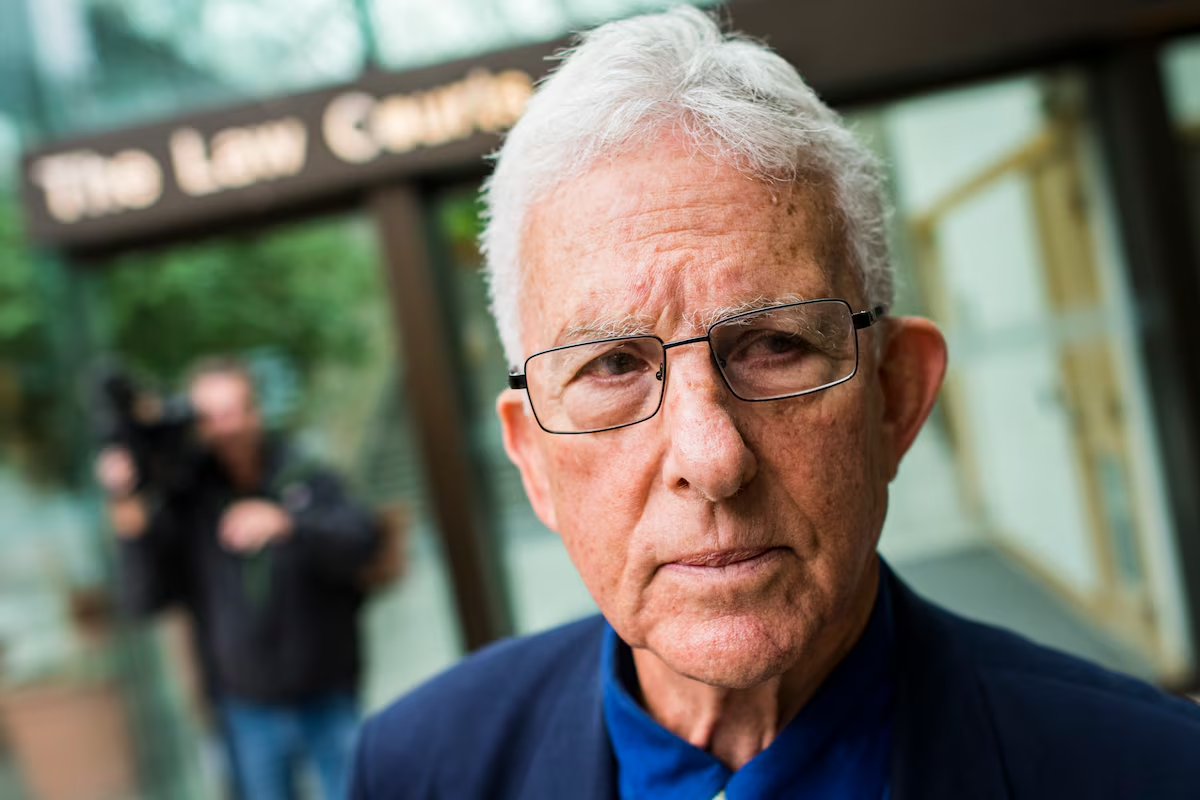
Open this photo in gallery:
Dr. Klein, a board member for Canadian Doctors for Medicare, outside the B.C. Supreme Court in 2016 before the start of a new lawsuit demanding private health care in Canada.John Lehmann/The Globe and Mail
He would eventually shift away from his specialty in pediatrics to work as a family physician, a highly unusual career path. He served as chief executive and medical director of Westside Health Services in Rochester, N.Y., from 1970 to 1975, one of the first family medicine clinics in North America.
Dr. Klein was recruited to serve as head of a McGill teaching centre and the department of family medicine at the Jewish General Hospital in Montreal, where he worked from 1975 to 1993. In 1993, he moved west to head of the department of family practice at B.C. Children’s and Women’s hospitals in Vancouver from 1993 to 2003. He was also professor emeritus of family practice at the University of British Columbia and senior scientist emeritus at the B.C. Children’s Hospital Research Institute in Vancouver.
In 2016, he was appointed to the Order of Canada in recognition of his “vital role in placing maternity care at the heart of family medicine.” Dr. Klein is often described as “Canada’s father of family-friendly births.”
Dr. Klein was an active member of Canadian Doctors for Medicare, and a staunch supporter of medicare, which he benefited from both professionally and personally.
In 1987, his wife, Bonnie Sherr Klein, suffered two catastrophic strokes, which left her with “locked-in syndrome,” a rare neurological disorder where the person is fully aware but unable to speak or move. She spent more than six months in hospital, and despite years of rehab, was left with significantly disability. She detailed her recovery and transition into activism in her acclaimed memoir, Slow Dance: A Story of Stroke, Love, and Disability.
Dr. Klein’s move from Montreal to Vancouver was prompted by Ms. Klein’s inability to navigate winter weather in Eastern Canada.
Open this photo in gallery:
Dr. Klein and his wife Bonnie Sherr Klein in 2006.Rafal Gerszak/The Globe and Mail
He also purchased a property in Roberts Creek, on B.C.’s Sunshine Coast, where his parents would move late in life, and where he would eventually retire.
In 2022, while doing yard work, Dr. Klein suffered a high aortic aneurysm tear, a life-threatening condition that required specialized cardiac surgery.
But the last ferry of the day had already sailed, and a snowstorm prevented the paramedic helicopter from flying, so, in a scene worthy of a James Bond movie, a Coast Guard hovercraft was dispatched to get him to safety.
After that, Dr. Klein suffered a long series of neurological issues. Among other things, he was diagnosed with myasthenia gravis, a chronic autoimmune neuromuscular disorder that causes fluctuating weakness in voluntary muscles, affecting the mobility and the ability to speak.
The condition was particularly frustrating because Dr. Klein was always active, swimming, scuba diving, paddling and crabbing among his many pursuits. He also played the clarinet his whole life, until he was unable to do so.
“He was in pain and struggling for a long time,” Seth said. “But he kept trying to figure it out. That was his nature.”
Dr. Klein leaves his wife, Bonnie, to whom he was married for 59 years, as well as his children, Seth, Naomi and Misha; his daughter-in-law Christine Boyle and son-in-law Avi Lewis; and grandchildren Zoe, Toma, Aaron and Theo.
You can find more obituaries from The Globe and Mail here.
To submit a memory about someone we have recently profiled on the Obituaries page, e-mail us at obit@globeandmail.com.