
Listen to this article
Estimated 4 minutes
The audio version of this article is generated by AI-based technology. Mispronunciations can occur. We are working with our partners to continually review and improve the results.
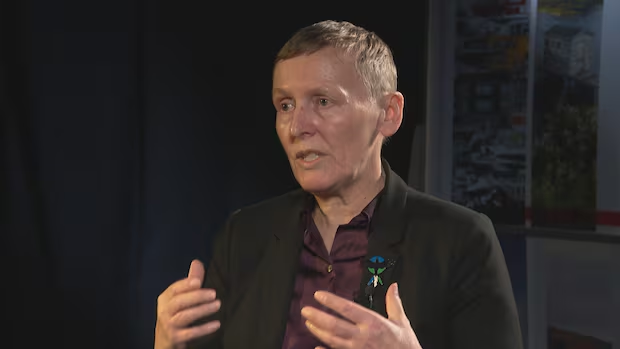
Newfoundland and Labrador’s Indigenous Relations and Reconciliation Minister Lela Evans says the provincial government is dedicated to “true reconciliation” with Innu people, but stopped short of any endorsement of Innu history in the region extending beyond 300 years.
A one-on-one interview Thursday with the CBC’s Leila Beaudoin marked the first time Evans has taken questions on the cancellation of a planned Innu-led cultural exhibit at the Labrador Interpretation Centre in North West River.
The cancellation was declared by Innu Nation on June 17. The decision was made because of what Innu cultural guardian Jodi Ashini described as an attempt to cap Innu history at 300 years. Ashini said it became apparent, in communications with The Rooms, the Innu-led exhibit was not going to allow for Innu people to present on their own history unfettered.
The Rooms is a provincial Crown corporation and operates the Labrador Interpretation Centre.
WATCH | N.L.’s Indigenous relations minister responds to claims by Innu leaders their history was being erased:
Minister Lela Evans says more work needed before agreeing on timeline of Innu’s history in Labrador
After claims by Innu leaders that the Newfoundland and Labrador government was trying to erase their history by capping their existence at 300 years, Minister of Indigenous Relations and Reconciliation Lela Evans speaks with CBC News about the issue and what happens next.
Premier Tony Wakeham and Evans have written statements on the matter, but their comments before now failed to address the central questions around the timeline. The pair have also met privately with Innu leadership.
Indigenous people have been in Labrador for much longer than 300 years, Evans clearly said in her interview on Thursday. However, despite questions returning repeatedly to the timeline, she did not specifically say Innu people have been present for more than 300 years.
Many people have weighed in since the issue erupted. A collection of eight anthropologists and archaeologists penned a letter in support of an Innu-led presentation of history. They and others in the field, speaking with CBC News, have questioned the approach of The Rooms and the Provincial Archaeology Office.
“If they’re disputing it, well that has to be looked at,” Evans said.
Evans said the back and forth on the historical timeline does not affect any ongoing Innu land claim negotiations. She repeatedly said her intent is to support the people of Sheshatshiu Innu First Nation and Mushuau Innu First Nation.
At one point, she said her position right now is to investigate, with the belief it will lead to a stronger understanding and better basis for “true reconciliation” work.
“If people are countering what The Rooms and the provincial archaeologists are saying, well then to be transparent we have to make sure we review that. It’s all about respect and making sure nothing is lost,” she said.
“We’re not going to close the door like the past government and not even look at it because it’s too controversial. Controversial stuff should not be shied away from if it’s going to add value to the story, to the credibility of the conversations that we have.”
Evans said — more than once — there are questions better put to someone from The Rooms. To date, The Rooms has refused response and referred all questions to the province.
The provincial minister responsible for The Rooms as a Crown corporation is Andrea Barbour, who has been in France this week for special events at Beaumont-Hamel.
Download our free CBC News app to sign up for push alerts for CBC Newfoundland and Labrador. Sign up for our daily headlines newsletter here. Click here to visit our landing page.