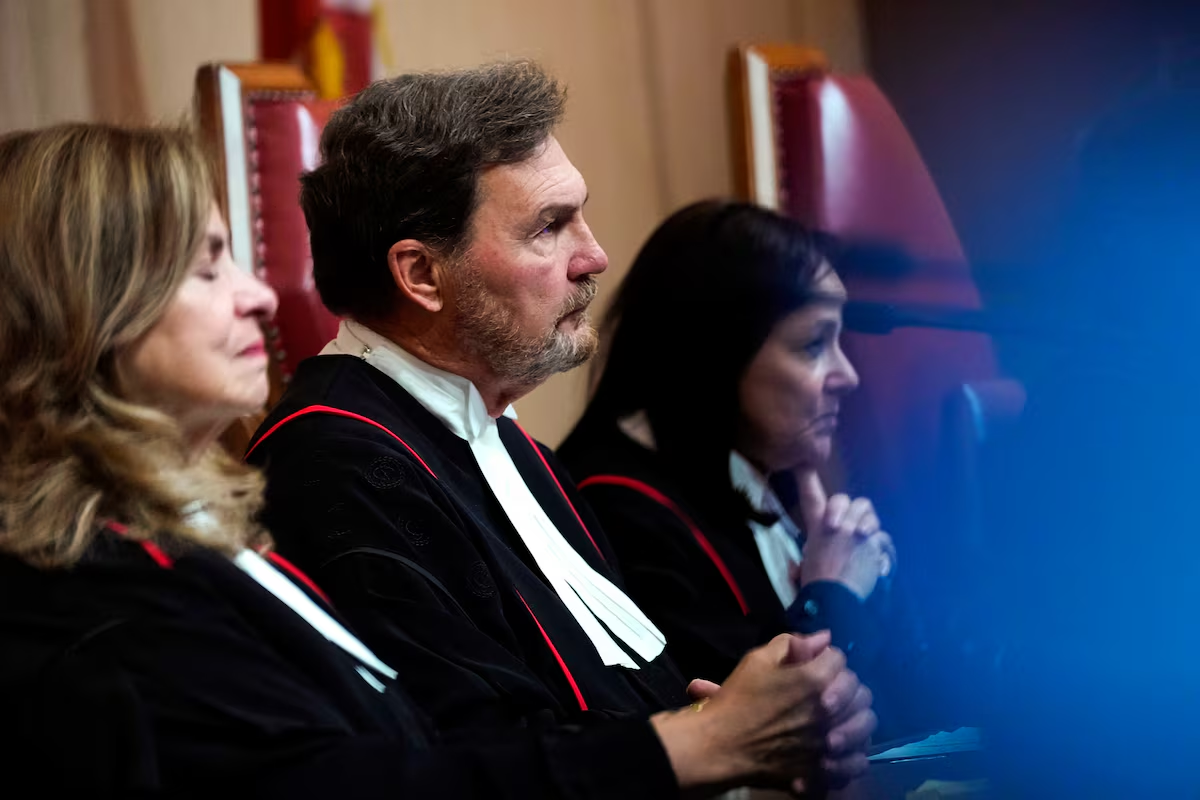

On Friday at 9:45 a.m. in Ottawa, the Supreme Court of Canada delivers a historic judgment at a roiling moment of political division and economic discord.
Judges of the country’s top court will answer essential questions about how Canada operates as a federation in their landmark ruling on six appeals of Bill 21, the secularism law Quebec passed in 2019. The judgment revolves around the limits of the Charter of Rights and Freedoms and governments’ ability to use the notwithstanding clause, the powerful tool that legislators can invoke to override many of the protections promised to Canadians in the Charter.
The ruling will reckon with the political compromises of the early 1980s that led to the enactment of the Charter, the entrenched contemporary divide between liberal and conservative views of the Charter, and what some people see as government attacks on minority groups.
In the Bill 21 case, there are clear echoes of two landmark judgments of the past, Patriation in 1981 and Secession in 1998, said Wade Wright, a law professor at the University of Western Ontario and co-author of the widely cited reference book Constitutional Law of Canada. Like Patriation and Secession, Bill 21 requires the Supreme Court to balance fundamental legal questions against politically sensitive puzzles. The role of the Charter, of legislators and of the courts are all once more in play.
“The Supreme Court,” said Prof. Wright, “must interpret the Constitution while being sensitive to, but not unduly influenced by, these political implications.”
When the Supreme Court weighs in on Quebec’s secularism law, it will be from a new home at the West Memorial Building in Ottawa. The courthouse across the street, which held public hearings on Bill 21 in March, is undergoing renovations.
Justin Tang/The Canadian Press
What’s the basic outline of the Bill 21 case?
Quebec’s secularism law, Bill 21, prohibits many public sector workers, including teachers and police, from wearing religious symbols, such as a hijab or a cross, on the job.
Quebec shielded the law from being struck down by the courts with Section 33 of the Charter, the notwithstanding clause. But an array of groups and affected citizens – including female Muslim, Sikh and Catholic teachers – launched court challenges. Critics of Bill 21 view the law as squarely aimed at minority women in a province with long and deep Catholic roots.
In April 2021, the Quebec Superior Court upheld Bill 21 after a 33-day trial. Justice Marc-André Blanchard observed that the law forced “a cruel consequence that dehumanizes the people targeted” but could not be struck down for Charter violations because it was protected by the notwithstanding clause.
The Quebec Court of Appeal, for the same reason, upheld the law in February 2024.
Nine months later, the Supreme Court agreed to hear six appeals, to be decided Friday. In March the court held four days of hearings, among the longest in its history. It included a record 38 outside intervenor groups.
The so-called Gang of Eight, sitting for breakfast in 1981, were instrumental in getting the notwithstanding clause we have today. These premiers played hardball with the Pierre Trudeau government on a plan to patriate the Constitution.
Peter Bregg and Andy CLark/The Canadian Press
What’s the history of the notwithstanding clause?
In November 1981, five weeks after the Supreme Court ruled that the federal government, by convention, had to garner substantial support among the provinces to patriate the Constitution from Britain, a final federal-provincial meeting in Ottawa began to disintegrate on the third day. “Can you give us more time?” whispered justice minister Jean Chrétien to Pierre Trudeau.
Later, in a small kitchen at the old conference centre near Parliament Hill, Mr. Chrétien and counterparts from NDP Saskatchewan and Progressive Conservative Ontario struck a deal. The Charter would include a notwithstanding clause that could override numerous rights.
This unlocked the 1982 patriation of the Constitution and the enactment of the Charter in the Constitution. Since Confederation in 1867, Canada’s founding document had resided at Westminster in London as the British North America Act.
Open this photo in gallery:
The Queen proclaimed Canada’s new Constitution on April 18, 1982.
For much of the past 44 years, political leaders rarely deployed the notwithstanding clause. Quebec’s Bill 21 in 2019 stands as a demarcation. Alberta used it in four laws a year ago, one to end a teachers strike and three to restrict the choices of transgender youth. The federal government, Conservative or Liberal, has never used the clause.
On the first day of the Supreme Court hearing in March, one lawyer for an appellant seeking to strike down Bill 21 warned of the dangers of a “mini-Trump” in Canada wielding the clause.
On the hearing’s last day, Chief Justice Richard Wagner sounded skeptical of such arguments: “I don’t think that this case will be disposed of by extremist or catastrophic scenarios.”
Open this photo in gallery:
Bill 21 will be a significant case for Chief Justice Richard Wagner, a Quebecker.Nicolai Gregory/The Globe and Mail
What are the legal issues at the Supreme Court?
There are many. The six appellants all want the judges to strike down Bill 21 and presented a long list of arguments.
Several of those focused on Section 23 of the Charter, protecting minority language education, and Section 28 on gender equality. Neither can be overridden by the notwithstanding clause and appellants argued these sections protected people affected by Bill 21.
At the heart of the Bill 21 case are two questions, both revolving around the notwithstanding clause and the Charter promises it can override, such as freedom of religion in Section 2 and equality rights in Section 15.
The first question is whether there should be new limits on political use of the clause, as the federal Liberal government and some appellants and intervenors proposed. None of the provinces, from conservative to NDP, supported this argument.
The Supreme Court has only once issued a significant ruling on the clause, in the 1988 Ford case. The precedent endorsed governments’ mostly unfettered right to use the notwithstanding override power as they like, in a case about French-language commercial signage in Quebec.
In March, conservative-led provinces, starting with Quebec, repeatedly cited that precedent in the courtroom as the reason why today’s judges should not heed calls for change. But many others argued the Ford ruling did not definitively settle every legal debate.
Alberta’s October referendum asked voters about constitutional reform, the courts and other issues besides independence. It’s one of the provinces opposed to an overhaul of the notwithstanding clause, which it has used in some recent legislation.
Leah Hennel/The Globe and Mail; Ahmed Zakot/Reuters
What’s going on with ‘judicial declarations’?
This is the second big question. Ottawa, along with numerous appellants and intervenors, support the idea of judicial declarations. This would allow superior trial court judges to declare that a law insulated by the notwithstanding clause violates the Charter, even as the law is allowed to continue to operate.
An endorsement of judicial declarations from the Supreme Court would make it easier for citizens to take on governments that use the notwithstanding clause.
In laws protected by the clause, the long-standing presumption has been that judges cannot issue declarations, as they can and do in some other cases.
Quebec, Ontario, Alberta and Saskatchewan argued the notwithstanding clause precludes judges from making declarations, while B.C. – under the previous NDP government – and Manitoba supported judges being able to issue them.
Open this photo in gallery:
The Manitoba legislature was one of two that came out in favour of judicial declarations.John Woods/The Canadian Press
The concept of judicial declarations took off in 2019, a month before Bill 21 became law, in a short essay entitled “the faulty received wisdom around the notwithstanding clause” in Policy Options, the online magazine of the Institute for Research on Public Policy. Academic journal work followed.
Supreme Court Justice Nicholas Kasirer, on the March hearing’s second day, when Quebec detailed its arguments, asked a dozen questions about declarations and cited the 2019 essay and related work.
Top provincial courts have split on this question. The Quebec Court of Appeal in its 2024 Bill 21 judgment rejected judicial declarations, saying the notwithstanding clause means judges “can no longer engage” in allegations of rights violations.
Last year, however, the Saskatchewan Court of Appeal ruled in favour of the idea. That case, UR Pride, stems from Saskatchewan’s 2023 law on transgender youth, personal pronouns and parental rights in which the government invoked the notwithstanding clause.
Judicial declarations were a primary issue in the UR Pride case at the Saskatchewan appeal court. The Supreme Court has scheduled a hearing on UR Pride this coming March but the issue may be fully settled in Friday’s Bill 21 judgment.
Eric Mendelsohn, a Montreal lawyer and one of the three authors of the 2019 Policy Options essay, has long thought about judicial declarations, going back to his time as a clerk for former chief justice Beverley McLachlin in the early 2000s.
In the centuries-long history of constitutional law, he described the 44-year-old Charter as “brand new.” He said if the Supreme Court rejects judicial declarations, it would open a dangerous avenue where governments could routinely use the notwithstanding clause to override Canadians’ rights with no recourse in the courts.
“The stakes,” said Mr. Mendelsohn, “are enormous.”
Open this photo in gallery:
The Bill 21 case is a personal one for appellant Amrit Kaur, a Sikh teacher whose turban runs afoul of the ban on religious symbols.Paul Stringer/The Globe and Mail
What impact has all this had on individual Canadians?
Significant – but not widespread.
Amrit Kaur, one of the appellants at the Supreme Court, grew up in Quebec and graduated with an education degree on the day Bill 21 became law. She is Sikh and wears a turban. Her planned teaching career in Quebec ended before it began.
“It’s about standing up to oppression,” Ms. Kaur told The Globe in March before the Bill 21 hearing of the seven-year legal odyssey.
In Alberta, where the province’s use of the notwithstanding clause faces court challenges, Kimberly Large worries about her teenage trans daughter. “It feels like the government doesn’t want us here, doesn’t want trans kids to live,” Ms. Large told The Globe in March.
Open this photo in gallery:
March’s Bill 21 hearings brought an array of protesters against the Quebec law, which forbids public-sector workers from wearing religious symbols.Sean Kilpatrick/The Canadian Press
Open this photo in gallery:
The governments of Mark Carney in Ottawa and Paul St-Pierre Plamondon in Quebec City will be watching the ruling closely.Adrian Wyld/The Canadian Press
What are the political stakes?
The Bill 21 ruling lands at a delicate moment in Canadian history. The country is under a sustained economic assault from a capricious U.S. President and Prime Minister Mark Carney is working to get provinces on board with an ambitious agenda of industrial development.
The Prime Minister’s key provincial partners are sometimes foes, such as conservative governments in Alberta and Ontario – and, as of October, British Columbia. And Quebec in October elected a separatist-conservative minority government.
Niki Sharma, a B.C. NDP opposition MLA who was attorney-general from late 2022 until this fall, called the notwithstanding clause “a problematic tool.”
“What it’s saying to your citizens is: ‘We’re going to block your Charter rights,’” Ms. Sharma said, adding that: “What is the guarantee of a Charter right if it can be so easily punted aside through the legislature?”
Open this photo in gallery:
Niki Sharma is the former attorney-general of B.C., one of the provinces backing Ottawa’s demands for limits on the notwithstanding clause.Darryl Dyck/The Canadian Press
The clause has become a symbol of political power among conservatives and at times a literal invocation of provincial political autonomy.
Quebec, most of all, insists its political soul is at stake. When the Supreme Court agreed to hear the Bill 21 case in early 2025, Quebec’s justice minster said it was essential and vital for the province of Quebec “to make its own choices.”
Last year, when the federal government in September filed its legal argument calling for restrictions on the notwithstanding clause, Ottawa asserted that the repeated override of rights effectively eliminates those rights.
This sparked umbrage among conservative-led provinces. A letter dispatched to Mr. Carney declared that Ottawa’s position threatened national unity. Five premiers demanded the Prime Minister “withdraw [the] written legal argument immediately.” The federal Liberals did not accede.
Bronwyn Eyre, senior counsel at the Canadian Constitution Foundation, said Ottawa’s move politicized the notwithstanding clause that had multi-partisan support in 1981.
“There is an ideological political aspect to this,” Ms. Eyre said, who was attorney-general for the conservative Saskatchewan Party government when it used the notwithstanding clause on the 2023 transgender law.
Open this photo in gallery:
High-school students in Regina rally against a pronoun bill in 2023. That law, which relied on the notwithstanding clause, has also been on the Supreme Court’s radar.Valerie Zink/The Canadian Press
What lessons do the past hold for the present?
In September 1981, with patriation and the Charter in peril, the Supreme Court understood the stakes. The court planned its first television broadcast of a judgment, after the provinces had challenged the federal government’s patriation plan. Could Ottawa act alone? Did Ottawa need provincial backing?
The broadcast failed. Walking into the courtroom one of the judges unknowingly kicked out an audio connection. The mishap rendered Chief Justice Bora Laskin’s reading inaudible to viewers.
The judgment also seemed contradictory. The court said yes to both key questions, that Ottawa could legally act alone and by convention needed provincial backing, with two mixes of nine judges in 7-2 and 6-3 camps.
Yet the ruling delivered clarity that helped propel the federal-provincial political deal five weeks later that led to patriation and the Charter.
Open this photo in gallery:
The Supreme Court chamber in 1981. That year was the first time judges allowed a TV broadcast of one of their rulings.
In August 1998, a Supreme Court riven by internal discord delivered a judgment on the rules around Quebec’s potential separation from Canada. This time there was no TV broadcast and the result was far clearer, 9-0, signed by “The Court.”
Like Patriation, the judges in the Secession judgment helped defuse a political bomb. They stepped beyond a cautious reading of black-letter law and into something more akin to a conjuring of Canada’s fundamental character: compromise and co-operation, when we are at our most divided.
Bill 21 may be much the same but the outcome, with myriad legal and political issues entwined in Canada’s past and present, is difficult to guess.
Prof. Wright, the co-author of Constitutional Law of Canada, feels reluctant to venture a forecast but said he is skeptical that the court would impose substantive restrictions on the notwithstanding clause. But after watching the hearing he is unsure which way the court might go on judicial declarations.
“I’m sure the court will make a concerted effort to reach a unanimous decision,” Prof. Wright said, “but that could be hard for it to achieve.”
Open this photo in gallery:
Check back at globeandmail.com on Friday for news on what the Supreme Court judges decide about Bill 21.Justin Tang/The Canadian Press
Notwithstanding Canada: More from The Globe and Mail
The Decibel podcast
How did the notwithstanding clause end up in Canada’s Constitution, and how have provinces used it? Justice reporter David Ebner spoke with The Decibel about that ahead of March’s Supreme Court hearings on Bill 21. Subscribe for more episodes.
Commentary
Sheema Khan: Canadians must not stand for the notwithstanding clause’s pre-emptive use
To understand the notwithstanding clause, you need to understand the entire Charter
Editorial: Lessons from the death of a Quebec constitution