
Open this photo in gallery:
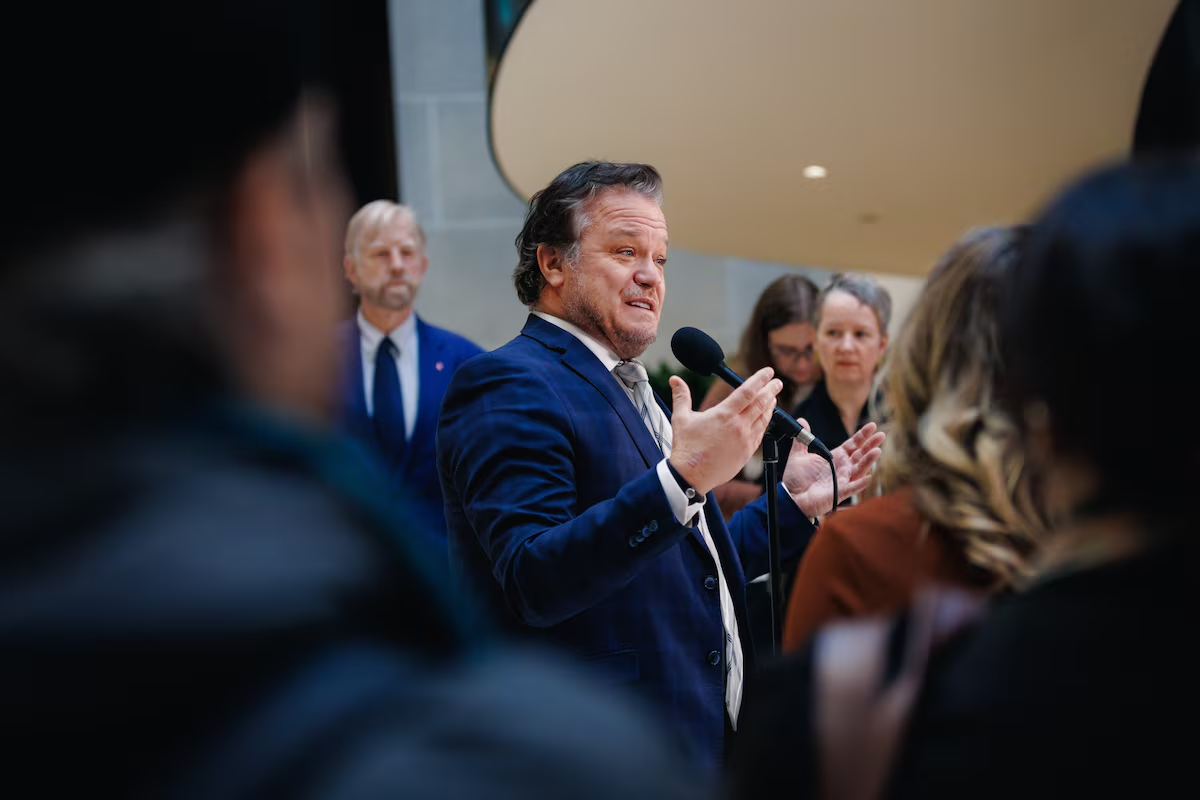
Frédéric Bérard, a Montreal lawyer who represented the Fédération autonome de l’enseignement, speaks to the media after the Supreme Court’s ruling.Keito Newman/The Globe and Mail
The Supreme Court’s near-total upholding of Bill 21, Quebec’s secularism law, has averted a political firestorm in the province amidst renewed constitutional tensions and disputes with Ottawa under a newly-elected sovereigntist government.
The legislation barring some public sector workers from wearing religious symbols is controversial in the rest of Canada and among minority groups, but is widely seen by francophones as an expression of the province’s distinctive values. The Court’s strong support for the use of the notwithstanding clause in this case will reassure many Quebeckers that their legislature can hold sway on important issues within the constraints of the Charter of Rights and Freedoms, politicians and lawyers in the province said.
“It’s a victory for Quebec secularism,” said Quebec Premier Paul St-Pierre Plamondon on Friday. “We were worried about the social peace if such a fundamental choice had been literally invalidated by the Supreme Court.”
Konrad Yakabuski: The Supreme Court’s ruling on Bill 21 will not end the debate over the notwithstanding clause
The Supreme Court judgement avoids what would have been a second potential constitutional crisis in Quebec this week, after a lower court ruled on Monday that the province’s legislators must swear an oath to the King, suspending a 2022 provincial law that abolished that requirement. Mr. St-Pierre Plamondon has said his separatist Parti Québécois plans to sit in the National Assembly as scheduled next week, with a ruling expected Monday on whether elected officials can sit without taking the oath while the case unfolds.
Although it defuses a political bombshell, the survival of Bill 21 was seen as a bitter defeat by some of the religious minorities and civil libertarians who opposed the law in court.
“It’s a dark day for Quebec and Canada,” said Stephen Brown, the Montreal-based CEO of the National Council of Canadian Muslims. “In our country in the 21st century, entire categories of people are now barred from entire sectors of employment, not because of what they have done, but because of who they are.”
English Montreal School Board chair Joe Ortona declared himself “extremely disappointed” by the ruling.
“It’s heartbreaking, gut-wrenching really to know that people can’t exercise their rights because of a law like Bill 21,” he said. “It prevented us from hiring qualified teachers for a completely arbitrary reason, and we’re in a labour shortage when it comes to teachers.”
Open this photo in gallery:
Protesters hold up signs against Bill 21 at a gathering at the University of Montreal on Friday.Adil Boukind/The Globe and Mail
Other Quebec opponents of the law found silver linings in the decision. Notably, three of seven judges found that large parts of the law should be voided because they violate the Charter’s gender equality protections. Samira Laouni, a hijab-wearing Muslim woman and Laval, Que. resident who has vocally opposed parts of Bill 21, said Friday’s decision produced mixed emotions.
“I’m disappointed by the judgement because it creates a two-tiered citizenship,” she said. “On the other hand, I’m relieved that it was such a close decision; it’s very satisfying that everyone doesn’t think the same.”
The roughly 500-page decision also saw the Court endorse judicial declarations that would allow judges to pronounce future laws inconsistent with the Charter even if they are protected by the notwithstanding clause, which some Quebec advocates saw as a major victory.
“It’s a very strong message about fundamental rights from the Supreme Court,” said Frédéric Bérard, a Montreal lawyer who represented the Fédération autonome de l’enseignement, a grouping of Quebec teachers’ unions. “You can’t violate fundamental rights without having to defend your bill in front of the courts.”
The same provision made Mr. St-Pierre Plamondon describe the ruling as a “setback” for Quebec’s autonomy, because it diminished the force of the notwithstanding clause. He said the possibility of judicial declarations against provincial laws was another reason for Quebec to become independent, an option his Parti Québécois government intends to put to a referendum in the next four years.
“We’ve just witnessed a major reversal for the provinces,” he said. “The only political and judicial solution is to subtract ourselves from a fairly unstable situation.”
Open this photo in gallery:
Joe Ortona, chair of the English Montreal School Board, said he was ‘extremely disappointed’ by the ruling.Justin Tang/The Canadian Press
Many observers doubt the Supreme Court ruling will help the separatist cause, despite the Premier’s arguments. Quebec Conservative Party leader Éric Duhaime called the decision “a victory for Quebeckers” and “a defeat for the referendum agenda of the PQ, which is often nourished, unfortunately, by defeats for Quebeckers.”
Political analyst Raphaël Melançon, who was a staffer for the governing Coalition Avenir Québec when Bill 21 was passed in 2019, said the judgement was good news for federalists in the province.
“I think it’s an illustration that Canadian federalism works,” he said. “To ordinary Quebeckers who are not nerds about the constitution, what they hear today is that Bill 21 is a done deal. Canada is not intervening in Quebec’s internal affairs.”
The fight over Quebec’s approach to religion in the public sphere will not end with this judgement. The notwithstanding clause shielding most of Bill 21 will have to be renewed in 2029, and the PQ has promised to go further in the meantime by banning students from wearing religious symbols in elementary schools.
Protests around the issue are likely to continue. Students at two Montreal colleges walked out of classes on Thursday to oppose Bill 9, another secularism law passed in April that bans most prayer spaces in public institutions, among other measures.