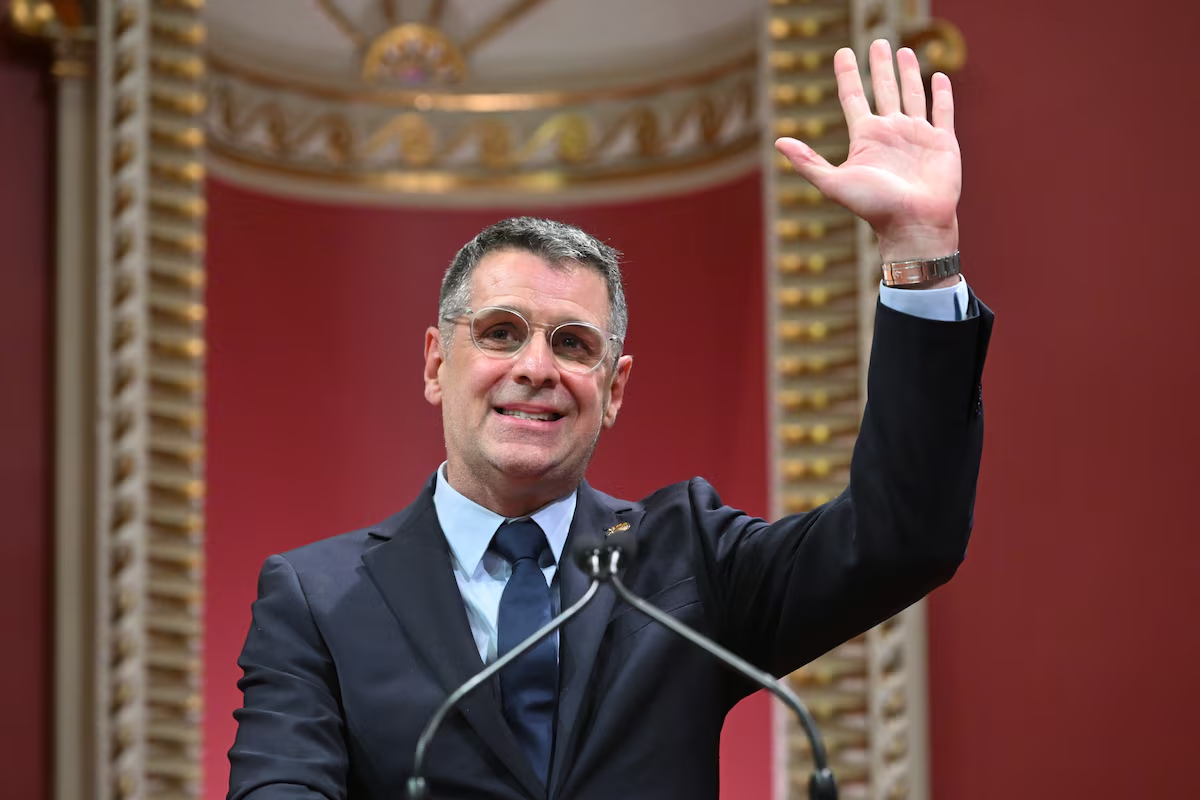

Open this photo in gallery:
Quebec Conservative Leader Éric Duhaime during a swearing-in ceremony at the legislature in Quebec City, on Oct. 22.Jacques Boissinot/The Canadian Press
It’s a safe bet that in 1980s Quebec, most preteens didn’t have posters of Margaret Thatcher on their bedroom walls. But then, Éric Duhaime has always been a bit of an outsider.
As a boy, he would run home from school to watch Question Period at Quebec’s National Assembly. He insisted on wearing his school uniform to supper.
The scrawny 16-year-old who wore a top hat and white gloves to his high-school prom was perhaps an unlikely candidate to become Quebec’s contrarian-in-chief. But Mr. Duhaime would transform himself from political aide to polarizing shock jock to the standard-bearer for pandemic rage.
Now he has remade himself once more as the sober head of a right-wing movement he has steered into Quebec’s political mainstream. A province that was once allergic to the Conservative brand suddenly elected 19 Tories last month, giving them the power to help decide the fate of a minority government led by the sovereigntist Parti Québécois.
Opinion: Quebec’s political mainstream has shifted to the right
Though Mr. Duhaime, 57, donned different hats before becoming leader of the Quebec Conservative Party in 2021, his politics have wavered little since he was a child gazing up at the Iron Lady. In books and on the airwaves, he has extolled the virtues of small government to a province known for its expansive bureaucracy.
It often seemed like a quixotic mission. Before this year, no Conservative had been elected to the provincial legislature in nearly a century. But amid a cost-of-living crunch and growing dissatisfaction with the state of Quebec’s public services, Mr. Duhaime has found his moment.
His success comes at an ambiguous moment for conservative politics in Canada, with the federal party faltering while Conservatives dominate provincial legislatures. Right-leaning parties now hold power in seven out of 10 provinces.
Mr. Duhaime is hoping to build an alliance with Conservatives across the country from his new perch on Quebec’s opposition benches. The long-time outsider has manoeuvred his party into the centre of provincial politics − and is doing his best to pull Quebec to the right.
“We didn’t have a Conservative force, and now we have one,” he said in a recent interview. “And I think it could change the dynamics of politics not just in Quebec, but all across Canada.”
Incoming Parti Québécois eyes friends and foes across the aisle
Quebec’s first government was Conservative, elected shortly after Confederation. But the party, closely tied to its federal counterpart, won its last election in 1892.
Over time, the Conservative label was poisoned in Quebec, not least because of the federal government’s decision to invoke conscription during the First World War.
In the 1930s, then-Conservative leader Maurice Duplessis dissolved the party into the Union Nationale, a right-wing alliance that channelled growing nationalist sentiment.
Mr. Duhaime came of age more than half a century later, after the Union Nationale had run its course and successive Liberal and Parti Québécois governments had established the “modèle québécois” − an interventionist state that administered a suite of social programs.
At the time, Mr. Duhaime’s libertarian principles ran against the grain. “Socialist ideas were much more fashionable,” he said. “I always believed in individual freedom.”
Raised in a nationalist household, he went to work for the Bloc Québécois in Ottawa but abandoned the sovereigntist cause after the 1995 referendum. He now says he’s ready to negotiate with Premier Paul St-Pierre Plamondon on anything except his promised independence referendum.
Instead, Mr. Duhaime took an interest in boosting provincial autonomy within Canada. He worked on Stockwell Day’s campaign for the leadership of the Canadian Alliance in 2000, and soon became a fixture of the conservative establishment.
Five takeaways from the Quebec election results
Today, he sees his party as a natural ally of conservatives across the country fighting “federal government intrusion.” Former Alberta premier Jason Kenney travelled to Quebec to speak to his caucus last week.
Federal Conservative Leader Pierre Poilievre recently said he is “very pleased that there will be a party in the National Assembly that will champion our priorities.” The two parties have no official ties.
But Mr. Duhaime eventually concluded that if conservative ideals were to flourish in his own province, they would need champions outside the world of politics.
In 2009, he became a talk-show host on Quebec City’s right-leaning “trash radio,” which specializes in outrage and provocation. He quickly developed a reputation as a fiery polemicist who, in the words of one prominent TV host, appeared to be “at war with everything.”
“He had no barrier,” said former Quebec City mayor Régis Labeaume. “The more toxic they are, the more money they make.”
Mr. Duhaime routinely caused offence and was reliably unapologetic. He came out publicly in a divisive 2017 book, The End of Homosexuality and the Last Gay Man, which argued that the battle for gay rights had been won and that LGBTQ groups were part of an “industry of victimization.” (When it emerged that his latest book, published this spring, was written with the help of AI, he responded with little more than a shrug.)
Quebec Conservative Party Leader Éric Duhaime admits to using AI to write book
But the pandemic and Quebec’s aggressive public-health measures drew the radio host back into politics. “I saw the fact that our civic rights, our individual freedom, even our democracy was at risk,” he said.
In 2021, he was elected leader of a new incarnation of the Quebec Conservative Party, which had languished ever since it was founded 12 years earlier. He railed against curfews and mandatory vaccination to his growing social-media following, tapping into a vein of discontent that helped him take nearly 13 per cent of the vote in the 2022 election.
“He really has a knack for getting his message across,” said Senator Josée Verner, a former federal Conservative minister who served as his campaign chair.
Still, those votes didn’t win him any seats, and the conspiracy theorists in his ranks made it easy to dismiss him as a fringe politician.
As the pandemic threat receded, Mr. Duhaime set about reinventing himself once more. The man who was at war with everything would now return to his roots, earnestly preaching lower taxes and more private health care.
“When you’re a radio host, you’re trying to polarize to get people’s attention,” he said. “You have to include everybody when you’re a leader of a party.”
Editorial: The real reason for the return of the Parti Québécois
In this fall’s election campaign, he emerged as a credible option for voters fed up with seeing their taxes rewarded with crumbling infrastructure and endless health care delays. His promise to shrink the size of government was echoed by most other parties.
“I think more and more Quebeckers are realizing that we’re not just heading toward a wall, we’ve crashed into the wall,” said Cédric Lapointe, Mr. Duhaime’s long-time right-hand man who now works in Mr. Poilievre’s office.
On Oct. 5, Quebeckers elected Mr. Duhaime and 18 other Conservatives to the National Assembly, mostly from ridings in and around Quebec City, where the federal Conservatives also hold a handful of seats. The party finished second in 32 of the province’s 127 ridings.
It was a stunning revival of a political brand that had been untouchable for so long. “The word ‘Conservative,’ he’s made it less toxic in Quebec,” said Ken Boessenkool, a senior campaign and policy adviser to former prime minister Stephen Harper and a long-time friend of Mr. Duhaime. “I think that’s an enormous feat.”
Not everyone agrees that Quebec’s political landscape is shifting to the right. Other right-leaning parties have come and gone over the years without calling themselves Conservative.
“There are people in Quebec who are angry,” Mr. Labeaume said. “People want a well-run government, but ask them if they want to lose services. The answer is no.”
Still, Mr. Duhaime believes Quebeckers are finally ready to “revisit the model” he has denounced for decades. “There’s more and more appetite,” he said. “It’s conservatism à la québécoise.”