Selena ‘Kublu’ Tucktoo of Taloyoak, Nunavut, remembers making parkas with her mom back when Tucktoo was in her early 20s.
“It was kind of complicated at first, but I learned,” she said. “They were fun to do. Lots of sewing.”
Tucktoo said she and other seamstresses in her community were making the parkas for the 1974 Arctic Winter Games happening in Anchorage, Alaska. Once the garments headed to the event, she didn’t expect to see them again.
Until now.

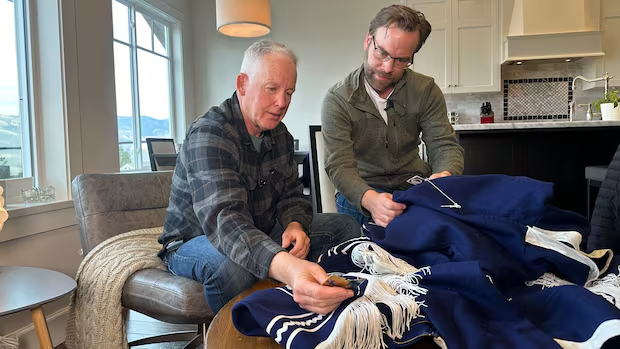
Selena ‘Kublu’ Tucktoo of Taloyoak was surprised to learn that a parka she created for the 1974 Arctic Winter Games was among those found at the Kamloops thrift store. (Liny Lamberink/CBC)
Some of those parkas were recently found at a thrift store in Kamloops, B.C. — and could soon be heading back to where they came from.
Mike Williams, a retired IT worker in Kamloops, found a parka bearing Tucktoo’s name at a Value Village in his city in mid-October, along with three others of a similar style. They caught his eye, but he didn’t buy them right away.
“I think it was the next day I went in, and they were still there, and I took a closer look at them and I knew they were special. So I bought them,” he recalled.

Williams bought the 4 parkas in mid-October, originally thinking he’d re-sell them. But as he learned more about their history, he decided to do something else. (Submitted by Mike Williams)
At the time, Williams thought he might be able to make money re-selling the parkas. They’d cost him $325 altogether.
But he was curious about them, so he posted about his find on social media and soon was in touch with people who knew more about the garments. That’s when he realized he didn’t want to sell them.
“I think they were meant to return to the community, and I think I was meant to get them there,” he said.
Hundreds of outfits made by craft collective
Arnaqarvik was a craft collective that started in the early 1970s in Taloyoak, then known as Spence Bay. Judy McGrath, who moved there from Newfoundland, and Arnaoyok Alookee, of Taloyoak, were instrumental in getting it off the ground, according to the Kitikmeot Heritage Society.
The society says the collective was contracted to design and produce nearly 400 outfits for athletes and dignitaries from the Northwest Territories for the 1974 Arctic Winter Games.
Archival photos show the parkas being worn by flag-bearers marching at the event in Alaska.

A photo in the N.W.T. Archives shows flag-bearers marching at the 1974 Arctic Winter Games in Anchorage, Alaska. (NWT Archives/Northwest Territories. Department of Public Works and Services fonds/G-1995-001: 0819)
In an email to CBC News, a collections manager with the Kitikmeot Heritage Society in Nunavut said the four parkas Williams found seem consistent in their materials and manufacturing, and pointed out that some have a “WG,” which stands for “Winter Games,” on their labels.
Three of the parkas Williams found still have labels attached bearing the names of the people who made them. The fourth, an amauti-style parka designed to carry a baby in the hood, has the name of its seamstress embroidered in Inuktitut syllabics.

Three of the parkas Williams found have labels attached to them with the name of the seamstress who made them. The seamstress who made the an amauti-style parka designed to carry a baby in the hood, is identifiable by a name embroidered in Inuktitut syllabics. (Mike Williams)
Tucktoo was surprised when she heard about Williams’s find at the Kamloops thrift store, and curious about how they ended up there.
“How come the people that wore them didn’t keep them, I wonder?” she said, speaking to CBC News on Tuesday during a visit to Yellowknife. “Maybe it’s not their style? I don’t know.”
Getting them back to Taloyoak
Williams was eventually able to get in contact with people in Taloyoak about the parkas, including some living family members of seamstresses who’ve since died.
He’s now trying to figure out the best way to get the garments back home.

A photo of the parka designs that the Arnaqarvik collective created for the Arctic Winter Games in 1974. (Kitikmeot Heritage Society)
Worried that a parcel might get lost somewhere along the 2,500-kilometre journey, Williams started thinking about delivering the parkas himself.
He was initially discouraged when he looked up the cost of flights. A return flight between Edmonton and Taloyoak in early December would cost more than $3,000, so he decided to reach out to airlines and ask for help.
Canadian North responded, and offered Williams and his wife free flights to the community.
The challenge now, however, is finding accommodation when they get to the community of around 1,000 people. But Williams said he’s determined to get the parkas back to Taloyoak, one way or another.
What happens to the parkas after that has not yet been decided. One idea that’s emerged from speaking with community members, Williams said, is to put the parkas on display at Taloyoak’s high school.
Pangniq High School principal Rod Drover told CBC News on Thursday he was just learning of the garments — but he was enthusiastic about making them part of a display the school is working on in its foyer. He encouraged Williams to get in touch with him.
“This is exciting stuff,” Drover said.
“Our desire is to celebrate the culture, making sure we have artifacts, things of history, relevance, and to showcase it, not only to our students but to the community.”
Williams said he’d bring the garments to the school and let the community decide from there what to do with them.
“They know what’s best,” he said.
Tucktoo supports having the parkas put on display somewhere in Taloyoak, but she’s also interested in having the one she made returned to her directly.
“I’m sure my daughter would love to use it for patterns.”