
Open this photo in gallery:
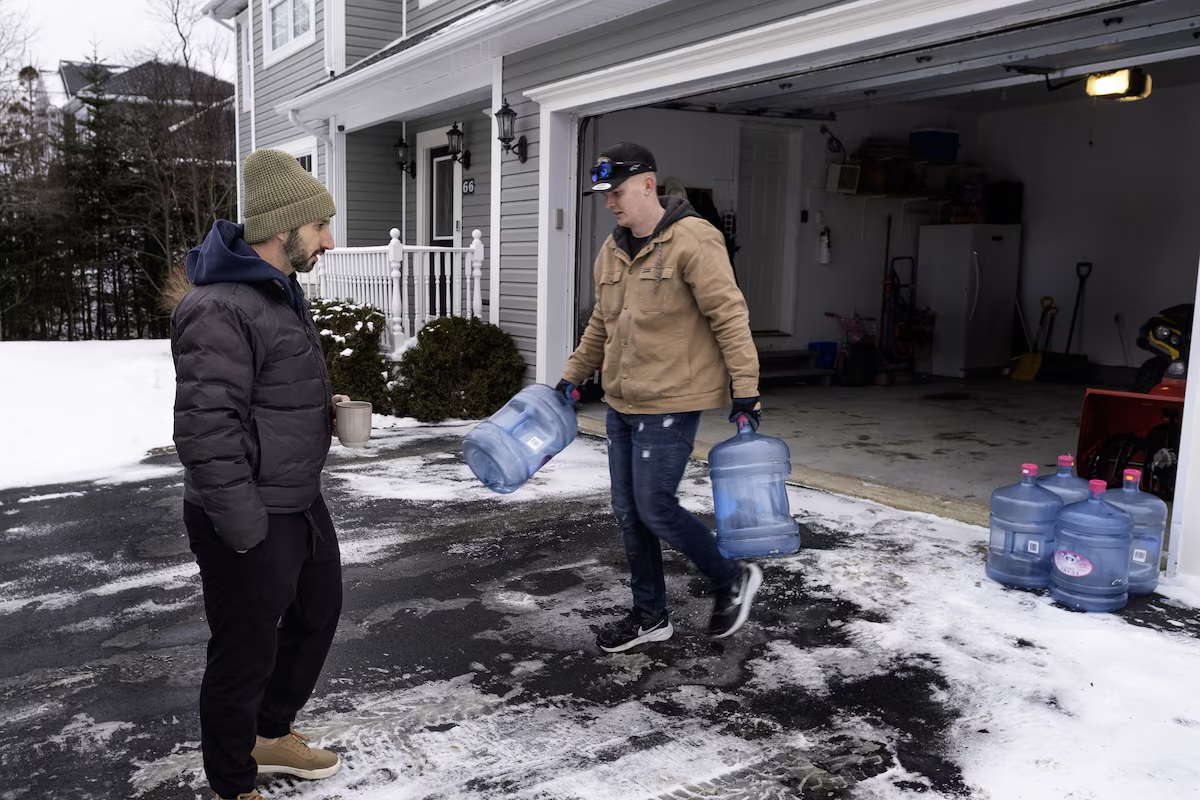
Ed Sheerr, left, getting his weekly water delivery in Torbay, N.L., in February 2025. Transport Canada has been delivering bottled water to Mr. Sheerr and other residents whose water exceeds the Health Canada threshold for PFAS concentration.Greg Locke/The Globe and Mail
More than two decades after firefighters last sprayed flame-dousing foam at a Newfoundland practice facility, high concentrations of toxic forever chemicals linked to those foams are still turning up several kilometres away, according to a new Memorial University paper.
The research, published earlier this month in the journal Environmental Science & Technology, appears to bolster the claims of residents living downstream of the St. John’s International Airport who are suing the federal government, alleging the chemicals have fouled their drinking water.
“The contamination the researchers found was significantly more widespread than even we had recognized,” said Ed Sheerr, one of the lead plaintiffs in a proposed class-action lawsuit on behalf of roughly 700 households in the area.
The lawsuit argues that per- and polyfluoroalkyl substances (PFAS) originating from the airport training facility have contaminated local well water, imperiling residents’ health and cratering property values. The plaintiffs are asking for immediate remediation and compensation for losses.
PEI family sues province over ‘forever chemicals’ found in their drinking water
Transport Canada, the federal agency responsible for the site, has acknowledged using PFAS-laden foams but in a statement of defence, it has denied that any PFAS migrated from the airport to drinking water wells. The agency declined to comment on the results of the published scientific paper.
Transport Canada spokesperson Sau Sau Liu wrote in an e-mail that given the proposed class-action lawsuit “involving the Government of Canada, and out of respect for the judicial process, Transport Canada will not comment on matters before the court.”
Memorial researchers began sampling local water in December 2024, after learning that Transport Canada wasn’t testing private wells outside a designated subdivision near the airport where PFAS had been found.
“We got involved because we wanted to better understand the issue and provide free testing for folks who wanted that,” said Karl Jobst, a Memorial chemistry professor who worked on the study, which was led by PhD student Emmanuel Tolefe.
Federal officials took years to notify residents of toxic chemicals in their drinking water
The researchers found the highest concentrations of PFAS in foams that naturally form on surface waters near the airport, with measurements reaching 2,000,000 nanograms per litre (ng/L), orders of magnitude higher than Health Canada drinking water guidelines of 30 ng/L.
Water samples near the airport were far lower, but still exceeded the federal guidelines, ranging from 318 to 2,302 ng/L.
Open this photo in gallery:
Karl Jobst at a PFAS water testing site in Torbay, in September 2025.Greg Locke/The Globe and Mail
Concentrations declined with distance from the airport, but levels remained well above drinking-water standards more than four kilometres away.
Researchers detected the chemicals in 32 of 42 private wells sampled. In seven of those wells, the PFAS levels exceeded the Health Canada guideline.
“It is concerning when these compounds are detectable above Health Canada’s drinking water guideline,” said Dr. Jobst, “They set that guideline for a reason.”
North Bay residents file lawsuit alleging ‘forever chemicals’ contaminated wells
PFAS refers to a family of more than 6,000 synthetic chemicals. Prized for their resistance to heat, water and oil, they have been a common additive in non-stick cookware, waterproof clothing and stain-resistant furniture since the 1950s.
In more recent years, PFAS have been linked to kidney and testicular cancer, metabolic disruption, immune suppression, pregnancy complications and other adverse health effects.
Open this photo in gallery:
Mr. Sheerr says he hopes the Memorial study will convince the government to work with residents rather than deny responsibility.Greg Locke/The Globe and Mail
One member of the chemical family, PFOS, was also a major component of fire-fighting foams used at the airport between 1982 and 2004.
The authors found that PFOS made up 62 per cent of the PFAS detected near the defunct practice facility.
Transport Canada has been delivering bottled water to Mr. Sheerr and other residents whose water exceeds the Health Canada threshold.
Federal agency failed to track ‘forever chemicals’ in Newfoundland town’s water, residents say
A Globe and Mail analysis last year found that eight communities across six provinces are in a similar position, relying on the federal government for bottled water to replace natural sources contaminated by PFAS.
Across the country, Ottawa has identified 86 federal properties where PFAS has fouled the groundwater.
The Memorial study could be a template for other communities seeking to map the spread of PFAS from contaminated sites. The researchers used novel spectrometry methods that allowed them to identify both well-known, regulated PFAS and those that are not readily identifiable using analyses.
Mr. Sheerr says he hopes the study will convince the government to work with residents rather than deny responsibility.
“Right now, every single day, I’m impacted by this,” he said. “We have to use bottled water for everything. And we’re not alone. There’s hundreds of families dealing with this and we just wanted to see it rectified.”