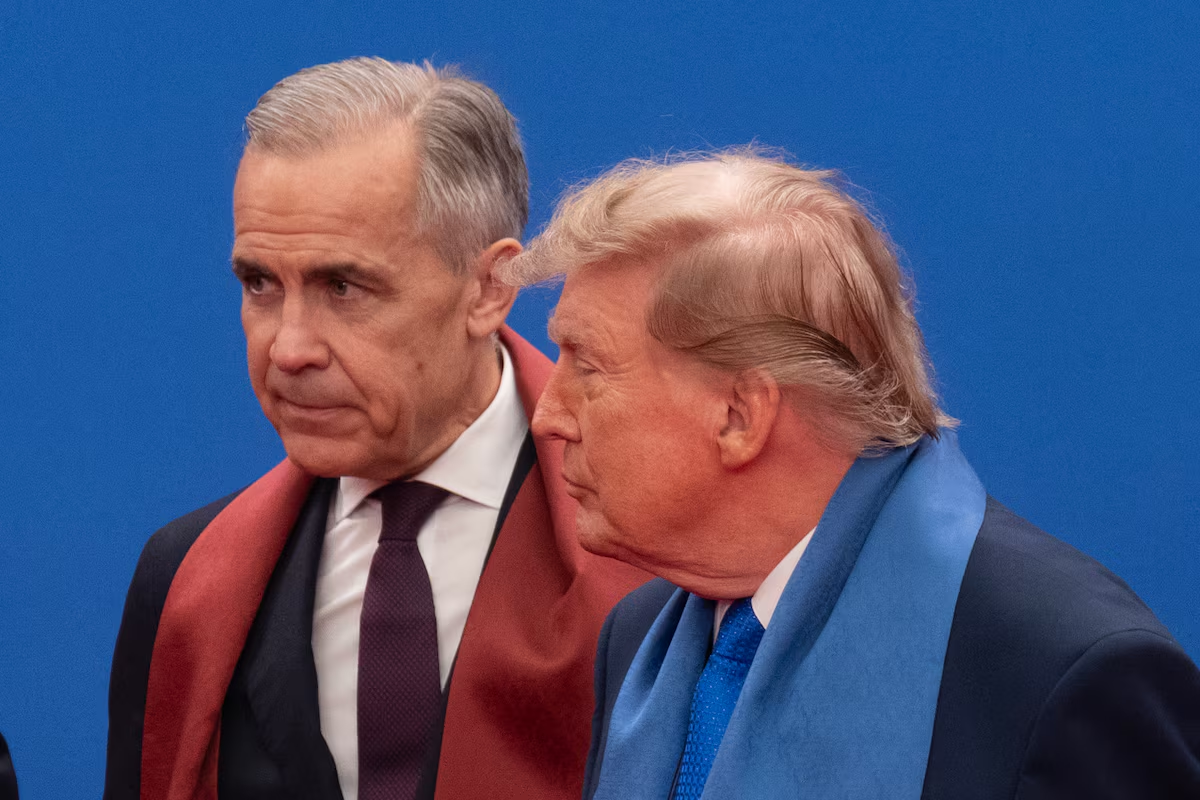

Open this photo in gallery:
Prime Minister Mark Carney and U.S. President Donald Trump at the APEC Summit in Shenzhen, China, on Thursday.Adrian Wyld/The Canadian Press
“I’m not MAGA.”
So said Elon Musk on Wednesday. Take it as the latest sign that the presidency of Donald Trump, and his supposedly permanent transformation of America and the world, is petering out after less than two years.
The world’s richest man is betting on it. So are others in Silicon Valley, across American business and within the Republican Party. They can read polls. They can see the election results. As the song says, you don’t need a weatherman to know which way the wind blows.
Mr. Musk sank hundreds of millions of dollars into backing Mr. Trump in 2024, and in this month’s midterm elections. He led the Department of Government Efficiency (DOGE), which lived out the MAGA fantasy going full Attila the Hun on the U.S. government. He appeared on stage with the President at rallies. He strode around with a chainsaw. He favoured hats with MAGA slogans like “Trump Was Right About Everything.”
Trump, Xi and Putin meet for historic trilateral summit in China
And while wearing an all-black outfit with a blacked-out Make America Great Again cap, he called himself “Dark MAGA” – a centibillionaire cosplaying Darth Vader, though coming across more like Dark Helmet from Spaceballs.
But now, Mr. Musk says he isn’t MAGA. Never was. And in any event, “I’m not sure what MAGA means, but if that means sort of blind adherence to a set of policies by the Republican Party, then I certainly don’t have that.”
He said that he now feels “pretty foolish” for having spent so much money backing Mr. Trump. He no longer believes that the Democrats are a mortal threat to the future; he now says that “there are positives and negatives” in both parties.
It’s morning in America, and Mr. Musk is one of many rebranding for the post-MAGA dawn.
American voters have overwhelmingly repudiated the Trump administration’s excesses, incompetence and appetite for self-destruction. The President will remain ensconced in his bunker for two more years, like the protagonist in Downfall, but his forces are in inexorable retreat.
They used to sing Tomorrow Belongs to Me. Now, they’re playing Yesterday.
Which raises the question: What does it all mean for Canada?
As America course corrects, how should Canada respond?
Straightlaced Carney is rattling the U.S. with his China reset – and it is unlikely comedy gold
Prime Minister Mark Carney was asked about that this week. Appearing remotely at the same event as Mr. Musk, he was asked what happens if, in 2028, the U.S. elects a president who says, “We want to be allies with Canada. We want to go back to the way it was.”
“You say what?”
Of all the questions lobbed at Mr. Carney, this should have been the easiest to hit out of the park. Yet he struggled to find the right words. He hedged and hemmed.
His answer should have been clear, unmistakable and enthusiastic: “Yes.”
“Yes,” he should have said, and should always say, “that’s exactly what Canada wants.”
Yes, we want to go back to Canada-U.S. free trade. Yes, we want to go back to zero tariffs on nearly all goods and services. Yes, we want to end Mr. Trump’s bizarre attempt to break up with Canada. Yes, we want to get back to the best of friendships.
And yes, we want to go back to full respect of the Canada-United States-Mexico Agreement – which means going back to the status quo ante before Mr. Trump’s tariffs on Canada.
Yes, yes, yes.
If that’s not what our trade negotiators are trying to negotiate, what are they doing? If that’s not what Mr. Carney talks to Mr. Trump about, what is it?
Carney contrasts ‘very professional’ Chinese trade talks with still-elusive U.S. deal
And if it’s not what Ottawa plans to spend the coming months pitching to the U.S. Congress and the American people – who are particularly ill-disposed to tariffs on Canada – then why not?
The American voter is on the same page as us. Carpe diem, Carney.
The Prime Minister is absolutely right that Canada must diversify our trade, our alliances and our partnerships in sensitive areas, from artificial intelligence and defence technology to payment systems. He’s right that we need to learn from the Trump experience, and avoid finding ourselves in positions of overdependence.
But geography means that the U.S. will always be our most important foreign relationship. Canada wants to make many new friends, and we should – but making new friends doesn’t have to mean diminishing an old friendship.
We want to build new ties with the rest of the world. We also want to restore broken ties with our former best friends. We want and need both.
The Americans are turning back toward us. Encouraging that turn should be Canada’s strategy; welcoming their return should be Canada’s goal.