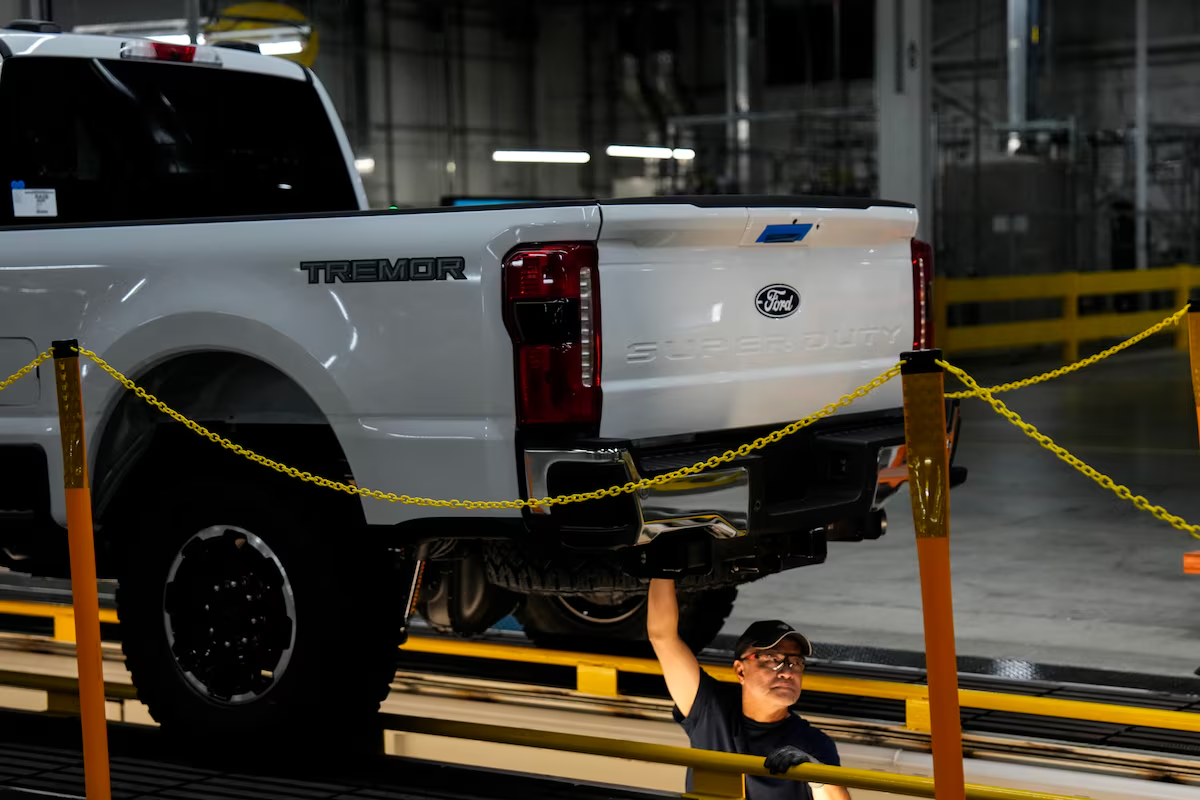

Open this photo in gallery:
An employee works on the assembly line at Ford Motors’s Oakville Assembly plant on Friday. Ford spent $5-billion retooling the plant to manufacture the company’s popular line of heavy-duty pickup trucks.Chris Young/The Canadian Press
Ford Motor Co.’s F-N assembly plant in Oakville, Ont., shuttered for more than two years, has reopened to make heavy-duty pickup trucks, defying the trade war and offering hope for the future of Canadian automaking.
More than 2,000 people have returned to work at the plant west of Toronto, which makes Ford’s F-Series Super Range of large pickups for Canadian, U.S. and global markets.
Detroit-based Ford spent $5-billion on the plant, retooling the assembly line and building a new stamping shop on site for body panels. The federal and Ontario governments contributed $464.5-million and $295-million, respectively, to the total.
Honda, Ford show commitment to Canadian auto plants despite tariffs
“Today is a big day for Ford and for Canada,” Bev Goodman, Ford Canada’s chief executive officer, said at a ceremony to mark the plant’s reopening on Friday.
Brad Walker, a 14-year Ford employee who assembles dashboards on the trucks, said he was glad to be back at work and never doubted the plant would reopen, given the customer demand.
Brent Hogenbirk, who started at the plant 30 years ago and conducts tests of finished trucks, has been back at work since May as the plant began ramping up production. “It was hard,” he said of the almost two years on layoff.
Premier Doug Ford and Industry Minister Mélanie Joly were among the speakers to hundreds of auto workers and Ford officials in an event marked by celebration and flashes of Canadian economic nationalism.
Open this photo in gallery:
Workers load trucks onto transport vehicles at the plant, where about 2,000 employees have returned to work. Oakville production will supplement output in Kentucky and Ohio.Sammy Kogan/The Globe and Mail
Mr. Ford’s mention of U.S. President Donald Trump, who has targeted much of Canada’s economy with tariffs, drew boos from the assembled crowd.
Lana Payne, national president of Unifor, which represents about 40,000 auto workers in Canada, a sector that has been battered by U.S. tariffs, called the plant’s reopening “nothing short of an industrial rebirth for Canada” and an “act of resistance” amid the trade war with the United States. She said the plant was a “lighthouse in some very dark times.”
Ms. Joly echoed Ms. Payne’s resistance comment and thanked all Canadians in these “tough days of dealing with American tariffs.”
Stellantis workers left in limbo as car plant’s future is determined
“Ford’s decision to invest in Oakville is a signal to the world that Canada is open for business,” Ms. Joly said. “Canada is competitive, and Canada is the place to build autos in North America.”
Ford’s Oakville plant, which used to make the Edge, closed in 2024 to be retooled for an electric car. Ford scrapped that plan amid slowing demand for EVs and began work to make the trucks, including the F-250, F-350 and F-450, which are all used in construction, agriculture and for other commercial purposes.
The work on the plant continued even after the U.S. last year widened its tariff policy to include the very trucks made in Oakville.
In an interview, Ms. Goodman said the reopening of the plant underlines Ford’s commitment to manufacture in Canada, dating back 122 years to a town near Windsor, Ont. The Oakville plant opened in 1953.
“This investment in this moment is really about staying true to our commitments,” Ms. Goodman said. “That’s a commitment to manufacturing here in Canada as well as to building new capabilities and supporting jobs here in Canada.”
Open this photo in gallery:
Assembled trucks are parked at the plant in Oakville. The facility has the capacity to produce 100,000 vehicles a year, some using engines made in Windsor.Sammy Kogan/The Globe and Mail
Including the smaller F-150, the F-Series trucks were bestselling vehicles in Canada and the United States in 2025, beating the Toyota RAV-4, according to DesRosiers Automotive Consultants Inc.
The Oakville plant made 3,488 trucks in October, and has the capacity to make 100,000 a year. Some of the trucks will use the 7.3-litre V8 gasoline engine made at Ford’s plant in Windsor. Ford recently announced a US$500-million investment at the engine plant.
“So what’s really cool here is you’re going to have a vehicle built in Oakville with engines from Windsor,” said Flavio Volpe, head of the Automotive Parts Manufacturers’ Association.
Mr. Volpe said the plant’s reopening signals the automaker believes Canada and the U.S. will eventually eliminate tariffs and abide by the terms of the U.S.-Mexico-Canada Agreement.
“It’s a very public bet that they think they’ll have tariff peace between Canada and the U.S.” he said.
Andrew Coyne: Too big to fail? Canada’s auto industry isn’t even all that big any more
Oakville production will supplement output at Ford’s Super Duty plants in Kentucky and Ohio.
Canadians bought more than 138,000 F-series trucks in 2025, outselling the nearest truck competitors combined, the GMC Sierra and Chevrolet Silverado, according to DesRosiers.
“The capacity that we’re adding here at Oakville to our system will allow us to meet that demand,” Ford’s Ms. Goodman said, “and it will give us the ability to deliver to our customers more configurations and shorten our order time for the trucks to get to customers.”
She spoke of the plant’s transformation over the past two years, from an almost empty factory and site, to the construction of the new stamping shop’s structure and the now-full employee parking lot.
“Seeing the activity over that time period with the folks who were transforming the plant, and now to have the employees back working full-time is just something to be really proud of,” Ms. Goodman said.
Open this photo in gallery:
A transport vehicle leaves the plant. Industry representative Flavio Volpe says the reopening signals Ford expects Canada-U.S. trade relations to normalize.Sammy Kogan/The Globe and Mail
Ms. Goodman said the company committed to Oakville production before the U.S. announced tariffs on heavy-duty trucks in October 2025. Ford supports renewal of the USMCA that, before Mr. Trump’s tariffs, allowed automotive and other goods to cross the border tariff-free.
“Our investments are long-term,” she said. “And they underscore that Canada is very, very important in our global Ford plan, but it’s also importantly a reflection of the capability of our team and the demonstration of the quality that they can build here.”
When asked why Ford did not delay the plant’s restart in the face of tariffs, Ms. Goodman said, “We made a commitment to our employees and made a commitment to our business, and we’ve retained those commitments, which is important to Ford.”