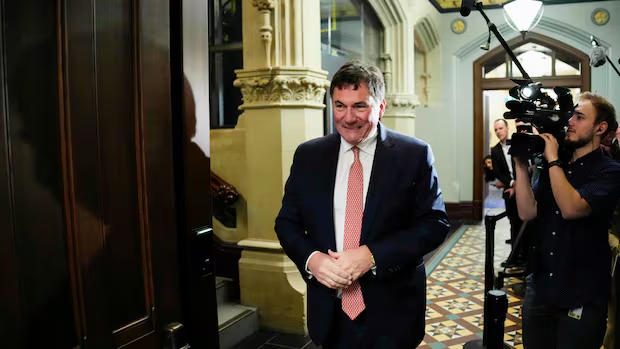
Canada-U.S. Trade Minister Dominic LeBlanc says if Canada can reach an interim agreement with the Trump administration, then that would likely kickstart formal talks around reviewing the trilateral trade pact with the U.S. and Mexico.
LeBlanc told CBC’s Power & Politics that an interim deal would likely include some level of Section 232 tariffs on steel, aluminum, auto and lumber, albeit at lower rates. But he said the government hopes to have further conversations on those levies in formal talks for the Canada-U.S.-Mexico Agreement (CUSMA) review.
“The Americans have been clear that if we come to an arrangement to reduce the 232 and 338 tariffs, we could also begin a formal review process that’s prescribed in the CUSMA agreement,” the minister told host David Cochrane.
LeBlanc argued that deals other countries have struck with the U.S. have all maintained some level of tariffs and that the goal is to reduce the 232 tariffs to a point where those industries could compete globally.
WATCH | Talks ‘have made some progress, but not enough,’ minister says:
Minister LeBlanc says Canada won’t get to zero U.S. tariffs
Power & Politics speaks with Canada-U.S. Trade Minister Dominic LeBlanc after he briefed the prime minister’s economic advisory council. Canada is now seeking to reach an interim tariff arrangement with the White House by the end of the year while negotiators seek relief on steel, aluminum, auto, lumber and other sectors.
“We have to be in a better comparative position,” he said. “But I think we have to be realistic with Canadians — in those particular sectors there is an element of those tariffs that are going to remain. But they have to be in a circumstance that the long-term economic viability of these sectors is assured.”
LeBlanc said the government wants to see the 338 tariffs, which Trump imposed in September, removed entirely. He said that progress toward an interim agreement with the U.S. was being made, but that there is still work to be done.
The minister briefed members of the federal government’s Canada-U.S. advisory committee earlier Thursday. CBC News reported that, based on discussions in that meeting, the government is seeking to reach an interim trade arrangement with the Trump administration by the end of the year.
After the previous round of trade talks fell apart in August, U.S. President Donald Trump threatened to slap higher levies on Canadian autos, car parts and steel on Jan. 1.
Not a hard deadline: committee member
Committee member Valérie Beaudoin cautioned that the end-of-year ambition isn’t a hard deadline.
“Maybe it’s going to go fast, but it can take a longer time. And we know when they deal with Donald Trump — and this is my opinion — it’s not always straightforward, it’s not always easy,” Beaudoin told CBC News Network host Andrew Nichols.
LeBlanc later echoed Beaudoin’s comments on the timing of an agreement.
“The idea is to get the best deal we can get for Canada as soon as possible,” he told Cochrane.
“If it takes until January or February to get that deal, we’ll do that work.”
Jean Simard, another member of the committee and head of the Aluminium Association of Canada, told CBC News that it’s “the opportune time” for Canada to negotiate.
“Next year there’s a new Congress being sworn in, a new Senate being sworn in with Democratic majorities in both — even though they cannot repeal a [presidential] veto. But still, they will take over part of the agenda,” he said.
The president’s Republican Party suffered massive losses in the recent U.S. midterms and some Democrats have pledged to try to end tariffs on Canadian goods once they officially take control of the U.S. Senate and House of Representatives.
But Flavio Volpe, president of the Automotive Parts Manufacturers’ Association and a member of the advisory council, told CBC News that “it appears that the dynamics in Congress have not yet hit the negotiating table.”
“The question would be: Is this the best time to do a deal with an administration that would like to take an issue off the table itself, without looking like it was forced to do by the new Congress? Or, is this an opportunity for the administration to fight with Congress and show that they’re really in charge?” Volpe said.
“It’s my read of it that different parts of this administration have a different opinion on it.”
LeBlanc said Canada shouldn’t see the Democrats taking control of Congress as a “magic bullet” that will end U.S. tariffs.
Prime Minister Mark Carney is heading back to Ottawa after a nine-day trade mission to Europe and Asia.
Speaking virtually to the Dealbook summit from China on Wednesday, Carney said Canada continues “to have a series of issues” when it comes to trade with the U.S.
The prime minister indicated that there had been progress toward an agreement in recent weeks but said they’re not at the point of putting anything to paper.
Carney met with Trump in China on the sidelines of the Asia-Pacific Economic Cooperation (APEC) summit — a conversation he described as “reasonably direct” but one that didn’t produce a trade breakthrough.
WATCH | Carney on the prospect of a U.S. deal:
‘If the U.S. doesn’t want to do a deal, we’re busy’: Carney
At the APEC summit in China, Prime Minister Mark Carney met face-to-face with U.S. President Donald Trump for the first time since trade talks fell apart. Carney, who secured a number of global deals at the summit, said if the U.S. still isn’t ready for a deal, ‘we’re busy.’
During his latest trip, Carney brokered free trade deals with the Philippines and the 11-nation ASEAN bloc — and secured meaningful market access for Canadian commodities in return for allowing a relatively small number of Chinese EVs to be imported at lower tariff rates and adjustments to import rules for certain Chinese steel and aluminum products.
“We’d like to do a deal. If the U.S. doesn’t want to do a deal, we’re busy,” Carney told the summit’s audience in New York.
Peter Navarro, one of Trump’s top trade advisers and a frequent critic of Canada, blasted Carney on Wednesday for seeking a more open trade relationship with China.
“Are you really threatening to play China off the U.S.? This is offensive in the extreme,” Navarro wrote in a social media post.
The White House official again criticized Canada’s negotiating tactics on Thursday.
“The arrogance and dishonesty of Ottawa on trade and misreading of their position is really something else,” he said.
“They are like a high school team taking on the New York Knicks. That doesn’t end well for Canada.”