Dominion Dynamics, an Ottawa-based defence technology company, has struck a deal with Canadian satellite giant Telesat, an agreement that opens the door to the development of a homegrown alternative to Elon Musk’s Starlink and its military variant, Starshield.
The $2.2-million partnership announced Thursday is part of a broader push to give the Canadian military greater control over the technology it relies upon to defend the Arctic.
The deal will see the two companies develop rugged, portable satellite antennas capable of connecting soldiers and uncrewed military aircraft to Telesat’s planned Lightspeed constellation of low-Earth-orbit satellites.
Securing the agreement is good news for Telesat, which faces a separate, but critical debt maturity issue. Roughly $3.1 billion in debt related to the company’s legacy satellite business is expected to come due between December 2026 and October 2027.
WATCH | More about Starlink and Telesat:
Carney wants Canada to move away from Elon Musk’s Starlink. Can it? | Hanomansing Tonight
Prime Minister Mark Carney says Canada will ‘diversify away’ from Elon Musk’s Starlink as it looks to reduce its reliance on U.S. technology. But with Canadian alternative Telesat Lightspeed still years away from full service, how difficult will that be?
Creditors have given Telesat management until Jan. 18, 2027, to reorganize the legacy end of the business, which is separate from the low-Earth satellite group that has signed with Dominion.
The project with Dominion, which includes financial support from the National Research Council, is intended to give Canadian troops a secure communications network that is not dependent on an American commercial provider.
Prime Minister Mark Carney has warned about the dangers of becoming dependent on a single technology provider whose decisions can have profound consequences for national sovereignty.
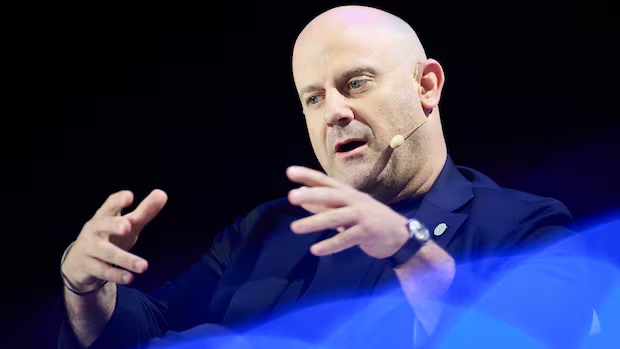
Eliot Pence, founder and chief executive of Dominion Dynamics, said the experience in Ukraine has demonstrated why Canada needs alternatives.
“Obviously, we’ve seen Starlink be shut off in Ukraine,” Pence said. “What we’re really building here is in addition to that [communications] structure.”
The technology being developed would allow military units and autonomous aircraft to communicate directly through the Canadian-controlled Telesat network.
Pence described the concept as something similar to Starlink’s portable satellite terminals, but designed specifically for military operations in Canada’s harsh northern environment.
“Think of it as a Starlink Mini, but a Telesat Dominion Mini,” he said. “It’s a sovereign comms link designed specifically for the Arctic” with military specifications.
Starlink difficult to avoid
The partnership does not mean, however, that Canada is about to abandon Starlink.
Pence suggested that the American company’s enormous satellite constellation makes it difficult to avoid entirely.
“It’ll have to have some interoperability with Starlink because the proliferation of their satellites is just so much more,” he said.
He said the goal, instead, is to ensure Canadian commanders have alternatives should one communications network become unavailable, unreliable or politically problematic.
Dominion’s existing communications technology is designed to manage multiple networks, allowing military systems to switch between them when necessary.
The company intends to develop two prototype terminals: a lightweight version that soldiers can carry into the field and a larger model for autonomous aircraft and other uncrewed military systems.
Both would be designed to withstand extreme cold and operate in remote locations with limited infrastructure.
The Canadian military is the intended first customer, although no defence procurement contract has been announced.
Dominion says the technology could eventually be used by Canadian Rangers, the Coast Guard, RCMP and emergency responders operating in the North.
There is, however, a significant hurdle.
WATCH | More about Dominion Dynamics:
AI drone warfare is here. Should Canada buy in?
Governments are spending billions on the autonomous arms race — should Canada join in? For The National, CBC’s Jennifer Yoon examines the future of AI-powered military weapons, what it means for international humanitarian law and where Canada fits in.
Telesat must first get its Lightspeed constellation into orbit and operational. The company currently expects to begin commercial service at high latitudes around the end of March 2028.
The Telesat agreement is one of several partnerships Dominion has announced this week as it attempts to establish itself as a major Canadian player in the rapidly expanding market for autonomous military aircraft.
On Friday, the company said, in addition to working on the Telesat receiver, Dominion has recruited the satellite-maker and a series of other Canadian firms to work on Scout, its uncrewed combat aircraft.
The other companies supporting the development of Scout include Thales Canada, Top Aces, ITPS Canada, PV Labs, SRC Can, Altitude Aerospace, Groupe DCM, HSB Solutions, North Aircraft Industries and RAMPF Composite Solutions.
Also on Tuesday, the company announced a collaboration with Pratt & Whitney Canada to provide the propulsion system for Dominion Scout, an uncrewed combat aircraft being designed to operate alongside conventional fighter jets.
Scout is intended to fly long distances over the Arctic, conduct surveillance and potentially carry out strikes against hostile targets.
The aircraft will be built around a Canadian-manufactured PW300-series engine.
Pence said securing an engine supplier was a critical milestone for a project still in development.
“You don’t really have a plane until you have a propulsion system,” he said.