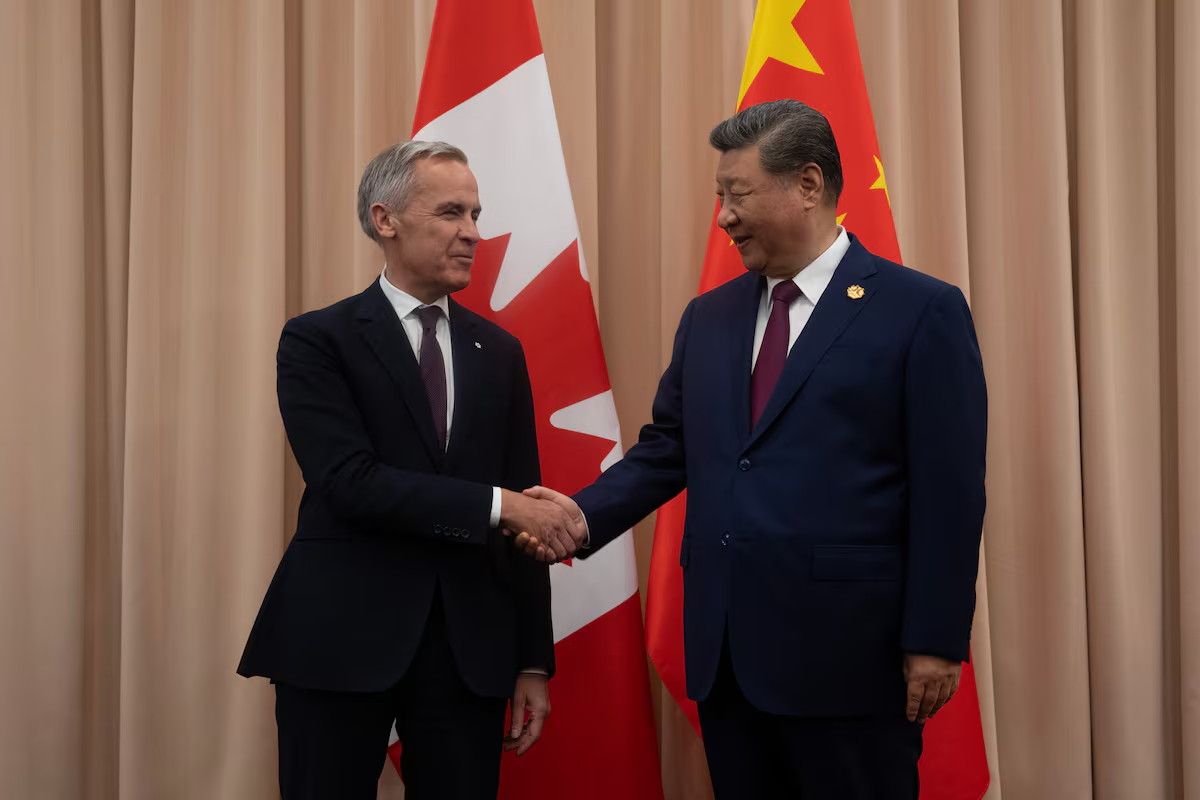

Open this photo in gallery:
Prime Minister Mark Carney shakes hands with Chinese President Xi Jinping at the start of a meeting in Gyeongju, South Korea, last month.Adrian Wyld/The Canadian Press
Prime Minister Mark Carney is on a roll with being droll.
The best part is that he is not intending to be funny. He is simply comporting himself like a statesman on the global stage by being prim, proper and focusing on advancing Canada’s economic interests with key trading partners.
Mr. Carney’s businesslike demeanour, however, is increasingly flustering U.S. officials as the two countries try again to reach a new trade deal – even though the United States-Mexico-Canada Agreement remains in effect.
Carney contrasts ‘very professional’ Chinese trade talks with still-elusive U.S. deal
In particular, Mr. Carney’s reset of Canada’s relationship with China appears to have gotten under American skin. It’s odd because U.S. President Donald Trump rolled out the red carpet for China’s President Xi Jinping in September.
Perhaps it is because Mr. Carney’s earnestness contrasts with Mr. Trump’s bombast. Whatever the reason, his deadpan delivery unnerved our American friends again this week. Frankly, it was a hoot to watch.
The Prime Minister made a series of matter-of-fact comments about Canada’s trade priorities. They included an observation that Ottawa would explore other options if the U.S. jeopardizes North America’s integrated auto sector.
“We have the best auto workers in the world, and we want them fully deployed,” Mr. Carney said in Cambodia. “That market has become less integrated because of U.S. trade actions.”
Mr. Carney has said Canada would reject any deal with the U.S. that erodes its domestic auto industry.
For his part, Mr. Trump has threatened to double auto tariffs from 25 per cent to 50 per cent on Jan. 1 and to apply them to auto parts for the first time.
“Depending on where that settles, and it’s part of the trade negotiations … there’ll be other options: European options; Asian options, of course – Chinese, Japanese,” Mr. Carney said.
Mr. Carney also said he planned to speak to President Xi about Chinese investment in Canada’s auto sector.
When asked if Canada was trying to get an edge over the U.S., Mr. Carney said: “It’s not leverage. But action, reaction.”
Logical, indeed.
Mr. Carney later remarked that negotiations with China regarding the removal of tariffs on Canadian pork and seafood “moved forward in a very linear fashion, and it’s all very rational.” As for the U.S., he pointed out that a trade deal “should have been done six months ago.”
No word of a lie.
Still, he triggered White House trade adviser Peter Navarro.
“The arrogance and dishonesty of Ottawa on trade and misreading of their position is really something else,” Mr. Navarro wrote in a social-media post on Thursday.
“They are like a high school team taking on the New York Knicks. That doesn’t end well for Canada.”
(Well, the Trump administration is like the L.A. Clippers, failing to perform in a good market. But I digress …)
Earlier this week, Mr. Navarro directed a separate post to Mr. Carney that stated in part: “Are u really threatening to play China off the U.S.? This is offensive in the extreme. You should be far more worried China is going to eat Canada alive – as it is already doing.”
U.S. Ambassador Pete Hoekstra reposted that missive.
Heavens to Betsy!
Why are these American gentlemen getting so bent out of shape because a Canadian prime minister is doing his job?
Mr. Carney would naturally seek tariff relief from Beijing and expand on the new Canada-China strategic partnership.
Ottawa had already outlined its conditions for Chinese electrical vehicle investment in Canada, suggesting it has learned from the missteps of the European Union.
Specifically, any Chinese investment must be made through majority Canadian-owned joint ventures. The cars must be manufactured with Canadian parts and by workers subject to local labour standards. Additionally, software used in the EVs must be secure and not compromise users’ data.
Earlier this year, Canada agreed to import up to 49,000 Chinese EVs at a low tariff rate. As of Aug. 31, only 16,211 of those vehicles have been imported into Canada. More are expected to arrive over the coming months.
This isn’t the first time that Mr. Navarro has attacked Canadian officials on social media. Earlier this fall, he referred to Mr. Carney and Ontario Premier Doug Ford as “the Sino twins.”
Why is he overwrought?
Canada is not pursuing a comprehensive free trade deal with China. A restrictive provision in the USMCA pre-empts Ottawa from signing such a trade pact with Beijing.
In fact, Ottawa wants to keep USMCA in place.
Mr. Carney is a quintessential Canadian do-gooder, who is playing by the rules. Officials of the current U.S. administration seem have a deep commitment to misunderstanding that.