
Open this photo in gallery:
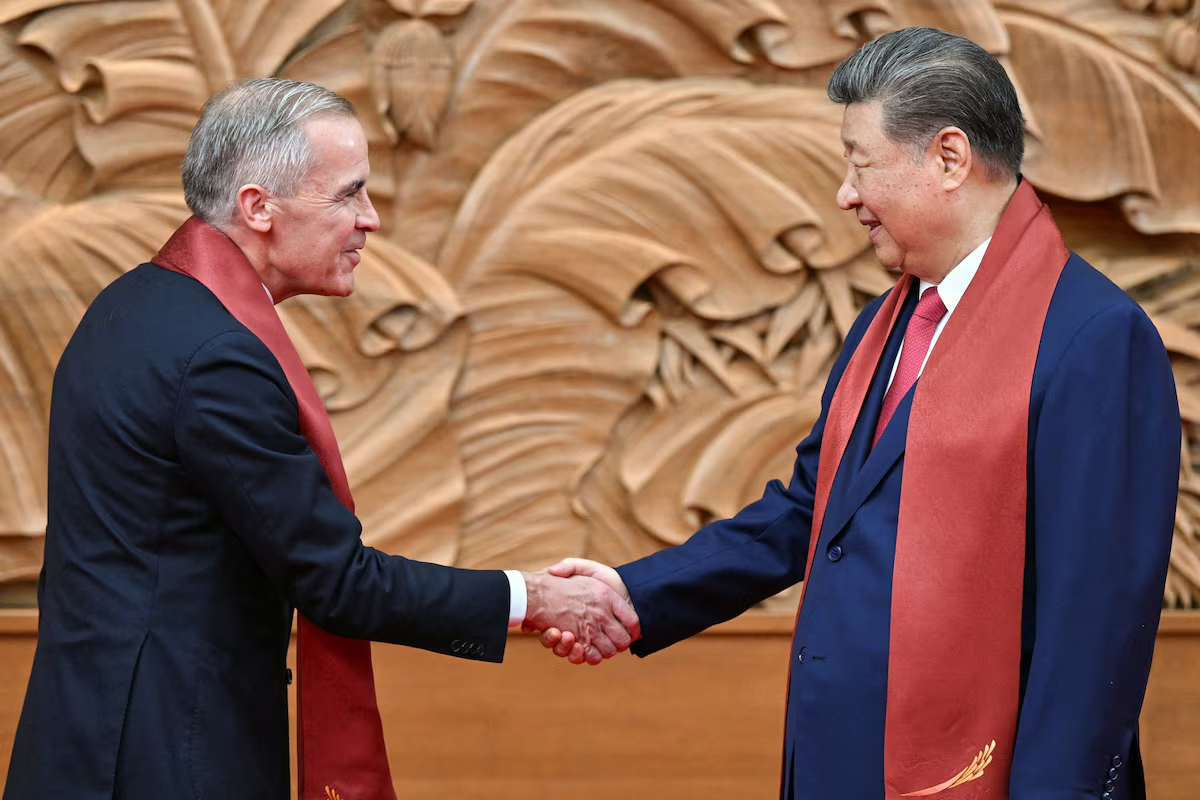
China’s President Xi Jinping shakes hands with Prime Minister Mark Carney before leaders take a group photo during the Asia-Pacific Economic Cooperation (APEC) Summit in Shenzhen, in China’s southern Guangdong Province, on Nov. 19.GREG BAKER/Reuters
National Bank of Canada plans to become a regular issuer of Chinese onshore panda bonds, potentially selling up to 15 billion yuan (US$2.25 billion) worth next year as relations between Ottawa and Beijing improve, a senior executive told Reuters on Thursday.
Prime Minister Mark Carney and Chinese President Xi Jinping have met twice this year to focus on improving trade relations to reduce reliance on the United States. Carney said on Wednesday the two countries had taken steps to widen access to each other’s markets for financial firms, after meeting Xi at the Asia-Pacific Economic Cooperation summit.
“Chinese investors have received the message loud and clear from the government authorities in China that Canada is welcome,” Vincent Joli-Coeur, National Bank’s chairman for the Asia Pacific region, said in an interview.
“We don’t want to raise all of our funding from either the Canadian or U.S. or European market. So for us to be able to access the world’s second-largest bond market, the Chinese market, it’s a no-brainer,” he said.
Montreal-based National Bank was the first North American bank to issue yuan-denominated panda bonds in China in 2016. Since then, the lender has received progressively larger issuance approvals from the People’s Bank of China, most recently for a 15 billion yuan program, Joli-Coeur said.
China offers alternative for Canada’s auto sector if U.S. no longer wants an integrated market, Carney says
China’s and Canada’s central banks have renewed a bilateral local-currency swap agreement and welcome qualified Canadian institutions to issue panda bonds, which are aimed at large investors such as bank treasuries, life insurance companies in China and institutional investors.
Joli-Coeur said Chinese investors were attracted by Canada being one of only two G7 countries with a AAA rating and the stability of the country’s banking system.
Six visits by senior Canadian officials to China in the past 12 months have also made it more appealing, he added.
The proceeds from future panda bond sales could be used to support Chinese investment in Canada, including in large infrastructure and energy projects, Joli-Coeur said, citing PetroChina’s investment in LNG Canada’s export terminal in Kitimat, British Columbia, as an example.
“Every time we have a road show in China, we make our commitment to the market because the (bond) program is approved,” Joli-Coeur said.