
Open this photo in gallery:
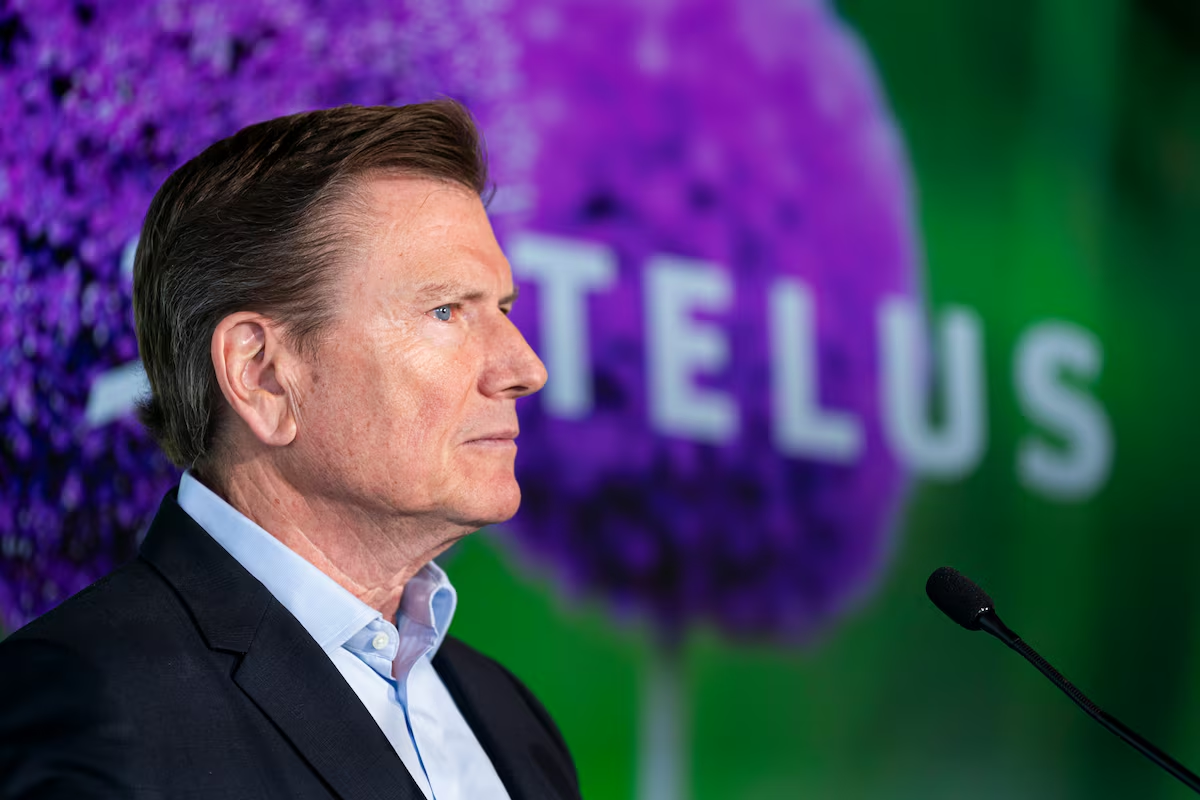
Darren Entwistle at a press conference in May.Rich Lam/The Canadian Press
Two days in, the palace intrigue is all anyone can talk about.
Ever since Quebecor Inc., a Montreal-based telecom company, went public with its $31-billion takeover offer for Telus Corp. on Monday, Bay Street has become obsessed with how this came to be.
The story has perfect casting. There is Telus, an industry incumbent, desperate to turn itself around under new leadership; Quebecor chief executive Pierre Karl Péladeau, whose guiding principle might just be chaos; and a federal government whose pro-competition policies helped Quebecor prosper, but is now being asked – by Mr. Péladeau of all people – to shred those same policies and allow the industry to consolidate.
The irony is almost comical.
But there is another character in this play, one who’s barely been mentioned thus far. Put him on stage and the narrative turns a bit tragic.
Over 26 years, Darren Entwistle grew Telus from its Western Canadian base into a national telco, and over time, he helped the company earn a premium valuation relative to its rivals. For many investors, Telus was the company they could trust.
Opinion: A Quebecor-Telus merger would be a problem for the industry – and for democracy
Yet over the past few years, it has all come crashing down. Telus’s shares have tanked, down roughly 60 per cent from their 2022 peak, and the company from which Mr. Entwistle retired this summer is vulnerable to a takeover from what was, until recently, a scrappy regional player.
The worst part: On his way out, Mr. Entwistle seemed oblivious to what’s transpired.
In an interview with The Globe and Mail in June, his outlook was mostly roses. Telus, he said, had strong fundamentals.
He stressed that since 2023, when Rogers Communications bought Shaw Communications, Telus had beat its archrivals Rogers and BCE Inc. on a range of metrics, including revenue (when their media businesses are excluded), free cash flow, and telecom subscriber growth, according to Telus’s calculations.
The reality: One month into the job, Victor Dodig, a Telus board member who took over from Mr. Entwistle as CEO, slashed the telco’s dividend by 55 per cent; pushed back the company’s debt reduction target by a year; took a $2.1-billion writedown on the Telus Digital division; and cut the company’s revenue and cash flow projections for the year.
Telus is by no means the only telco that’s suffered. Rogers’s shares are trading at 2013 levels.
BCE shares are even worse off, trading for the same price they did in the year 2000. The company has also slashed its dividend. (All three telcos paid dividends over these time frames that boost their total returns.)
How telecom stocks went from dividend darlings to portfolio poison
Ottawa has also made things difficult. Telus (and BCE) have both invested billions of dollars to upgrade their networks with fibre-optic cables, and these infrastructure programs were largely funded with debt. As they invested, Ottawa turned hell-bent on lowering prices for cellphone plans across Canada, and was successful at it.
Telus’s average revenue per user in its wireless segment today is hovering around $57 a month, almost the exact same as it was in 2021. Over these five years, inflation has soared. If cellphone plans had risen at the average inflation rate, average revenue per user would be around $67.
Ottawa has also reworked its immigration policies, sending the number of newcomers to Canada plummeting.
As revenue growth stalled and the number of new users dwindled, debt interest costs became unmanageable and the dividend had to get cut.
But that is only part of the story. For years, Mr. Entwistle deployed a diversification plan that included adding a health care unit, buying a human resources company and expanding into agricultural services and overseas call centres.
The thinking: Telus had a premium valuation, so it could raise money for cheaper than its peers. If these funds were invested in new businesses, it would broaden the company’s revenue mix.
The problem is that some of these purchases were also funded by debt, or involved assuming the target’s debt. In 2022, for instance, Telus paid $2.3-billion for LifeWorks (formerly Morneau Shepell), and assumed $600-million of the company’s debt. It also paid US$1.23-billion, including debt, for WillowTree in its Telus Digital arm.
Opinion: Quebecor’s offer for Telus exposes tension between creating national champions and competition law
For years, investors believed in the strategy. Mr. Entwistle could be trusted. Yet under the covers, it was actually a mess.
In July, when Mr. Dodig, the new CEO, cleared the decks, RBC Dominion Securities analysts Drew McReynolds ran the numbers and calculated that, since 2022, the Telus Digital and Telus Health divisions had lost between $5 per share and $6 per share in net asset value – or between $7.8-billion and $9.4-billion in total value.
As Telus wobbled, Quebecor prospered.
To start, Mr. Péladeau waited patiently to buy Freedom Mobile to expand his wireless network. (Freedom was owned by Shaw, and Ottawa forced its sale so that the combined Rogers-Shaw wasn’t too big.) He was also a beneficiary of Ottawa’s pro-competition policies. The federal government allowed smaller wireless players to use incumbents’ infrastructure to expand their networks, and that allowed Freedom to be aggressive on pricing and steal market share.
The company’s average revenue per wireless user today is only $36 a month – about two-thirds of the incumbents’ – but its number of mobile subscribers has nearly tripled since 2022 as Canadians scooped up its cheaper plans.
Shareholders have loved this growth, and at the start of the week, before the Telus takeover bid was announced, Quebecor’s stock had jumped roughly 50 per cent over the year prior. Telus’s shares plummeted 40 per cent over the same period.
Mr. Entwistle, who was paid an average of $19.7-million annually over the past five years, didn’t get into these sorts of details as he headed off for retirement this summer, but he did acknowledge that he was so closely tied to Telus, his baby, that the distinction between where he ends and the company begins was “opaque.”
Taking that at face value, he has to own what’s become of Telus, a company that was, not so long ago, the premium telco.