
Open this photo in gallery:
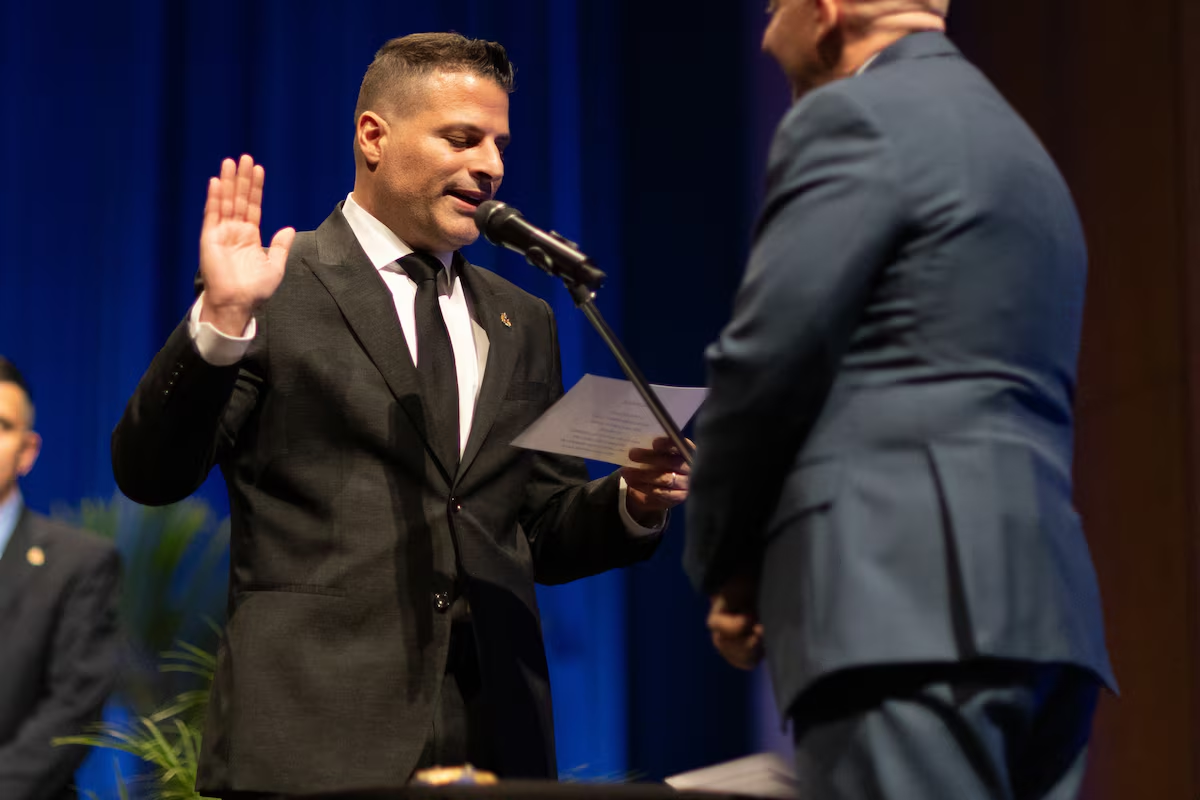
Fred Francis is sworn in as Windsor’s new mayor at the Capitol Theatre on Monday. He succeeds Drew Dilkens, who lost his bid for re-election after 12 years in office.Dax Melmer/The Globe and Mail
As Scotland the Brave blared from the bagpipes, hundreds of well-dressed Windsorites twisted to watch their new city council walk down the aisle to be sworn in.
Nine of the 11 council members drew polite applause. The crowd saved a full-throated Windsor salute for Councillor Darcie Renaud, the sole woman on council, and Mayor Fred Francis.
In his dark suit and skin-tight crewcut, the new boss looks a whole lot like an old boss. Mr. Francis’s brother Eddie held the mayor’s job from 2003 to 2014.
And the policies Mr. Francis laid out during a 15-minute inaugural speech had a familiar ring here: fiscal conservatism, downtown revitalization, a vow to stand firm in the face of U.S. tariffs and other economic challenges.
“Over the next four years,” he told a packed Capitol Theatre on Monday, “our work will be guided by a shared vision of a city that is financially responsible, economically competitive, safe, affordable, welcoming and full of opportunity.”
Despite his local familiarity, Mr. Francis is the face of a particular strain of change sweeping through local councils this week as new mayors are sworn in across Ontario. Voters in the province’s cities – and border cities in particular – issued an unusual rejection of incumbent leadership in last month’s elections. Among mayoral incumbents who ran in municipalities with more than 25,000 residents, about 52 per cent lost – a rate roughly double that of recent historical averages.
In border cities hit hard by Donald Trump’s tariffs and testy U.S.-Canada relations, the carnage was more pronounced. The mayors of Windsor, Niagara Falls and Sarnia all suffered defeat by nine or more percentage points.
Open this photo in gallery:
Mr. Francis delivers his inaugural address as city councilors applaud. He pledged fiscal responsibilities, downtown revitalization and a firm response to U.S. tariffs.Dax Melmer/The Globe and Mail
Of the 26 Ontario members of the Border Mayors Alliance, a coalition formed last year as a unified voice in the fight against U.S. tariff threats, only eight are returning to office. It’s a trend that politicians at all levels need to watch, said Martin Horak, an associate professor of political science at the University of Western Ontario who specializes in comparative urban politics.
“The voters who bothered to turn out municipally are clearly in a bad mood and that usually spells bad news for incumbents,” he said. “And we might see some reflection of that when we get to federal and provincial elections down the road.”
The Windsor election might offer hints of the complex voter dynamics at play. Incumbent mayor Drew Dilkens’s loss by 14 percentage points surprised even the most obsessive of city hall junkies. He had served in the chair since 2014. In his final term, he helped break ground on a new hospital and participated in ribbon cuttings for a $6-billion battery plant and an international bridge that nearly became collateral damage in the larger trade dispute.
As U.S. tariffs targeted Canadian automobiles, the Windsor region’s chief export, Mr. Dilkens became the face of municipal resistance, appearing on CNN and other U.S. networks. Early in 2025, he spearheaded the formation of the Border Mayors Alliance and ran the organization out of his office.
“If I look at my three terms, my most productive was my last term,” he said in an interview.
Municipal World, a national trade publication for local government, agreed, naming Mr. Dilkens the 2026 Mayor of the Year.
“The irony is not lost on me,” he said nearly two weeks after the disappointing election results. “But it just speaks to the fact that it was not about me. I don’t take it personally. It just was about the need to seek a different situation than the one we find ourselves in.”
Open this photo in gallery:
His victory was part of a broader wave of electoral change in Ontario’s border cities.Dax Melmer/The Globe and Mail
He ascribes the loss, and others like it across the province, to “a spell of uncertainty” cast by the Trump presidency. The spell is deepest in border communities where residents rely on U.S. exports, cheer U.S. sports teams and, in many cases, work U.S. jobs.
The economic data isn’t as gloomy as most people think. While the regional unemployment rate snuck past 11 per cent last summer, it has since retreated to around 7 per cent.
“The sentiment publicly is that the economy is struggling,” said Ryan Donally, president and chief executive officer of the Windsor Essex Chamber of Commerce. “But the data and the feeling are not aligning.”
Part of the sentiment could come from Windsor’s downtown street life. As civic-minded residents spilled out of the swearing-in ceremony on Monday night, scenes of human crisis were evident all over the core. A security guard outside a Salvation Army used his foot to nudge a man sprawled on the sidewalk. A screaming match between a man and a woman descended into a fist fight. A group of people left an empty morphine sulfate bottle behind on a park bench.
Pat Papadeas, co-host of the Rose City Politics podcast devoted to local concerns, said downtown issues were “a big part” of both the Dilkens and Francis campaigns.
“I think what really resonated with voters is Francis saying Dilkens had 12 years to address this,” Ms. Papadeas said. “I think absolutely that local issues, downtown being one of them, was actually more prominent than the broader border context for people.”
In short, all politics are local.
There was one notable exception to the turnover in border-city mayors. Sault Ste. Marie Mayor Matthew Shoemaker won a second term with 50 per cent of the vote. The local electorate was uneasy over layoffs at Algoma Steel, U.S. tariffs and increasing challenges around addictions and homelessness, he said.
He’d spent the previous four years dealing with those issues head-on and offering up a healthy dose of hope in the form of a massive port project. The city is still looking for provincial and federal assistance with the $250-million first phase. The finished project could bring 4,000 jobs and $900-million in annual GDP.
“That was critical,” Mr. Shoemaker said of his hopeful message. “It was critical because of the history of our community. We have faced these ups and downs before.”