
Listen to this article
Estimated 4 minutes
The audio version of this article is generated by AI-based technology. Mispronunciations can occur. We are working with our partners to continually review and improve the results.
At a news conference in May, Telus’s then-CEO Darren Entwistle made a rather saucy prediction about two new AI data centres planned for Vancouver.
“They’re going to be sexy as hell,” he declared with a grin, as he confirmed a partnership with developer Westbank Corp.
But the affair turned out to be more of a fling.
This week, the telecom giant confirmed it was abandoning its involvement in both projects.
“Telus has decided not to proceed with co-developing two previously announced Vancouver data centres with Westbank,” a spokesperson said in a statement, adding that the company would instead turn its focus to expanding an existing data centre in Kamloops, B.C.

Former TELUS CEO Darren Entwistle, speaking in Vancouver in May, said the new A.I. data centres would be ‘sexy as hell.’ (Ethan Cairns/CBC)
Westbank doesn’t appear to be wallowing.
In a statement, a spokesperson confirmed it had already found a replacement.
“We are proceeding with the projects as planned, with a new partnership that will be announced in the coming months,” the company said.
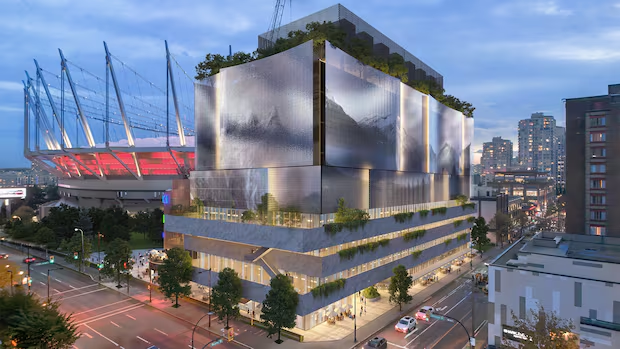
The first of the two centres, an office building formerly housing the Hootsuite headquarters in the Mount Pleasant neighbourhood, had been due to come online at the end of the year.
A second facility at West Georgia Street in the downtown area was planned to open in 2029.
Telus hasn’t given a reason for dropping the projects, leaving plenty of room for speculation.
“I assume that Telus is concerned about its reputational risks,” said Vancouver Coun. Lucy Maloney.

Vancouver Coun. Lucy Maloney says she believes Telus is concerned about its reputation. (Ben Nelms/CBC)
“I’m sure that it’s looking at the return on investment compared to complications dealing with public concerns about AI”
Vancouver’s newly elected council is set to consider and debate a motion from Maloney to tighten up approval processes for AI data centres at a meeting this week.
“All I’m asking staff to do is help recommend an appropriate robust regulatory framework to help us have the information that we need to assess rezoning applications for AI data centres,” she said.
“Because we know that AI data centres can have outsized impacts compared to other industrial and commercial uses.”
The motion failed to secure support when it was moved before the previous council, but Maloney is hopeful the new cohort elected in October will be more supportive.
“I’m expecting more success,” she said.
“It’s well known that the motto of Silicon Valley is to move fast and break things, but that is certainly not an appropriate attitude for any government regulator or governing body.”
‘A lot of uncertainty’
Grassroots protest group No AI Vancouver has played a major role in organized resistance to the data centres, arguing they are under-regulated and being rushed through without proper community consultation.
The group hosted a number of protest events across the city through 2026, some attracting hundreds of protesters.

Hundreds of people have marched in Vancouver this year to protest planned AI data centres. (Avery Woods/CBC)
Organizer Guerric Haché says he also believes public backlash is influencing the decision-making of companies like Telus.
“You saw lots of protests in the streets, you saw people writing letters. There were stickers all around town,” he said.
“There’s a lot of pushback against AI and that does seem to be increasing. There’s also increasing concern about whether the market is even stable. If it’s a bubble, if it’s going to collapse. There’s a lot of uncertainty.”
That uncertainty extends to Telus itself.
Montreal-based Quebecor has made a $31-billion takeover bid, which would create a company with a market cap greater than rivals Rogers and Bell.
Telus says it’s evaluating the offer, which is also subject to review by the Competition Bureau and the Canadian Radio-television and Telecommunications Commission.