
Listen to this article
Estimated 4 minutes
The audio version of this article is generated by AI-based technology. Mispronunciations can occur. We are working with our partners to continually review and improve the results.
A group of Manitobans doing volunteer work are back home after Friday’s closure of U.S. airspace forced them on a long journey across that country.
Doug Brown was returning from Nicaragua with about 40 other volunteers with Operation Walk Manitoba, a charity that provides surgical treatments to people in developing countries.
The former Winnipeg Blue Bombers player works for a medical device company. He was aboard a flight from Managua to Houston, Texas, when he learned U.S. authorities had grounded flights nationwide, causing tens of thousands of flight cancellations over the weekend.
“We were literally just about an hour and a half out of Houston, and we all found out via the internet,” Brown said Monday.
“I thought it was some sort of AI-fabricated joke.”
The nationwide stop, the longest in 25 years, was in place for about four hours Friday.
U.S. officials said a contractor was replacing a copper wire with fibre optic cable when an unknown issue triggered an air traffic control system outage.
Brown’s plane landed in Houston, but the outage delayed a connecting flight that would take the cohort of volunteers he was with to Denver.
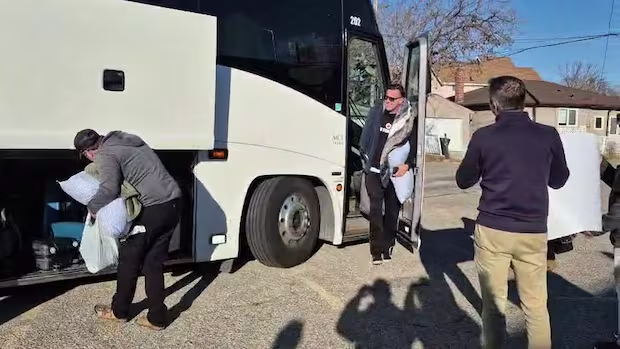
With cancellations rolling over into Saturday morning, the charity chartered a bus driving the volunteers back to Winnipeg instead.
The trip was about 28 hours long, Brown said.
“First stop, we went to Walmart just so we could get supplies,” he said.
He bought pillows, a blanket, electrolyte water and a couple of apples.
Two Americans would alternate driving the bus, one taking over while the other slept.
“We didn’t stop for dinner. We didn’t stop overnight. We just essentially stopped when the bus needed fuel,” Brown said.
“When we finally got to Winnipeg…, I almost laid down on the ground,” he said.
“We hadn’t showered or whatever in 24 hours. I was able to brush my teeth twice, but [it was the] first time I’ve done that at truck stops, right?…. It was a different world.”
Sense of perspective
A team of nearly 70 volunteers was in Nicaragua for more than a week as part of the mission, with medical professionals performing hip replacement surgery to patients with severe joint disease who can’t access that kind of care in the Central American country.
Medical lead Eric Bohm was in a cohort that managed to avoid disruptions while getting back to Manitoba.

Eric Bohm welcomed the volunteers who were left stranded in Texas after the U.S. ground stop. (Submitted by Doug Brown)
Bohm said those who made it home as planned wanted to make the other volunteers feel special. He was there to receive them at the end of their trip in Winnipeg.
“I thought … these guys are going to be tired and hungry and a little bit bummed out,” Bohm said.
“Let’s try to welcome them back home with some posters and some people showing up and some gift bags.… Just remind them, you know, how much the people in Nicaragua appreciate what they’re doing.”
Brown said he used to take a bus with the Bombers to Regina for the Labour Day Classic, but those trips were only about a quarter of the length of the 28-hour journey over the weekend.
He said nobody wanted anyone else to be in charge of the music. Everyone also wanted to avoid using the one tiny bathroom that was available.
At six feet eight inches tall, sitting in the bus was uncomfortable enough for the former professional athlete.
But Brown said the trip to Nicaragua gave him a sense of perspective.
“One of the surgeons on the bus ride said, you know, Nicaragua was one of the poorest nations in the entire Western Hemisphere.…
“This is still nothing compared to what the vast majority of those people go through on a daily basis.”
Senior officials in U.S. President Donald Trump’s administration blamed the grounding on aging air traffic control infrastructure and Congress underfunding.