
Open this photo in gallery:
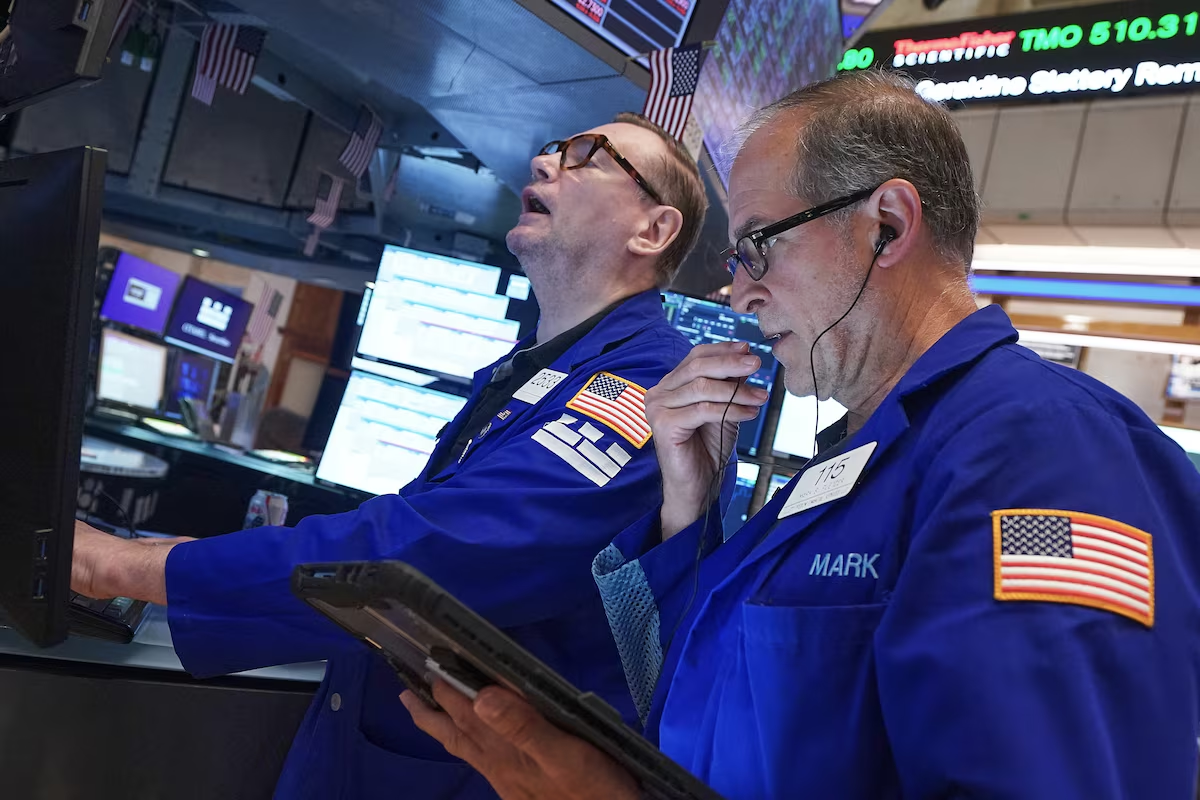
Specialist Patrick King, left, and trader Mark Puetzer work on the floor of the New York Stock Exchange, on June 26, 2026.Richard Drew/The Associated Press
Most of Wall Street is rising Wednesday, but drops for some influential technology stocks are keeping the market in check.
The S&P 500 rose 0.2 per cent and was heading toward a third straight gain following five consecutive losses. The Dow Jones Industrial Average was up 269 points, or 0.5 per cent, as of 11:45 a.m. Eastern time, and the Nasdaq composite was 0.1 per cent lower.
General Mills helped lead the market and climbed 7.1 per cent after the company behind the Cheerios and Progresso brands reported better results for the latest quarter than analysts expected. It also announced a plan to cut US$3-billion in costs over four years.
Opinion: What the ‘volatility anomaly’ can tell us about a possible stock market bubble
The market’s gains were broad, and two out of every three stocks within the S&P 500 climbed. The index erased an early loss after a report said U.S. manufacturing grew again last month, but at a slightly slower speed than economists expected. The survey from the Institute for Supply Management also said prices were increasing at a slower pace.
The data could take some upward pressure off inflation, which in turn could make the Federal Reserve less likely to raise interest rates later this year. Following the report, the yield on the 10-year Treasury pulled back from its peak near 4.50 per cent in the morning and fell to 4.46 per cent.
That offered some relief to markets because higher yields make it more expensive for businesses and households to borrow money and in turn can slow the economy. Higher yields also tend to undercut prices for stocks and other investments.
Yields have been on the rise since the war with Iran began because of worries about high inflation caused by expensive oil.
The wild ride in global markets this year that no one would have predicted
The heaviest weights on the market were stocks that had soared earlier in the euphoria around artificial-intelligence technology, including drops of 8.8 per cent for Micron Technology, 1.5 per cent for Nvidia and 8 per cent for Applied Materials. Such stocks have been zigzagging in recent weeks because of worries that they had become too expensive.
Kroger sank 1.1 per cent after the grocer said it agreed to buy Giant Eagle for $1.25-billion in cash. It will also take on $400-million in liabilities to buy the food and pharmacy retailer with stores stretching from Indiana to Maryland.
World markets walk a tightrope between AI stocks and oil shocks
Nike swung from an initial loss to a gain of 4.8 per cent after reporting a stronger profit for the latest quarter than analysts expected. The athletic-gear giant is in the midst of a turnaround attempt by CEO Elliott Hill, and he said it’s still facing headwinds dragging on its revenue.
Gold’s price also recovered from a morning loss to rise. It briefly sank below US$3,980 per ounce overnight, down from more than US$5,300 per ounce early this year, when Treasury yields were higher. When Treasurys are paying more in interest, investors become less willing to pay high prices for things seen as riskier bets. Gold, for example, pays its holders nothing.
But the weaker-than-expected manufacturing report and ensuing easing of Treasury yields sent gold back to $4,091.80 per ounce.
For their part, oil prices eased Wednesday as hope remains that the United States and Iran may ultimately end their war and reopen the Strait of Hormuz to oil tankers delivering crude. The price for a barrel of Brent crude, the international standard, fell 2.3 per cent to US$71.29.
In stock markets abroad, indexes were mixed in Europe and Asia.
South Korea’s Kospi fell 2 per cent for one of the world’s biggest moves. It’s been one of the world’s brightest stars thanks to euphoria around SK Hynix and other AI stocks, and the index is still up 97 per cent for the year so far.
In Tokyo, the Nikkei 225 rose 0.6 per cent after the Japanese yen fell to a 40-year low against the U.S. dollar.