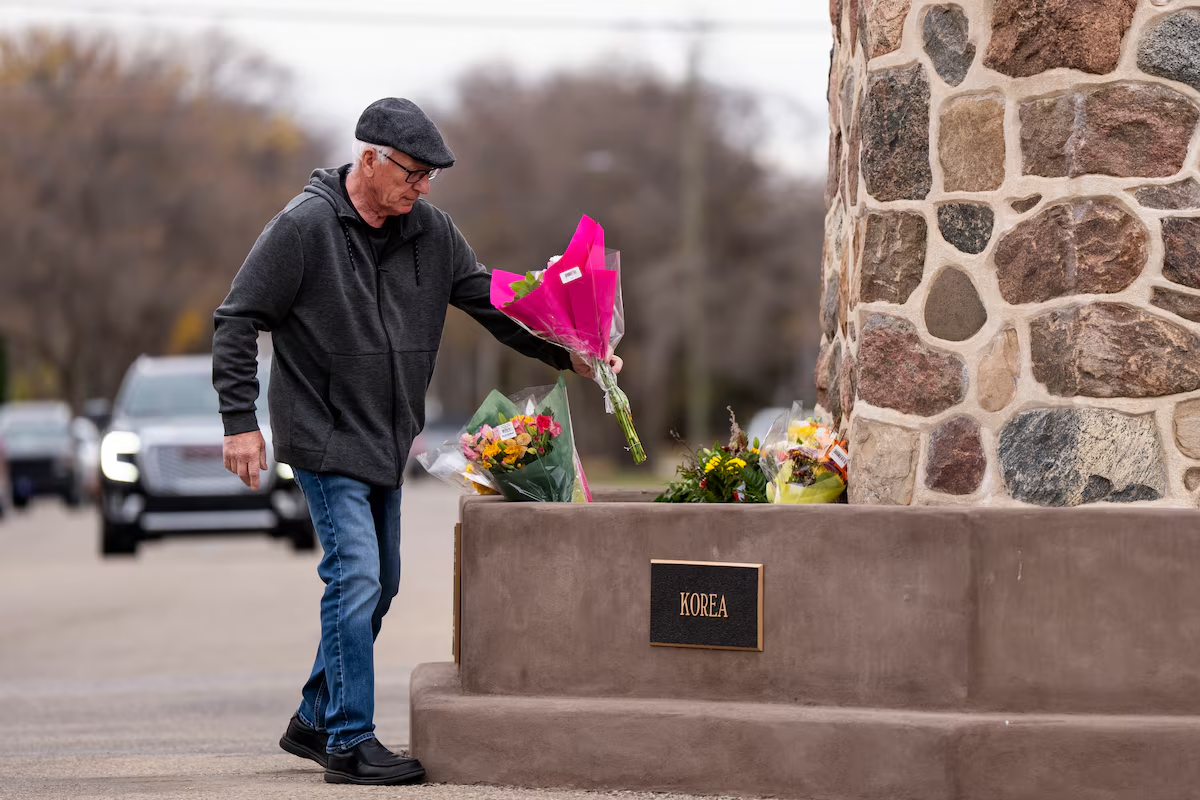

Open this photo in gallery:
A man pays his respects to the victims of a fire that killed four soldiers at CFB Wainwright, at the Memorial Clock Tower on Main Street, in Wainwright, Alta., on Oct. 19.Christopher Katsarov/The Canadian Press
The death of a fifth soldier from injuries sustained in last month’s massive fire at Canadian Forces Base Wainwright has underlined the vulnerable condition of the more seriously hurt victims of the Oct. 17 blaze.
Three sources with direct knowledge of some of the military personnel who remain in hospital described a number of soldiers’ injuries as profound, severe and life-altering. The sources described cases of devastating facial, head and neck trauma from the burns, as well as severe damage to hands, arms and upper torsos.
For some, the sources said, the injuries to the upper-body area were so significant the victims could not be easily identified after being pulled from the grass fire that erupted near the CAF base in central Alberta during a training exercise, or later in hospital.
The Globe and Mail is not identifying the sources because they were not authorized the discuss the soldiers’ conditions publicly.
The latest fatality, Private William Douglas Dal Bianco of the 3rd Battalion, Princess Patricia’s Canadian Light Infantry regiment, died Friday, nearly four weeks after he was hospitalized. He was receiving medical care in Ontario, the Department of National Defence said in a statement Saturday.
Open this photo in gallery:
Canadian Armed Forces member Pte. William Douglas Dal Bianco.The Canadian Armed Forces/The Canadian Press
Of the 38 remaining injured soldiers, 24 are still in hospital, the statement said. Four members of the CAF – Sergeant Morgan Wong, Private Shaun Farrell, Private Aidan Goulding and Private Hayden Lykkemark – were pronounced dead in the immediate aftermath of the fire.
In an e-mail response to The Globe, the department said it cannot provide more information on the hospitalized soldiers because “patient status falls within the clinical purview of provincial health authorities and attending clinicians.”
The department has refused to answer broad questions about how many soldiers remain in critical condition or remain intubated, citing privacy.
Acute Care Alberta said 21 of the military victims remain hospitalized in that province, with nine of them in critical condition as of Nov. 10.
Patients who suffer severe burns can die from complications weeks or months after the original injury, because they are in such a medically vulnerable state, Alan Rogers, a surgeon at the Ross Tilley Burn Centre, said in an interview.
Victims of Wainwright fire remembered as young people dedicated to service
“This is a recognized feature of severe burn injury. Surviving the first few days is an important milestone, but it does not necessarily mean that the danger has passed,” Dr. Rogers said. “This is particularly relevant when burns involve more than half the body’s surface, although burn depth, age, smoke inhalation and underlying health also influence the outlook.”
Part of Toronto’s Sunnybrook Health Sciences Centre, the Ross Tilley facility is Canada’s highest-volume adult burn unit, and it is among the hospital departments that have dispatched specialists to help treat the victims of the Wainwright fire.
Many of the soldiers injured at CFB Wainwright sustained extreme burns that will require multiple surgeries and extensive rehabilitation. Those with skin so scorched that it cannot heal on its own have required skin grafts, a surgical procedure where donated skin or a patch of healthy skin from another part of the patient’s body is removed and transplanted to the area needing repair.
In the first few hours and days after a serious burn, the immediate priorities involve maintaining the patient’s blood circulation and breathing, Dr. Rogers said. Following that initial phase, he said the threat becomes complications, such as infections, sepsis, blood clots, organ failure and lung issues.
“One reason for the prolonged vulnerability is that the skin is a vital protective organ,” he said. “Extensive, deep burns remove a large part of that barrier, and restoring durable wound coverage can require multiple operations. At the same time, a major burn profoundly disrupts the immune system.”
For those reasons, Dr. Rogers said, a patient can improve for a period of time, but then deteriorate rapidly should a complication develop.
Ottawa proposes $28-million to support those affected by CFB Wainwright fire
“There is no particular day or week after which every patient is safely out of danger,” he said. “Many people survive very extensive burns, but achieving that recovery can require weeks or months of co-ordinated surgery, intensive care, specialist nursing, nutritional support and rehabilitation.”
The CFB Wainwright incident is one of Canada’s worst peacetime training tragedies on home soil, with dozens more affected than the Slesse Range disaster in 1988 that killed six military engineer trainees and seriously injured three others during a demolition exercise at CFB Chilliwack.
Prime Minister Mark Carney, in a statement posted to social media on Saturday, said Canadians are holding all those who are grieving in the wake of last month’s tragedy in their hearts.
“Private Dal Bianco and his fellow soldiers were training to defend Canada. With their bright futures still before them, they chose to safeguard ours,” he said. “That is service. Now, we serve them.”
General Jennie Carignan, Chief of the Defence Staff, offered her condolences to Pte. Dal Bianco’s family, friends and those who served alongside him.
“We will honour his dedicated service and continue to stand with all those affected by this tragedy along the difficult road ahead. My thoughts are also with our injured members and their families, and I am deeply grateful to everyone involved in providing care and support during this time of tremendous sadness,” Gen. Carignan said in a statement.
Canadian Forces Provost Marshal Vanessa Hanrahan, who heads the military police, has said that the fire had started on CFB Wainwright’s automatic grenade launcher range and was monitored continuously throughout the day. “A subsequent change in wind direction and velocity significantly increased the fire’s intensity and rate of speed which led to these tragic events,” Brigadier-General Hanrahan said.
Military police have launched an investigation into the circumstances of the fire. The CAF has promised a separate investigation by its board of inquiry. Alberta’s chief medical examiner is also investigating.