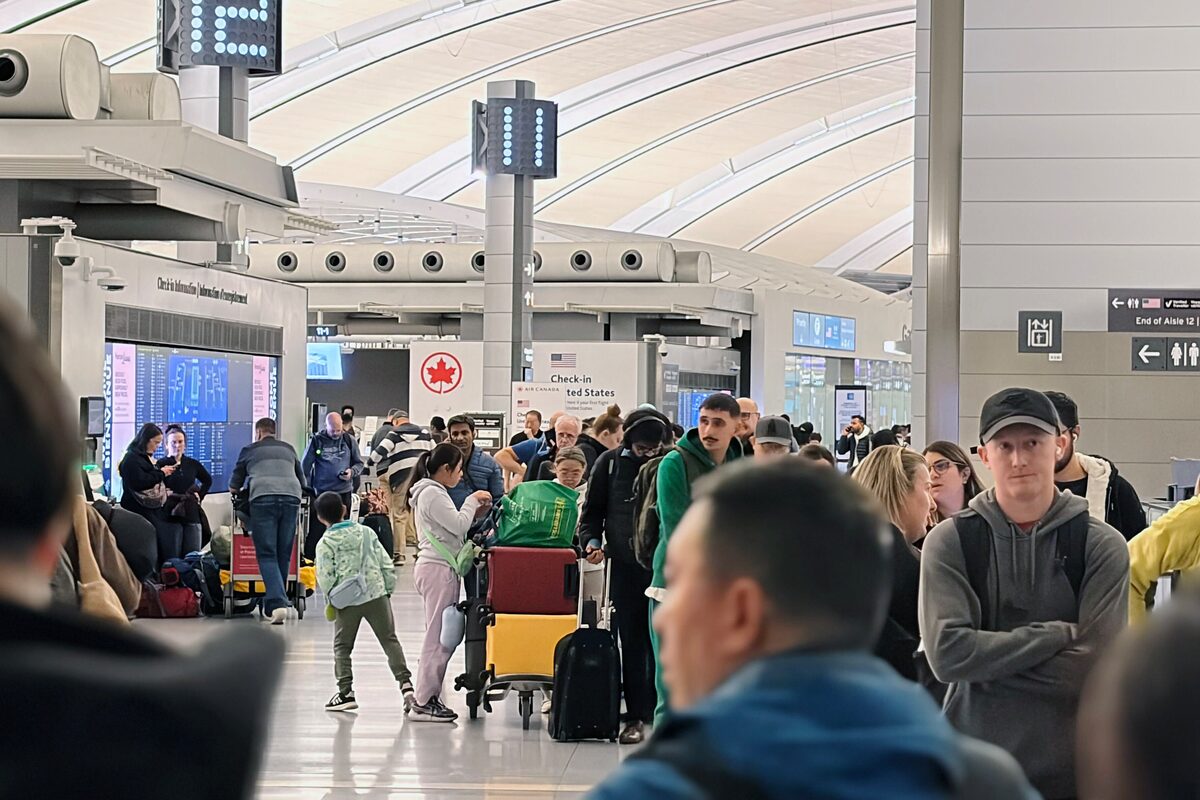

Open this photo in gallery:
People wait in line to rebook cancelled flights at Pearson International Airport in Toronto on Friday. Air Canada cancelled roughly 250 flights on Friday, according to a spokesperson.Sandra Ezekwesili/The Canadian Press
Canadian air travellers continued to face disruptions Saturday as more than 100 flights were cancelled and airlines scrambled to deal with the fallout from Friday’s U.S. nationwide ground stop that brought air travel to a grinding halt.
While Canadian air traffic systems continued to operate normally, the grounding of all flights departing from the U.S., which lasted about five hours, triggered a major knock-on effect in Canada and around the world.
Air Canada said Saturday it was adding extra flights to help stranded travellers get to their destinations, and several other airlines including WestJet and Porter said they were offering flight changes free of charge.
Spokesperson Yasmine Mehdi said Air Canada cancelled roughly 250 flights on Friday, affecting about 27,000 passengers.
“This was a significant disruption, and its effects have carried over into today, with additional cancellations as aircraft and crews are out of position across our network,” Ms. Mehdi wrote in an e-mail statement.
U.S. lifts nationwide ground stop after FAA order triggers widespread flight disruptions
In Toronto, 143 U.S.-bound flights were cancelled on Friday, a spokesperson for Pearson International Airport said. Another 63 were cancelled on Saturday.
Dozens of flights were also cancelled on Saturday in Montreal, Ottawa, Vancouver and Calgary.
The U.S. air travel schedule should be back to normal by the end of Sunday, Bryan Bedford, administrator of the Federal Aviation Administration, said on Saturday.
Some Canadians stranded away from home said they were anxious to resume their journeys after spending hours stuck in airports or onboard parked planes.
John Jacques had just walked up to his gate in Brisbane, Australia when news of the ground stoppage broke. The Toronto resident was returning home on a flight connecting through Dallas, Texas.
“When you’re on the opposite side of the world it’s just about the last thing you would expect,” he told The Globe and Mail.
Key moments from the FAA’s halting of U.S. planes on Friday
His flight to Dallas still boarded but had to await takeoff clearance on the tarmac. Including the journey time, Mr. Jacques spent 16 hours inside the plane. He arrived in Dallas in time to make a connection to Toronto, which was also delayed. For the time being, he is making the most of being off a plane.
“I’m quite happy to just be out of that and stretching my legs before the second hop,” he said.
“I’m used to the long hauls from Brizzy to Toronto but today is really feeling long,” he said, adding that the total journey is now stretching more than 24 hours.
But Mr. Jacques feels he got lucky compared to other passengers on his flight. He has a seat on the plane back home to Toronto. Others had to scramble to find other options, he said.
Maggie Sepulveda is a long-haul truck driver who drove from Dallas to Ontario this week. She had hoped to fly home to Dallas on Friday but said she’s still stuck in Toronto Pearson airport.
Her flight has changed three times. She had to pay to stay in an airport hotel last night and is late for her next job. On top of that, her phone is acting up and she’s had to sit in the airport Starbucks to get wireless internet.
In total, the delay has cost her more than $250 in accommodation and food, and she’s not expecting to be reimbursed. It’s the last thing she needs right now. Life is already expensive enough, she said. But she’s keeping things in perspective.
“I’m hopeful that I’ll be able to get out tonight, and I’m thankful that I’m safe,” she said. “Everything happens for a reason.”
South of the border, meanwhile, officials are still searching for answers around what caused the longest nationwide flight shutdown since the Sept. 11, 2001, attacks.
U.S. Transportation Secretary Sean Duffy said on Saturday that FAA contractor L3Harris’ installation of at least one new router at a remote facility triggered the disruption.
Mr. Duffy said that the router being replaced started “flooding” other routers in the country’s air traffic control system, disrupting communication lines to airplanes and scrambling radar feeds.
But it’s unclear whether the problems were the result of “incompetence” or a faulty router, Mr. Duffy said.