
Open this photo in gallery:
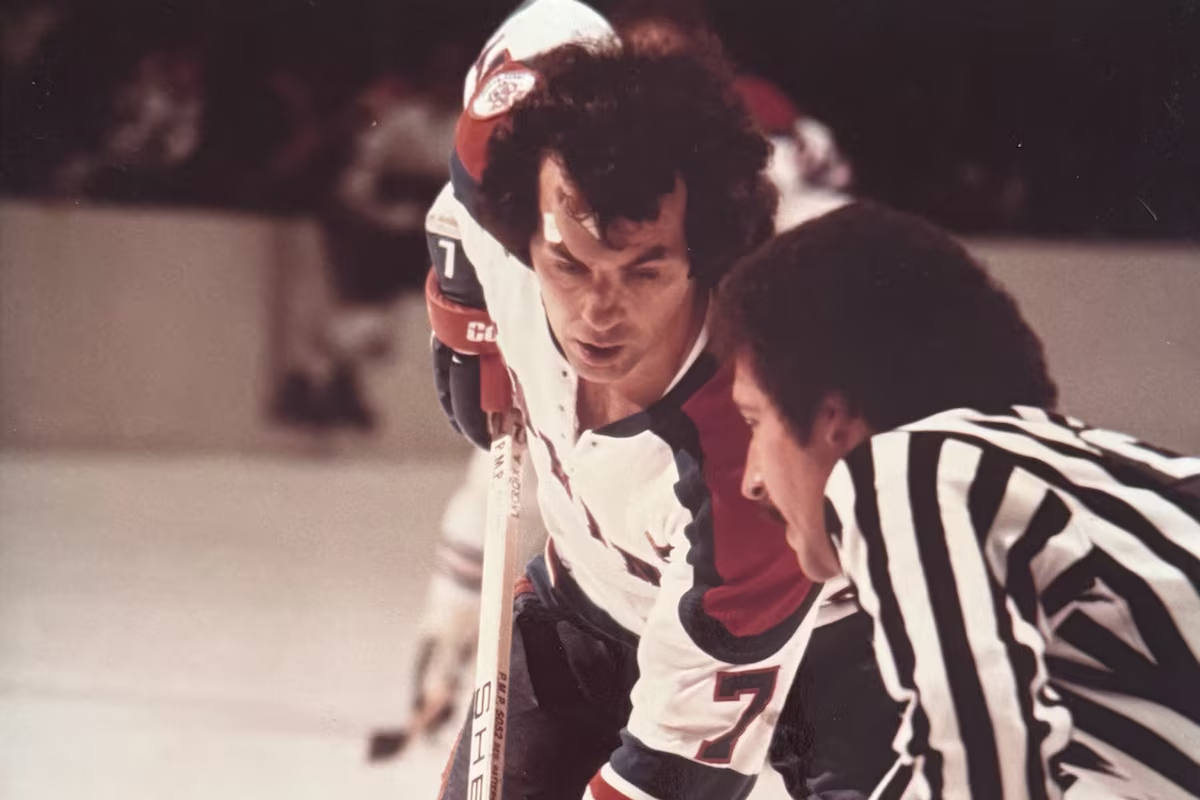
Andre Lacroix, the WHA’s all-time top scorer, was nicknamed the Magician for the legerdemain of his stickhandling.Supplied
André Lacroix was an average skater but a brilliant playmaker who survived seven wild and wacky seasons to emerge as the World Hockey Association’s all-time top scorer.
The WHA was launched in the early 1970s as a rival to the well-established National Hockey League. By offering large salaries, the league managed to lure away such stars as Bobby Hull, Gordie Howe, Dave Keon and many others.
The unheralded Mr. Lacroix skated alongside all three of those future Hockey Hall of Famers over seven peripatetic campaigns. He played for franchises that folded, for franchises that changed cities and, memorably, for a franchise in which the coach travelled with wads of cash because hotels would accept the athletes only if the bill was fully paid in advance.
The slight centreman, who stood just 5-foot-8 (1.73 metres) and weighed 175 pounds (79 kilograms), was nicknamed the Magician for the legerdemain of his stickhandling and for the intuitive genius he displayed in passing the puck.
When the remnants of the WHA were rolled into the NHL before the 1979-80 season, Mr. Lacroix held permanent records for most regular-season games played (551), most assists (547) and most points (798).
Mr. Lacroix, who has died at 81, was as savvy in negotiating contracts as he was in making pinpoint passes on the ice. Working without an agent, he earned more than many of his peers by including a clause making him a free agent if a club moved cities or stopped operating. He also got desperate owners to include several bonuses for scoring. He signed to play for a team based in San Diego by cajoling multi-millionaire owner Ray Kroc, who made his fortune with McDonald’s restaurants, into guaranteeing his salary over six seasons even if he retired or played for another team.
“I was probably one of the few guys who never missed a paycheque,” he wrote in After the Second Snowfall, his self-published 2020 memoir.
Often overshadowed by more famous teammates, he proved his talents on the global stage, emerging as one of Canada’s stars in an eight-game showdown against the Soviets held two years after the more famous Summit Series of 1972.
Despite a successful career, he has not been enshrined in the Hockey Hall of Fame, a snub he believed he suffered because he had abandoned the NHL for an upstart remembered as the Rebel League.
He was born in Lauzon, Que., a shipbuilding town now part of Lévis, across the St. Lawrence River from Quebec City, on June 5, 1945. He was the youngest of 14 children – Lorraine, Raymond, Hervé, Marcel, Bertha, Pierrette, Monique, Colette, Maurice, Françoise, Hélène, Claude and Jacques – born to the former Albéa Lapierre and Alfred Lacroix, who worked at an automobile repair shop, among other jobs.
Open this photo in gallery:
André Lacroix proudly holds the trophy from the three consecutive Bienville Midget Championships of 1959, 1960 and 1961. More than six decades later, he considers these consecutive victories a defining highlight of his remarkable hockey career.Supplied
The boy, who shared a bed with a brother, learned to skate at school at age six and later cleared the ice at a public rink in exchange for not paying a 50-cent admission. He did not play an indoor game of hockey until age 13, when he was bumped up a level to play with and against older teenagers on an area all-star team that won three consecutive provincial championships.
“For me, hockey always came first,” he told the Houston Post in 1978. “During the summer, instead of chasing girls, I would play baseball and tennis so I could keep in shape.”
In junior, a coach insisted he practice skating and stickhandling while blindfolded, a regimen the player credited for developing his superior puck sense.
After a season with the Montreal Junior Canadiens, he spent two seasons of junior with the Peterborough Petes of the Ontario Hockey Association. He led the circuit with 120 points in just 48 games in 1965-66, winning a second consecutive Albert (Red) Tilson Memorial Trophy as the most outstanding player, beating out a promising young defenceman named Bobby Orr.
The centre turned professional with the Quebec Aces, who played across the river from his hometown.
In 1967, the Philadelphia Flyers, one of six NHL expansion teams preparing for their inaugural season, purchased the Aces to serve as a farm team while also getting the rights to 11 players, including Mr. Lacroix, not under contract to NHL teams.
Near the end of the season, the Flyers called up the centre, who scored a goal in his debut and added a goal and three assists in his second game. Quebec wanted him returned for their own playoff run, while the Flyers wanted his scoring punch.
He stayed in Philadelphia, though the team’s home arena, the Spectrum on Broad Street, had to be closed for repairs after strong winds blew off part of the roof. The team played home games at Madison Square Garden in New York and Maple Leaf Gardens in Toronto before settling in at the Colisée in Quebec City, where the rookie centre had starred for the Aces. On his return, grateful local fans presented the hometown hero with a new Oldsmobile Cutlass Supreme.
Open this photo in gallery:
Near the end of the 1967 season, the Philadelphia Flyers called up Lacroix, who scored a goal in his debut game.Supplied
Playing on what was called the French Line with Jean-Guy Gendron, of Montreal, and Dick Sarrazin, of Saint-Gabriel-de-Brandon, Que. (the latter later replaced by Simon Nolet, of Saint-Odilon-de-Cranbourne, Que.), Mr. Lacroix scored a respectable 66 goals over three seasons with the Flyers.
When coach Vic Stasiuk ordered the team’s Francophone players to stop speaking French in the dressing room, on the bench and on the team bus, the ban was leaked to the press while the team was in Montreal for a game against the Canadiens, further distancing the players from management. The team and the league later clarified they wanted the players to speak English during games.
The Flyers adopted a rougher, more physical style, becoming known as the Broad Street Bullies. Mr. Lacroix, known more for finesse than fisticuffs, was dispatched to Chicago for defenceman Rick Foley, a scofflaw who spent 306 penalty minutes in the minors the previous season.
The Blackhawks had no plan for their new acquisition, who was often a healthy scratch.
“He’s the only French-Canadian hockey player I know who can’t skate,” coach Billy Reay said.
The WHA arrived just in time to rescue Mr. Lacroix. He was drafted by the Quebec Nordiques, but they could not match his contract demands. His rights were then sold to the Miami Screaming Eagles, who folded before the season started. New owners purchased the franchise, and Mr. Lacroix returned to Philadelphia as a member of the Blazers, doubling his base NHL salary by signing for $60,000 plus performance bonuses.
The Blazers featured several top NHL players in goalie Bernie Parent, moon-faced winger Johnny (Pie) McKenzie and flamboyant playboy Derek (Turk) Sanderson, a centre whose extravagant contract briefly made him the highest-paid athlete in the world.
Mr. Lacroix led the WHA in scoring in its inaugural, 12-team season with 50 goals and 74 assists to claim the W.D. (Bill) Hunter Trophy. He was also named to the league’s First All-Star team at centre, while linemate Danny Lawson was on right wing and Mr. Hull, who had gained the league credibility by rejecting the NHL in favour of signing a million-dollar contract, on left wing.
The league’s fate seemed to be captured in the Blazers’ first home game in 1972, a Friday the 13th, when an ice-cleaning machine cracked the ice, forcing a postponement, an announcement which led to a hail of souvenir pucks being thrown at the club president.
The Blazers sold the team to Canadian businessman Jim Pattison, who moved the franchise to his base in Vancouver. Mr. Lacroix then signed with the New York Golden Blades (formerly the Raiders), who wore leather skates painted white with gold paint on the metal blades. Dismal attendance, numbering in the hundreds, led the new owner to return the franchise to the league, which moved back into the now-abandoned Philadelphia market by playing as the Jersey Knights in Cherry Hill, N.J.
In 1974, a second Summit Series against the Soviet Union was held, with Canada represented by top WHA players. In this eight-game exhibition, Mr. Lacroix centred a line with Mr. Hull and Mr. McKenzie, scoring one goal and six assists. The Soviets emerged victorious with a record of four wins, one loss and three ties.
His next stop in the WHA was in San Diego, where he drove to Mariners practice in a street-legal dune buggy. He led the league in points with 41 goals and 106 assists in 1974-75, but once again, financial troubles overshadowed the game on the ice. A nadir was reached when the team had no money for a bus from the airport, so the trainer’s father operated a shuttle with his mobile home.
At first, Mr. Kroc’s ownership promised stability, but not even his acumen could make the operation profitable. The franchise folded. Mr. Lacroix signed with the Houston Aeros. When they, in turn, folded, he signed with the New England Whalers, where Mr. Howe and his son Mark were linemates.
Mr. Lacroix scored a goal in his final WHA game, a 6-3 loss to the Edmonton Oilers. An 18-year-old Wayne Gretzky scored twice for the Oilers.
With the exhausted league near collapse, the NHL absorbed four teams, including the renamed Hartford Whalers. Mr. Lacroix returned to the NHL for one final season, finishing his NHL career with 79 goals and 119 assists in 325 games. His combined WHA-NHL totals left him four points shy of 1,000.
After hanging up his skates, Mr. Lacroix spent eight years as an analyst and colour commentator for Whalers games alongside legendary play-by-play broadcaster Chuck Kaiton.
During his playing days, he co-owned a rink with Flyers teammate Ed Van Impe. He later operated a sporting goods store and a drywall company before spending a decade directing hockey operations for a rink in Oakland, Calif. He coached youth hockey in Ohio, guiding his daughter’s high school team to a championship.
In 2019, he was presented the Jacques Amyot Award for lifetime achievement by Sports Quebec.
As well, an arena in his hometown carries his name.
Mr. Lacroix died on Oct. 27 at his home in Chagrin Falls, Ohio. He leaves a son, André Jr., and a daughter, Chantal Lacroix Ayers, a college ice and field hockey coach. He also leaves seven grandchildren; a brother, Fr. Jacques Lacroix; and two sisters, Bertha Méthot and Françoise Lemieux. He was predeceased by five brothers and five sisters, as well as by an infant grandson, Joseph Lacroix, who died in 2004. A marriage to the former Suzanne Postus, the daughter of National Football League player Al Postus, ended in divorce.
In New York, he was once invited to a lunch by a businessman only to discover his dining companions were three models representing a new magazine for women called Viva, a risqué companion to publisher Bob Guccione’s adult Penthouse. The hockey player was asked to pose both clothed and unclothed in the shower and other suggestive locations.
“The reason I gave them for not accepting their offer was that I was not brought up that way,” he wrote in his memoir, “my parents would not appreciate it, my wife would not like it, my brother, Jacques, who was a priest, would not agree with it, and I could not face my fans knowing I did something like that.”
Not wishing to offend, he politely suggested they try Mr. Sanderson.
You can find more obituaries from The Globe and Mail here.
To submit a memory about someone we have recently profiled on the Obituaries page, e-mail us at obit@globeandmail.com.