
Listen to this article
Estimated 5 minutes
The audio version of this article is generated by AI-based technology. Mispronunciations can occur. We are working with our partners to continually review and improve the results.
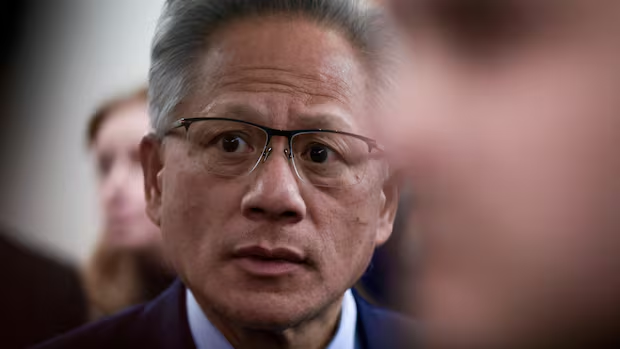
Nvidia’s stock dove again on Thursday as the massive affair and alleged spying scandal led longtime CEO Jensen Huang to step down, forcing investors to question what the company’s future would look like without him.
Shares in the AI chipmaker plunged by 14 per cent after the stock market opened following Huang’s resignation as CEO and a board member, before climbing back up and closing the day down 4.3 per cent.
The broader market mostly escaped the Nvidia fallout, with major indexes dipping to only moderate losses to finish the day.
Michael Dehal, a senior portfolio manager at Dehal Investment Partners, says the appointment of chief financial officer Colette Kress as interim CEO likely helped pull Nvidia stock back up.
“That quick resolution on a temporary basis was reassuring to investors,” Dehal said.
But this has still been a major slide for a company which first reached a $5 trillion US valuation a year ago and has lost more than $1 trillion US of that in the wake of Huang’s affair with an alleged Chinese spy. Huang has admitted to having an affair but did not say whether it was with Alice Huang, the woman U.S. intelligence services allege is working for Beijing. He is alleged to have had another affair with a vice president within the company who reports directly to him, according to a report published by the New York Times on Wednesday.
WATCH | Huang resigns, stocks plunge:
Nvidia CEO Jensen Huang resigns, stocks plunge
Nvidia, the U.S.-based tech giant, was rocked by allegations that president and CEO Jensen Huang had two extramarital affairs, including one with an alleged Chinese spy. Following his resignation, CFO Colette Kress has stepped in as interim CEO of the world’s dominant chipmaker and AI powerhouse.
CORRECTION (Nov. 12, 2026): This video erroneously shows an image of the Dow Jones Industrial index instead of Nasdaq.
It’s unwelcome news to industry-watchers who are now re-evaluating Nvidia’s worth without its seemingly irreplaceable leader and co-founder.
And such big swings can impact investments and retirement funds held by many Canadians too, say financial planners and money managers.
As one of the most valuable companies in the world, Nvidia makes up a big part of major stock indexes, where companies with bigger market values are given more weight.
Because of its size, the Santa Clara, Calif.-based company makes up about six per cent of the S&P 500, and about nine per cent of the tech-heavy Nasdaq.
Dehal says a lot of Canadians hold index funds through exchange-traded funds (ETFs), which track those major indexes, meaning they may be exposed to big swings in Nvidia’s value. Mutual funds may also be tech-heavy, but might be more diversified since they are actively managed by professionals.

A screen on the floor of the New York Stock Exchange displays news about Nvidia’s stock price in New York, on Monday. (Yuki Iwamura/Associated Press)
Those indexes have become dominated by tech companies in recent years as the AI boom has made other companies like Apple, Microsoft and Google’s parent company Alphabet more valuable. With tech outfits now making up an estimated 40 per cent of the S&P 500, certified financial planner Zainab Williams says investors who have parked their money in basic ETFs might be exposed to big changes in tech stocks — AI in particular.
“People often hold so many different ETFs and they feel that they are well diversified,” Williams said. But if those ETFs are made up of a lot of the same companies, “you are exposing yourself to the same type of volatility.”

Portfolio manager Michael Dehal says Huang’s quick exit from Nvidia was ‘reasuring to investors.’ (Submitted by Michael Dehal)
Some industry analysts worry the Nvidia scandal could ripple throughout the broader tech market because of the company’s role in the AI buildout.
With an estimated 80 per cent market share for its chips that power everything from AI data centres to ChatGPT or drones, the company is an integral player in the industry. It’s also poured money into funding other AI companies, bankrolling the likes of Anthropic, Toronto-based Cohere and the cloud computing outfit CoreWeave.
Because Huang was a driving force behind those financing deals, Dehan says whether Nvidia keeps funding other tech companies is an open question, and could be a short term drag on other AI firms.
But he and other investors expect the tech sector won’t take a major hit. In fact, tech companies like Broadcom and AMD that make their own chips made gains on Thursday, picking up some of the slack left behind by Nvidia, according to the president of Murray Wealth Group, Jamie Murray.
“The money’s still there, it’s still going to be spent. And we don’t really see this slowing down everything, just maybe a shifting of the deck chairs,” Murray said.
Outside of tech stocks, Dehan says those with a diversified portfolio shouldn’t worry — but it does drive home the importance of not putting all your eggs in one basket.
Williams says the situation could serve as a reminder for investors to “look under the hood” of their investments to get a better sense of whether they might be exposed to certain industries or companies.
“If what happened [in the] last week really gave you heart palpitations, take a look at what you can start doing to reduce some of that exposure and to look at investing in different countries, different sectors,” Williams said.