
Open this photo in gallery:
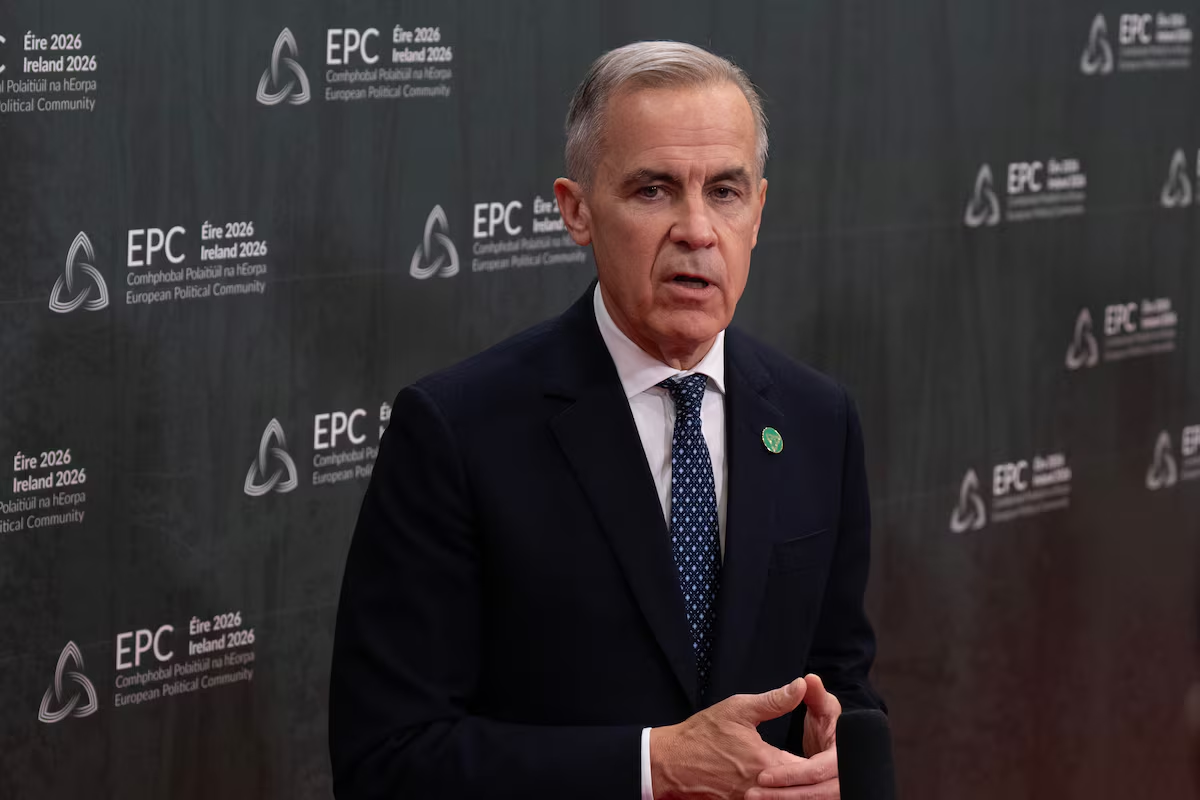
Prime Minister Mark Carney speaks with reporters as he arrives at the European Political Community meeting in Dublin, on Thursday.Adrian Wyld/The Canadian Press
Prime Minister Mark Carney says he expects more European partnerships with Canada’s auto sector coming out of Ottawa’s budding relationship with the European Union but couldn’t say whether Chinese automakers are any closer to building cars here.
Speaking to reporters at a summit of European leaders in Dublin, the Prime Minister said Chinese investment in Canada’s auto sector will be one of the topics under discussion with China’s President Xi Jinping when the two meet next week in Shenzhen.
Mr. Carney’s visit to the European Political Community summit in Ireland on Thursday is his first trip to the continent since it was confirmed last month that Canada is working toward becoming the first “associate member” of the European Union.
Back in January Mr. Carney’s government announced a strategic partnership with China and said flowing from that it expected significant Chinese auto investment in Canada “within three years.”
Carney joins Dublin talks on Ukraine, security
But on Thursday, Mr. Carney declined to say whether Canada was any closer to welcoming Chinese investment in the auto sector 10 months after the Beijing announcement with Mr. Xi.
“Canadian auto workers are some of the most productive auto workers in the world, are certainly the most productive in North America, and so we want real opportunity for those workers,” the Prime Minister said.
He noted South Korea and Japanese and Europeans have made or pledged investments in Canada’s auto sector, including within the electric vehicle industry. Toyota and Honda have car plants, and other companies have pledged battery facilities.
The auto sector has Asian partners and European partners, he noted. “I think you will see more European partnerships coming out of this,” the Prime Minister said, referring to growing Canada-EU relations.
Only 15,603 Chinese-made EVs have entered Canada under Carney-Xi deal
He hedged on China, though, saying “the extent to which there’s Chinese investment depends on a variety of factors. It’ll be one of the discussions with President Xi.”
He said he was also mindful of the fact discussions about Chinese auto investment have implications for relations with the United States. Canada-China co-operation on autos “also is relevant to our ongoing discussions with the United States,” Mr. Carney said.
The U.S. has a 100-per-cent tariff in place on Chinese-made electric vehicles. Canada, which imposed the same tariff back in 2024 in tandem with the former Joe Biden Administration, broke with the United States in January to scale back 100-per-cent tariffs on Chinese-made electric vehicles in return for Beijing sharply reducing retaliatory levies on canola products and other agricultural shipments from Canada.
Open this photo in gallery:
From left, Prime Minister Mark Carney, Latvia’s Prime Minister Andris Kulbergs, Poland’s Prime Minister Donald Tusk, Albania’s Prime Minister Edi Rama and Finland’s Prime Minister Petteri Orpo during a round table meeting in Dublin.Virginia Mayo/The Associated Press
The United States during negotiations on a new trade deal with Canada and Mexico has been pressing Ottawa into aligning its tariffs with the steep American levies on China.
The Canadian government offered a more optimistic projection for Chinese auto investment in Canada. Back in January, the Prime Minister’s Office said it expected within three years, the new partnership with Beijing “will drive considerable new Chinese joint-venture investment in Canada with trusted partners to protect and create new auto manufacturing careers for Canadian workers, and ensure a robust build-out of Canada’s EV supply chain.”
Mr. Carney is due to meet with Mr. Xi on Nov. 17 in Shenzhen where China is hosting the Asia-Pacific Economic Cooperation summit.
In June, Industry Minister Mélanie Joly met with four Chinese companies in China about the possibility of them building electric vehicles in Canada.
Canada on track for increased low-tariff Chinese EV imports, Joly says
The four companies – BYD, Chery, Geely and Shanghai Launch Automotive Technology – had been examining possible investments in Canada. Ms. Joly said Shanghai Launch’s proposal includes a partnership with British automaker Austin Motor Co.
The push to attract Chinese investment was an effort by the Carney government to save the Canadian auto industry as it faces an uncertain future because of protectionist United States trade policy.
The federal government has been repairing ties with China as it seeks to reduce dependence on U.S. trade.
In April, Ms. Joly rejected Stellantis NV’s plan to assemble electric cars with kits shipped from China at the automaker’s idled factory near Toronto, saying she wants cars to be made with Canadian parts and Canadian labour.
Asked Thursday in Dublin, Mr. Carney said his government still rejects kit car assembly plants.