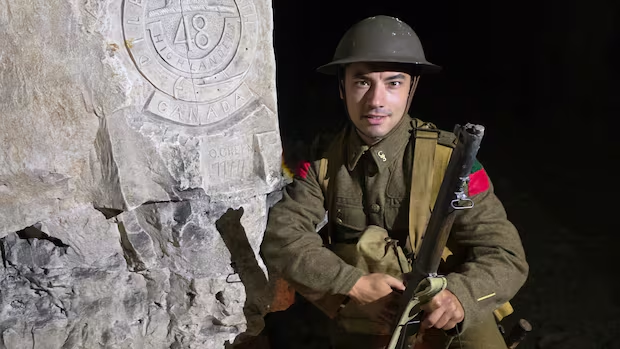
In the dark, men brace their hands against the walls as they make their way down the narrow and slippery passage, barely able to see in the void.
One man in uniform at the front of the line calls out in warning, “Advance! Low spot coming up!” as his hand steadies his descent on the rocky wall. Slowly, carefully, more soldiers come through the narrow passage, ducking their heads to clear the low ceiling.
This is a scene from a new documentary, with the working title Return to Maison Blanche, that captures the work of non-profit Canadigm, a volunteer group that’s been documenting a chalk cave system in northern France.
In the leadup to the Battle of Vimy Ridge in April of 1917, hundreds of Canadian soldiers stayed safe by living underground at Maison Blanche souterraine. These men left behind a testament to their time as soldiers, with carvings of loved ones, farm animals back home, Canadian maple leaves and cap badges on the soft chalk walls.
For over a decade, the members from Canadigm and U.K.-based Durand Group have been heading to this quarry to excavate and document the markings left by Canadians more than a century ago.
Zenon Andrusyszyn, Canadigm’s artistic director, said because it was used as a dump for years after the war, it’s still being cleared out so they’re always finding new markings.
“We’re hoping that we’ve got 95 per cent of them now,” Andrusyszyn said in a recent interview.

Zenon Andrusyszyn and Paul Culliton hope their documentary helps to inspire a new generation to connect with the First World War. (CBC)
Canadigm collaborated with the Canadian Great War Society Archives to bring men wearing historic uniforms into the cave to capture what life would have been like for soldiers.
“They came down in uniform and then they were in complete awe with everything they saw because they directly connected with Maison Blanche and with the people that were there before them,” said videographer Paul Culliton.

The walls of the souterrain are covered in carvings, like this one of the 15th Battalion cap badge carved by Pte. R. McKee. (Elizabeth Whitten/CBC)
The experience of seeing these men in uniform was moving for Culliton.
“It was arguably one of the most unique experiences that I would have in my life and possibly the most historic event recreation of the footage.”
Andrusyszyn said when he was first down in the souterraine in 2010 he never thought they’d get to a point where there would be a film, adding “It’s quite touching.”
When it came to researching for the film, Andrusyszyn said they were lucky because people left behind names and service numbers on the walls, so they could dig into Archives Canada and read the war diaries.
“It’s all from the archives, a lot of reading. You know, a lot of book work,” said Andrusyszyn.

In the leadup to the Battle of Vimy Ridge in April of 1917, hundreds of Canadian soldiers stayed safe by living underground at Maison Blanche souterraine. (Canadian War Museum)
“When you get down to it,” said Culliton, “it was just soldiers being soldiers.” That included playing cards, talking and eating, in an attempt to have something approaching a normal life.
That’s what they aimed for when they brought in the living historians — a term for interpreters who strive to use historic clothing and artifacts from a particular period to demonstrate daily life.
Culliton said they recreated a scene they know happened in the cave, where a letterbox was carved from the wall and before battle, soldiers wrote a final letter and left it in the letterbox.
“The story goes, if you come back, you pick your letter out and if not, then your comrades send it home to your family. So it really always comes down to the closeness of soldiers and it’s a bond that’s forged only under those conditions. And it basically lasted for the rest of their lives,” said Culliton.
WATCH | ‘It’s just a legacy, so to speak,’ says Canadigm’s Zenon Andrusyszyn:
Go back in time to a French cave hundreds of WWI soldiers called home
A new film is documenting the works of volunteer-led Canadigm to record carvings left by Canadian soldiers in a French underground cave during the First World War. With the help of Canadian Great War Society Archives, they’re bringing history to life. The CBC’s Elizabeth Whitten reports.
‘I gasped’
One of those living historians who headed down into the cave was Marcus Nicoletti, a Grade 5 teacher at Immaculate Heart of Mary Catholic Elementary School in Scarborough, Ont.
Nicoletti remembers going through the narrow doorway and walking the some 40 feet to reach the souterraine’s floor and then seeing the engraving on the walls.
“I gasped … I was taken completely aback — knowing that these had survived… I mean chalk is very crumbly. It tends to erode pretty quickly,” he told CBC by Zoom, seated in his classroom.
The carvings made him wonder about the individuals who had made them.
“What was going on in their minds when they had decided to carve their name or carve their battalion’s badge into the chalk,” he said, adding the souterraine was probably the last moment of rest they had before going over the top.

Canadigm recreated certain scenes they knew happened in the cave, like soldiers leaving letters to loved ones in a letterbox before a battle. (Submitted by Paul Culliton)
As a living historian, he was kitted out in period appropriate clothes, in his case the uniform of the 3rd Battalion (Toronto Regiment), with boots that didn’t have any metal spikes or hobbles, just hard leather soles, which made staying steady tricky.
“And I was, you know, just scared out of my wits that I was going to trip on something or slip going down,” Nicoletti said, adding a producer told them to be on guard because there could be live grenades about.
The experience in the cave helped him better understand the conditions soldiers were facing, said Nicoletti — and it was also personal.
Several of his relatives fought in the First World War, including William Bradley, who was listed as missing after fighting near Ypres in April of 1915 — not far from where the souterrain is. Nicoletti said Bradley’s disappearance prompted Bradley’s 45-year-old father to enlist, which Nicoletti believes was an effort to find his missing son.
While filming, Canadigm videographer Norm Dinner brought out a book that belonged to his own enlisted relative and they found out their relatives had fought in the same battalion and died around the same time, said Nicoletti. Given their shared connection, Nicoletti was given the book to read from for that scene.

Marcus Nicoletti (l) and Norm Dinner both had relatives serve in the same battalion and went missing during battle in April 1916, and their names are inscribed on the Menin Gate in Ypres, Belgium. (Submitted by Marcus Nicoletti)
Later, when they visited the war memorial Menin Gate in Ypres, which has the names of missing First World War soldiers inscribed along its walls, Nicoletti and Dinner were able to find their relatives’ names on the wall, just a few lines apart.
“This was a war of attrition … for us to have this, you know, real personal connection, it brought it home,” Nicoletti said.
‘A legacy’
Canadigm’s mission is to document the souterrain before it collapses, which is what eventually will happen to all such caves. For Culliton and Andrusyszyn, the documentary helps support that work, and passes on the story to the next generation.
“It picks that moment in time and it immortalizes it,” said Culliton. “It connects the dots from April of 1917 to today. And so for the Canadian youth that are out there, they actually get to see that.”
Andrusyszyn said they’ve been monitoring the stability of the souterrain and have noticed places starting to show signs of collapse.
“Some of the drawings and some of the images are starting to slowly fade, which is, you know, minute, but it’s happening,” said Andrusyszyn. “I doubt very much if that is going to be around in the next 100 years or so. So having the documentary like this about the work that we’re doing … it’s just a legacy, so to speak, I guess, for future generations.”
Culliton hopes to finish the documentary by April 2027, to coincide with the 110th anniversary of Vimy Ridge, with screening later in the year.
Download our free CBC News app to sign up for push alerts for CBC Newfoundland and Labrador. Sign up for our daily headlines newsletter here. Click here to visit our landing page.